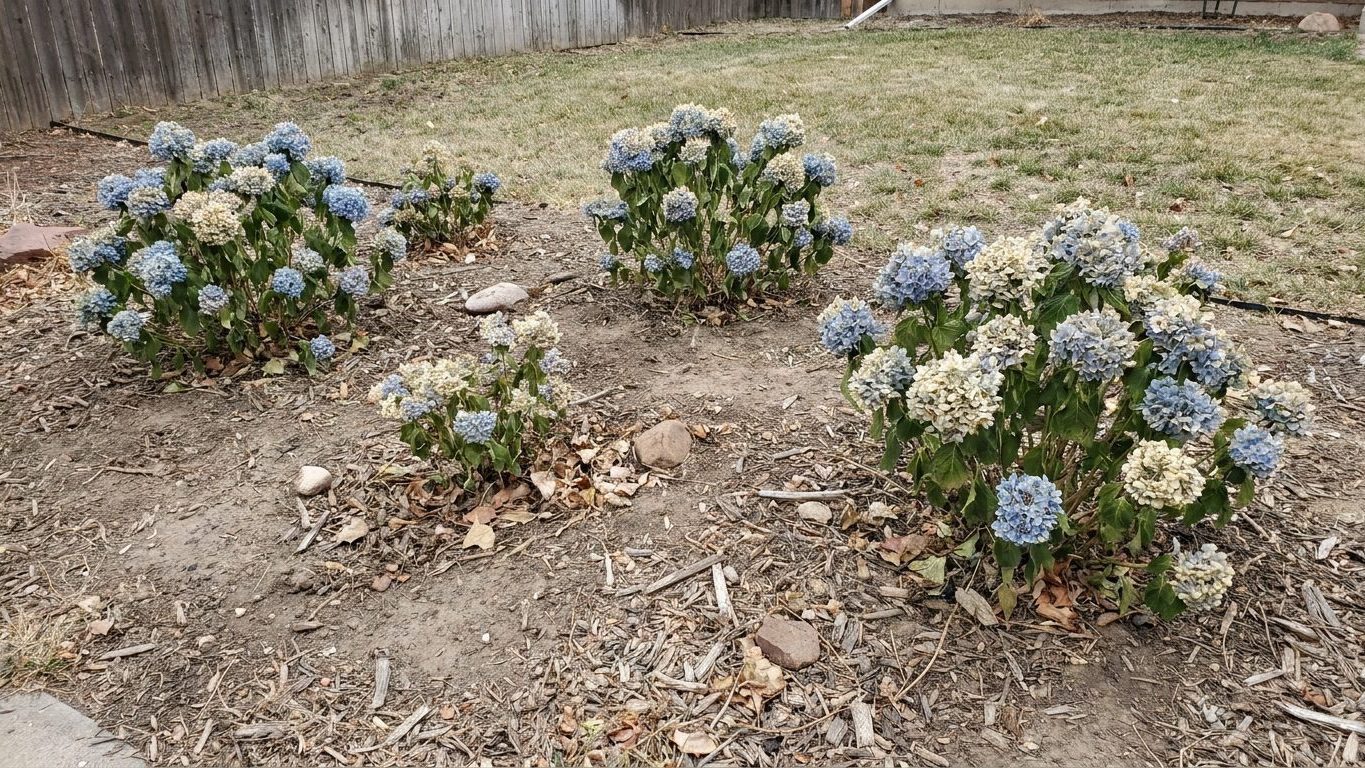
Hydrangeas will grow almost anywhere in California, but the calendar that decides bloom, pruning and water looks nothing like the one gardeners use east of the Rockies. Along the coast and through the south, frost never really shows up. Inland, in the Central Valley and the Sierra foothills, it still does. The state’s zone range runs from 5a to 11a, and that spread is the whole story here.
Hydrangeas Care Calendar for California

NOAA NCEI 1991-2020 Climate Normals list the frost-free season at Los Angeles as 365 days a year, and the state’s USDA hardiness zones run from 5a in the high Sierra to 11a on the immediate coast, which means the calendar here turns on heat and water, not on a last freeze date.
- Dormancy: winter is the safe window to move a plant, its roots undisturbed.
- Planting: put new hydrangeas in the ground through late winter along the coast, or once the last hard cold breaks inland.
- Leaf-out: new growth pushes as soon as nights stay mild, often weeks earlier near the ocean than in the valley.
- Bud set and bloom: flower buds swell through spring and open by late spring in southern gardens, later at elevation.
- Summer water: inland heat pulls moisture fast, and a hydrangea left dry for even a few days will droop by afternoon.
- Post-bloom pruning: cut spent flowers back once the color fades, before the plant sets next year’s buds.
- Fall tidy: mulch roots in the foothills and Sierra where nights turn cold, skip it on the frost-free coast.
None of these steps waits on a frost date here. They wait on heat and on the difference between the coast and the interior.
California — the year and the numbers
- State
- California
- USDA zones
- 5a-11a
- Frost
- none in an average year
- Annual rain
- 12 in
- Lawn zone
- warm-season
- Source
- NOAA NCEI 1991-2020 Climate Normals · Los Angeles
Best Hydrangeas for California
Not every hydrangea suits every part of this state. What does well on a foggy coastal street can sulk in the Central Valley, and the reverse is just as true.
Bigleaf types want steady moisture and part shade, which the coast supplies easily and the interior does not without real effort. Panicle and oakleaf types tolerate the drier, hotter yards found away from the ocean.
| Kind | Verdict here | Why |
|---|---|---|
| Bigleaf (mophead, lacecap) | Good on the coast, tricky inland | Needs part shade and steady moisture, struggles in Central Valley heat and dry air |
| Panicle | Reliable inland and in the valley | Tolerates more sun and heat than bigleaf types |
| Oakleaf | Works statewide in part shade | Handles heat once established, wants afternoon shade inland |
| Smooth (Annabelle type) | Struggles in mild-winter zones | Wants more winter chill than the coast or south provides |
| Climbing | Slow but workable in coastal shade | Prefers the cool, moist part shade the immediate coast offers |
Mountain hydrangea and a few other lesser-grown kinds are on their own pages. The fuller rundown of which hydrangea suits which yard lives on the hydrangeas guide.
When to Plant, Prune and Feed Hydrangeas in California
Planting, pruning and feeding each follow a different clock here, and none of them start counting from a frost date, since the coast and south do not reliably freeze.
Inland and in the Sierra foothills a real winter still arrives, so gardeners there watch soil temperature and the last cold snap the way the rest of the country watches frost.
| Task | Window here | Counted from |
|---|---|---|
| Planting | Fall through late winter, coast and south | The frost-free calendar, since no freeze date applies |
| Pruning (mophead, lacecap) | Right after bloom fades, roughly midsummer | Bloom time, not a frost date |
| Feeding | Early spring as new leaves emerge | The start of active growth, before bud set |
The month-by-month version of this same calendar, broken out for your part of the state, goes further than these three windows alone.
Hydrangeas Problems in California and What Causes Them
Leaves scorched on the sunny side

Inland heat and direct summer sun burn leaf edges even when the soil underneath is damp, since a hydrangea loses water through its leaves faster than roots can replace it. Afternoon shade solves most of this.
No flowers despite healthy green growth

A shrub pruned at the wrong point in the year, or one that never gets the chill some bigleaf varieties expect, can leaf out fine and still skip flowering. Check the pruning window above before assuming a plant problem.
Blooms turn an unwanted color

California’s often alkaline soil pushes bigleaf blooms toward pink even in a garden built for blue, because color follows soil pH, not the season. A soil test settles the question faster than guessing.
California North to South: How the Dates Shift
Gardeners moving from a state that truly freezes, the way it’s counted on the Alberta hydrangeas page, will notice the whole spring dance around a last frost date simply doesn’t apply along the California coast.
- The coast (Los Angeles, San Diego, the Bay Area shoreline): frost-free conditions let bigleaf hydrangeas run a mild, steady schedule with no winter dieback to prune away.
- The Central Valley (Sacramento, Fresno, Bakersfield): occasional winter cold and much hotter summers push gardeners toward panicle types and more shade.
- The Sierra foothills and higher elevations: a real dormant season shows up here, closer to the 5a end of the state’s zone range.
- Southern inland valleys (Riverside, San Bernardino): desert-adjacent heat rewards drought-tolerant panicle types over thirsty bigleaf ones.
Whichever part of the state you garden in, the California page ties these differences back to your own county.
California Extension Offices and County Contacts
UC ANR runs California’s Cooperative Extension network, listed in the USDA NIFA Land-Grant University Extension directory at ucanr.edu, and the county office nearest you turns the state’s broad zone range into a yard-specific answer.
- Your state page: the California hydrangeas page ties the coast, the valley and the Sierra back to one place.
- Which ones hold up here: the fuller rundown of hydrangea kinds suited to this state, beyond the short table above.
- What goes wrong: pests and problems particular to California gardens, covered in more depth on their own page.
Whatever month you’re reading this in, check that page before you cut anything back.
Common questions
Do hydrangeas need a winter freeze to bloom in California?
No. The coast and south run frost-free in an average year, and bigleaf hydrangeas there bloom without ever seeing a hard freeze. Inland and in the Sierra, real cold does still arrive most winters.
What zone is my part of California for hydrangeas?
The state spans USDA zones 5a to 11a. The coast sits near the warm end, the high Sierra near the cold end, and everywhere between depends on elevation and distance from the ocean.
Can I grow hydrangeas in Southern California without frost?
Yes, and frost is not the obstacle there. Heat, drought and water restrictions do more damage to a Southern California hydrangea than cold ever will, so shade placement and irrigation matter more than any frost date.