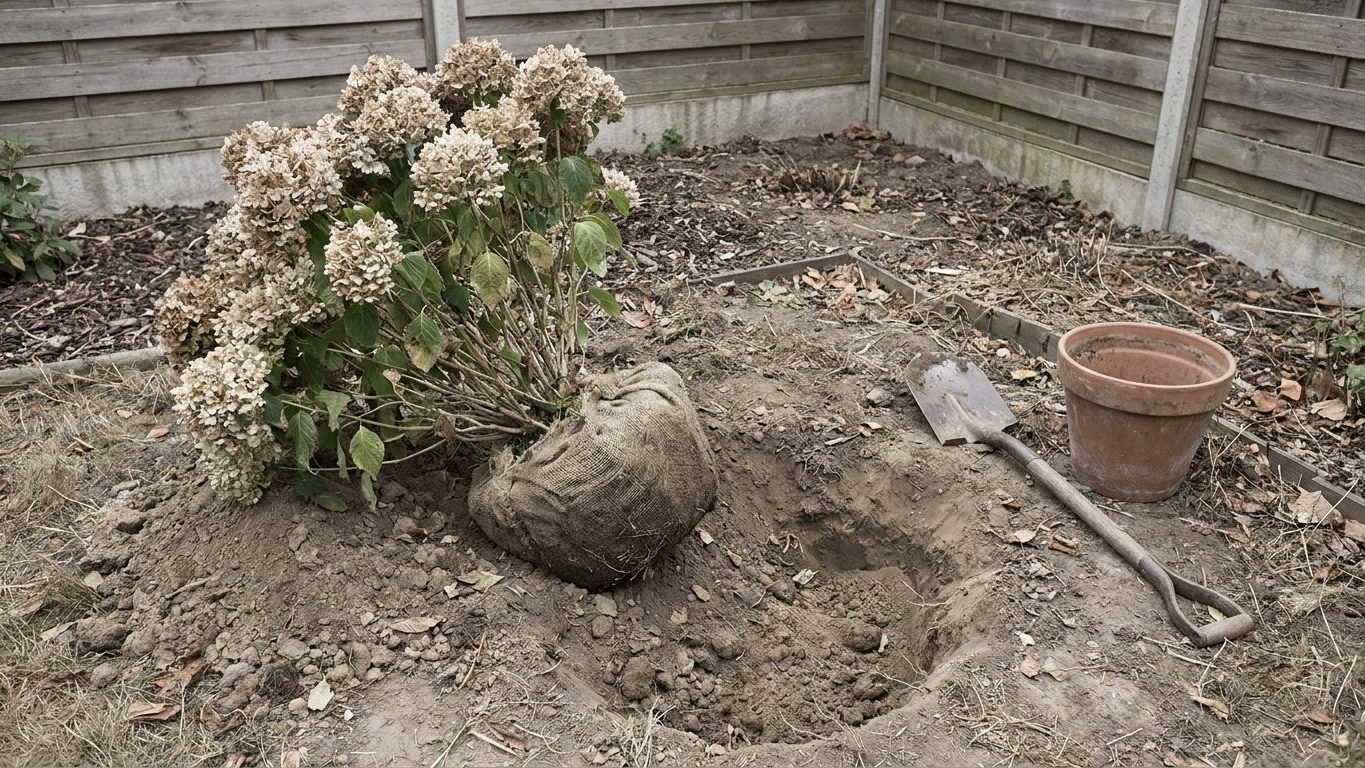
Move a hydrangea in the dormant season, roughly from leaf drop in fall through before bud swell in late winter, and dig a root ball as wide as the branch spread. The exact week depends on your USDA zone and which hydrangea you’re moving, since bigleaf, panicle, oakleaf and smooth types set their flower buds on different schedules.
Transplanting Hydrangeas: The Short Answer
The safest window for transplanting hydrangeas sits in the dormant season. That means after leaves drop in fall or before new buds swell in late winter, when the shrub isn’t feeding flowers or foliage.
NC State Extension Gardener Plant Toolbox puts the genus at USDA zones 3a through 9b. That figure depends entirely on which type you’re moving, since bigleaf, panicle and smooth hydrangeas keep different clocks.
A bigleaf shrub in a warm coastal zone and a panicle shrub in a cold inland zone don’t share a transplant calendar. Neither one shares it with a mountain hydrangea planted between them.
The state selector below this section leads straight to the planting and pruning window for your own zone. It replaces guesswork with a date range built for where you garden.
Match the move to the hydrangea’s type first, then let your zone narrow the week. That order rarely fails.
From the almanac
Hydrangeas in your state
The dates on this page depend on where you live. Your state's page carries its frost dates, its USDA zones and the year laid out month by month.
Northeast
Southeast
- Alabama
- Arkansas
- Delaware
- Florida
- Georgia
- Kentucky
- Louisiana
- Maryland
- Mississippi
- North Carolina
- South Carolina
- Tennessee
- Virginia
- West Virginia
Midwest
Southwest
West
Pacific Northwest
Canada
Transplanting Hydrangeas, Step by Step

The digging and resetting stay the same everywhere, only the calendar around them shifts state by state.
- Water the day before: soak the root zone deeply so the shrub goes into the move hydrated instead of stressed.
- Dig twice the width of the root ball: NC State Extension Gardener Plant Toolbox notes that macrophylla and paniculata are both shallow rooted, so width matters more than depth here.
- Lift with the root ball intact: keep the native soil clumped around the roots to limit transplant shock during the trip to the new hole.
- Reset at the same depth: setting the crown lower invites rot, since these shallow-rooted shrubs were never built to be buried.
- Water in, then mulch: a mulch ring around the base holds moisture over the shallow roots while they reestablish.
- Hold off on fertilizer: a high-phosphorus feed locks up the aluminium a bigleaf hydrangea needs for blue flowers, so let a newly moved shrub settle a season before feeding it.
A newly moved hydrangea needs steady water through its first year, especially the shallow-rooted macrophylla and paniculata types, until new roots push out past the original hole.
Transplanting Hydrangeas by Hydrangea Type
Every hydrangea sets its flower buds on a schedule tied to its type, and that schedule decides how forgiving a transplant or a hard prune really is. Move an old-wood bloomer at the wrong moment and the buds for next year go with it.
NC State Extension Gardener Plant Toolbox lists bigleaf hydrangea at USDA zones 6a to 11b, flowering on last year’s wood. Panicle hydrangea sits at zones 3a to 8b instead, flowering on the current season’s growth, which forgives a harder cut.
| Kind | Flowers on | USDA zones | Sun |
|---|---|---|---|
| Bigleaf | Last year’s wood | 6a to 11b | Part shade, protect from afternoon sun |
| Panicle | Current season’s growth | 3a to 8b | Full sun |
Smooth hydrangea blooms on new wood like panicle does, while oakleaf, mountain and climbing hydrangeas all bloom on wood set the previous summer like bigleaf. The other kinds are on their own pages, since the source gives them a bloom habit but not the zone or sun figures used in this table.
Transplanting Hydrangeas: Mistakes That Cost a Season
No flowers on a healthy shrub

Cutting a bigleaf, oakleaf or mountain hydrangea at the wrong time removes buds set the previous summer, since those types flower on last year’s wood. Check which wood your hydrangea blooms on before any pruning cut, not after the flowers fail to show.
Shrub wilts for weeks after the move

Digging a root ball too small for a shallow-rooted macrophylla or paniculata hydrangea leaves too few feeder roots to support the leaves above. Dig wide rather than deep, water the day before, and move the shrub while it’s dormant rather than in leaf.
Blue flowers won’t turn no matter what

Coffee grounds and citrus peel barely shift soil pH, and they never work on a panicle, oakleaf or climbing hydrangea that stays white or green regardless of pH. Aluminium sulfate lowers pH below about 5.5 for blue on bigleaf and mountain types, and a high-phosphorus fertilizer works against that by locking the aluminium up.
Transplanting Hydrangeas in Your State
The general rule above stops short of a date, because frost timing and zone boundaries change from state to state. Your state page and your local extension office narrow that window down to the weeks that actually work where you garden.
- Your state page: the frost dates and the transplant window built for your zone.
- Which types hold up here: the hydrangea types matched to your local winters and summers.
- Your local extension office: soil test results and pH readings specific to your own yard.
Common questions
Can I transplant a hydrangea in full bloom?
Better to wait for dormancy. Moving a shrub while it’s in leaf or flower stresses its shallow roots, and it often drops both blooms and leaves within days of the move.
Will a transplanted hydrangea bloom the same year?
Old-wood types like bigleaf, oakleaf and mountain often skip a bloom cycle if buds were disturbed or pruned during the move. New-wood types like panicle and smooth tend to flower again the same season, since they build buds on fresh growth.
Does soil pH matter for anything besides flower color?
The color shift applies only to bigleaf and mountain hydrangeas, blue below about pH 5.5 and pink above about pH 6.5, purple in between. Panicle, smooth, oakleaf and climbing types keep their own color regardless of the pH in the new hole.