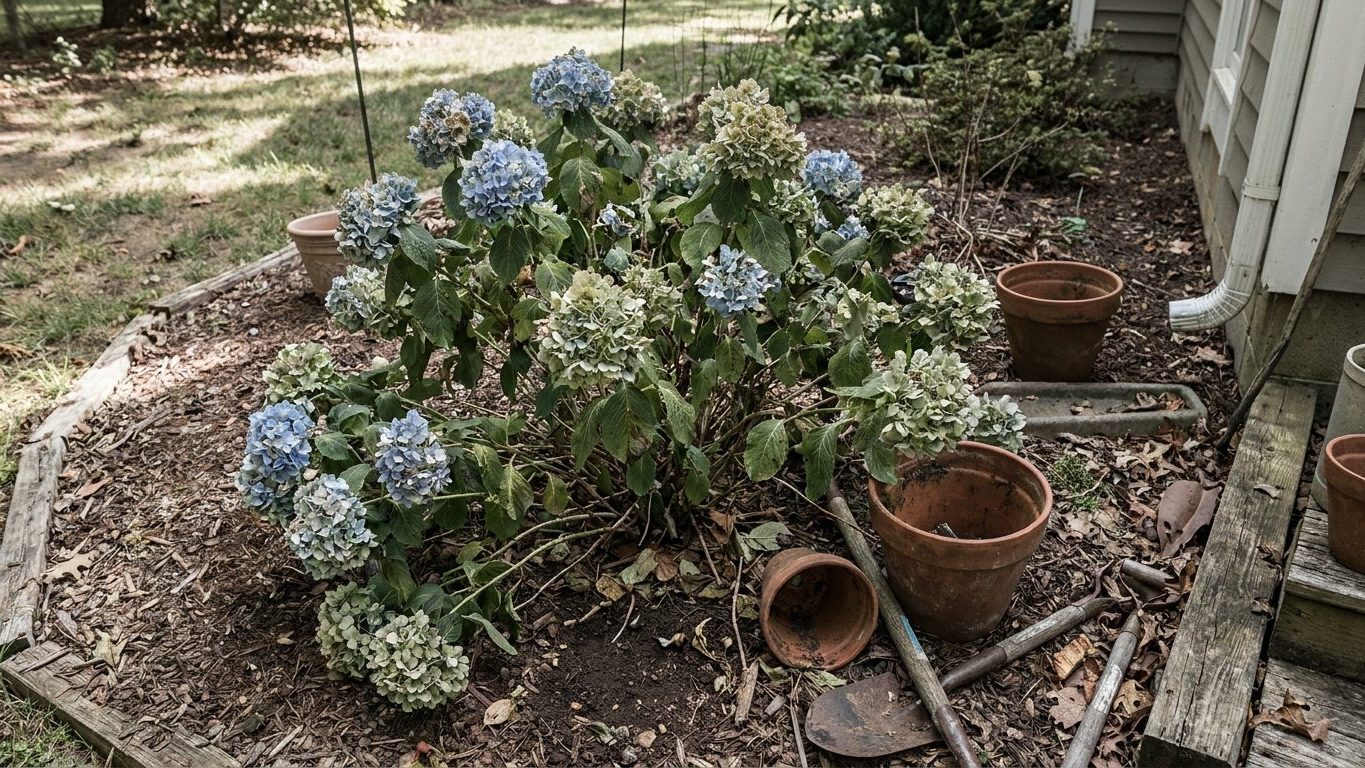
Hydrangeas want a spot with morning sun and afternoon shade, soil that drains without staying soggy, and enough room for the mature shrub rather than the one in the nursery pot. The exact answer shifts with your USDA zone and the type you’re planting, which is why a bigleaf and a panicle rarely belong in the same corner of the yard.
Where to Plant Hydrangeas: The Short Answer
Most hydrangeas want morning sun and afternoon shade, in soil that drains but doesn’t dry out completely. That rule holds across the genus, but not every hydrangea reads it the same way.
NC State Extension Gardener Plant Toolbox lists genus hardiness at USDA zones 3a through 9b, though it depends entirely on the type. A panicle hydrangea takes full sun and cold down to 3a, while a bigleaf needs zone 6a and dappled shade.
Spacing follows the same split. Panicle types can reach 25 feet and want room, while an oakleaf tops out near 5 feet.
Region plays a part too: the source calls panicle hydrangeas a good substitute for the mop-head where bigleaf isn’t winter hardy, which is why the shrub sold in Minneapolis often isn’t the one sold in Charleston.
Type decides sun, size and bloom timing all at once, so naming your hydrangea comes before picking the spot. The state selector below matches your zone to your state’s own planting page.
From the almanac
Hydrangeas in your state
The dates on this page depend on where you live. Your state's page carries its frost dates, its USDA zones and the year laid out month by month.
Northeast
Southeast
- Alabama
- Arkansas
- Delaware
- Florida
- Georgia
- Kentucky
- Louisiana
- Maryland
- Mississippi
- North Carolina
- South Carolina
- Tennessee
- Virginia
- West Virginia
Midwest
Southwest
West
Pacific Northwest
Canada
Where to Plant Hydrangeas, Step by Step

Planting a hydrangea in the right spot is a sequence, not a single decision, and skipping a step shows up later as a shrub that survives but never really performs.
- Match zone to type: check your USDA zone against the type you want, since NC State Extension Gardener Plant Toolbox puts bigleaf at 6a through 11b, panicle at 3a through 8b, and the whole genus at 3a through 9b.
- Read the light: only panicle hydrangeas take full sun well, while bigleaf, oakleaf, mountain and climbing types want dappled or partial shade with the afternoon sun blocked.
- Test drainage and pH: hydrangeas grow in clay, loam or sand as long as the site drains, and on bigleaf and mountain types flower colour runs blue below about pH 5.5, pink above about pH 6.5, and purple in between.
- Space for the mature size: panicle types can spread 8 to 25 feet, bigleaf and mountain settle at 3 to 6 feet, and oakleaf holds near 5 feet, so measure the shrub it will become.
- Dig twice the width of the root ball: set the plant at the depth it grew in the nursery, then mulch, since both bigleaf and panicle roots stay shallow and dry out fast without cover.
- Water in deeply and step back: growth runs medium for the genus and rapid for bigleaf and panicle, and maintenance stays low once the roots take hold.
None of these steps needs a calendar date. The when belongs to your zone and your type, which is exactly what the state pages sort out.
Where to Plant Hydrangeas by Hydrangea Type
Every planting decision above bends around one fact: whether the shrub sets its buds on last year’s wood or on this year’s growth. Get that backwards and a late frost or a spring prune can remove an entire season of flowers.
NC State Extension Gardener Plant Toolbox spells this out clearest for the two most planted types. Bigleaf blooms on last year’s wood and needs shade from afternoon sun, while panicle blooms on new wood and is the only hydrangea that takes full sun well.
| Kind | Flowers on | USDA zones | Sun |
|---|---|---|---|
| Bigleaf (mop-head, lacecap) | Last year’s wood | 6a–11b | Dappled or partial shade |
| Panicle (peegee) | Current season’s growth | 3a–8b | Full sun |
Smooth, oakleaf, mountain and climbing hydrangeas each carry their own bloom timing and root habits, from the wine-red autumn leaves of the oakleaf to the aerial rootlets a climbing hydrangea uses to grip a wall. The other kinds are on their own pages rather than a shared table.
Where to Plant Hydrangeas: Mistakes That Cost a Season
Full sun for a bigleaf hydrangea

Afternoon sun scorches the leaves and stresses a shrub built for dappled or partial shade, since only the panicle type tolerates full sun well. Move new plantings to the morning side of the house or under filtered shade, and check the type pages before choosing a spot.
Pruning after the buds are set

Bigleaf, oakleaf, mountain and climbing hydrangeas set their buds on last year’s wood, so a late prune removes next year’s flowers along with the cut stems. Panicle and smooth types forgive this because they bloom on new growth, which is why the safe pruning date depends on which type is in the ground.
Chasing blue with coffee grounds

Coffee grounds and citrus peel shift soil pH only slightly, and colour change needs available aluminium, which acidity releases, not a kitchen scrap. High-phosphorus fertiliser locks that aluminium up and pushes blue flowers toward pink anyway, and the trick only works on bigleaf and mountain types in the first place.
Where to Plant Hydrangeas in Your State
The national rule stops short of a calendar, since frost dates, pruning windows and winter protection depend on where you garden. Your state page fills in the dates this one leaves out.
- Your state page: the frost dates and pruning window for your zone, matched to the type you’re planting.
- Which types hold up here: a shortlist of bigleaf, panicle, oakleaf, smooth, mountain or climbing hydrangeas suited to your winters.
- Your local extension office: a soil test for pH before you decide whether a bigleaf will run blue or pink.
Common questions
Can I plant a hydrangea in full sun?
Only the panicle type takes full sun well, according to NC State Extension Gardener Plant Toolbox. Bigleaf, oakleaf, mountain and climbing types need dappled or partial shade with afternoon sun blocked.
Will coffee grounds turn my hydrangea blue?
Only slightly, and only on bigleaf and mountain types, since the colour shift needs available aluminium in acid soil, not the small pH nudge grounds give. High-phosphorus fertiliser can push the same flowers back toward pink.
How far apart should I space hydrangeas?
Match the gap to the mature size: panicle types can reach 25 feet, bigleaf and mountain settle at 3 to 6 feet, and oakleaf holds near 5 feet. Measure the shrub it becomes, not the one in the nursery pot.