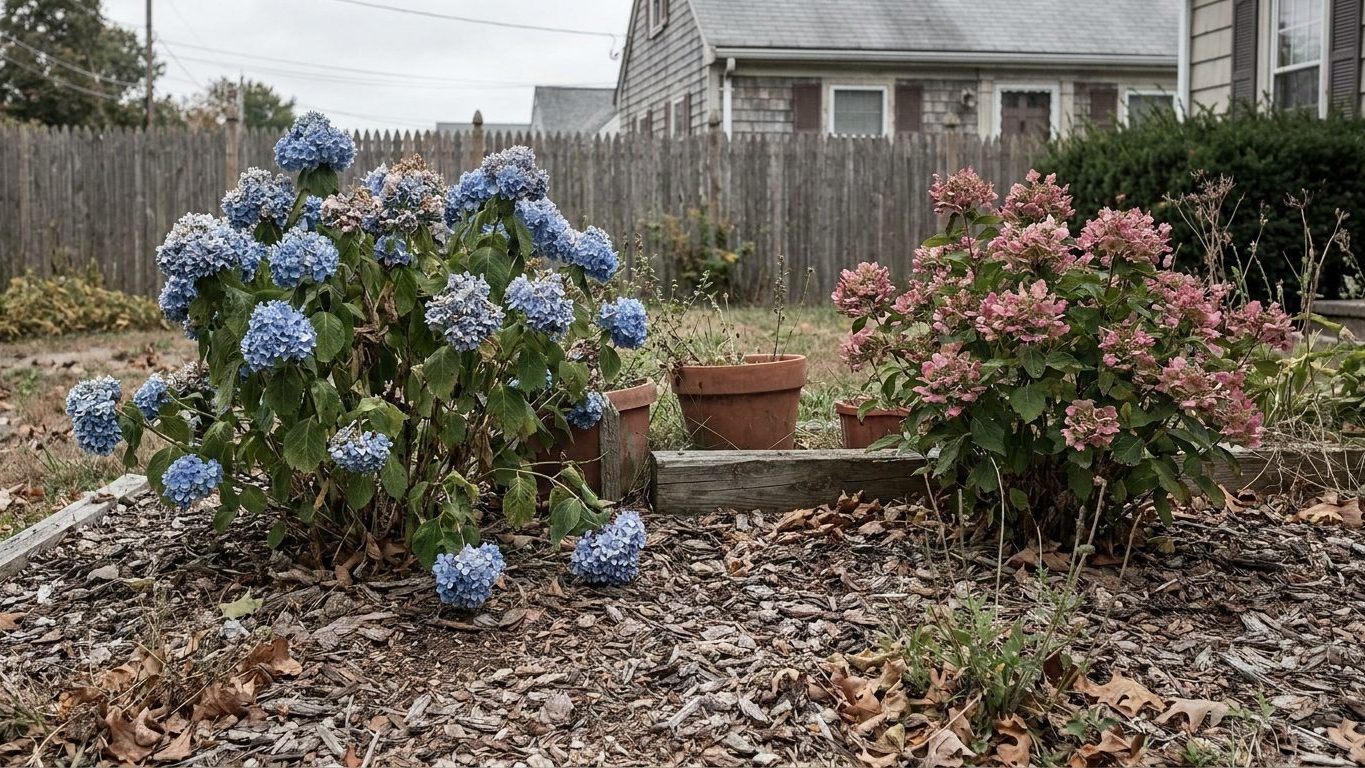
Hydrangea flowers pick up aluminum from the soil, and how much aluminum the roots can use depends on pH. Below about 5.5 the shrub turns blue, above about 6.5 it turns pink, with purple in between. That switch only works on two kinds of hydrangea, and the fix most kitchen tips suggest isn’t the one that actually moves it.
Hydrangea Color Soil Ph: The Short Answer
NC State Extension Gardener Plant Toolbox puts the color line at about pH 5.5 for blue and about pH 6.5 for pink, with purple in the gap between. Only bigleaf and mountain hydrangeas respond this way, the rest hold their color no matter what’s in the ground.
Aluminum sulfate acidifies the soil for blue, garden lime pushes it toward alkaline for pink. Which move makes sense depends on your existing soil, and that starting point varies more than a national page can cover.
The state selector below this section opens the page built for your zone. It carries the frost dates and pruning window that decide when an amendment actually reaches the roots in time to matter this season.
A soil test still beats guessing from a flower’s color, since a shrub can sit right on the edge of the range for years. The reading itself, not the color you see today, is what tells you which amendment to reach for.
From the almanac
Hydrangeas in your state
The dates on this page depend on where you live. Your state's page carries its frost dates, its USDA zones and the year laid out month by month.
Northeast
Southeast
- Alabama
- Arkansas
- Delaware
- Florida
- Georgia
- Kentucky
- Louisiana
- Maryland
- Mississippi
- North Carolina
- South Carolina
- Tennessee
- Virginia
- West Virginia
Midwest
Southwest
West
Pacific Northwest
Canada
Hydrangea Color Soil Ph, Step by Step

Changing a bigleaf or mountain hydrangea’s color is a soil chemistry job worked into the ground, not a spray applied to the flowers.
- Test the soil first: a home kit or a lab test tells you where you actually stand instead of guessing from last year’s blooms.
- Water deeply before you amend: dry soil carries granules unevenly, so give the root zone a deep soak, covered in hydrangea watering, the day before you apply anything.
- Apply aluminum sulfate for blue: work it into the top few inches around the drip line to pull the reading toward and below 5.5.
- Apply garden lime for pink: raise the reading toward and above 6.5, in smaller doses spread across more than one application.
- Skip the high-phosphorus fertilizer: it locks aluminum up in the soil where roots can’t reach it, which nudges blue flowers back toward pink even when the pH itself hasn’t moved.
- Recheck in six to eight weeks: soil pH shifts slowly, and next season’s flowers, not this season’s, usually show the fuller change.
None of this touches panicle, smooth, oakleaf or climbing hydrangeas, whose color follows the calendar instead of the soil test. If you’re starting new shrubs to try this on, hydrangea propagation covers rooting cuttings true to the parent plant, aluminum uptake and all.
Hydrangea Color Soil Ph by Hydrangea Type
NC State Extension Gardener Plant Toolbox lists bigleaf’s hardiness at 6a to 11b and panicle’s at 3a to 8b. Only these two, along with mountain hydrangea, answer to soil pH at all, while the rest shift with the calendar instead, whatever the ground offers.
Bigleaf flowers form on last year’s wood, so a hard prune or a late frost removes next season’s color before it starts. Mountain hydrangea sets buds the same way but tolerates a late frost better, which makes it the safer bet in colder yards.
| Kind | Flowers on | USDA zones | Changes color with pH |
|---|---|---|---|
| Bigleaf | Last year’s wood | 6a–11b | Yes, blue to pink |
| Panicle | Current season’s growth | 3a–8b | No, ages white to pink |
| Mountain | Old wood | — | Yes, buds handle late frost better than bigleaf’s |
Smooth, oakleaf and climbing hydrangeas keep their own bloom-color story, tied to age and light rather than pH. The other kinds are on their own pages for pruning and placement.
Hydrangea Color Soil Ph: Mistakes That Cost a Season
Amending soil for a hydrangea that never turns blue
Panicle, smooth, oakleaf and climbing hydrangeas don’t answer to pH, so working aluminum sulfate into their roots does nothing but shift a number on a soil test. Check which type is actually growing before buying an amendment, the hydrangea hub covers the differences by type.
Coffee grounds in the planting hole

Coffee grounds and citrus peel are a common home fix for blue flowers, but the pH shift they cause is small and inconsistent. Color depends on aluminum being available to the roots, not on the soil smelling acidic. Aluminum sulfate does that job at a measured rate, kitchen scraps don’t.
Pruning bigleaf into a tidy mound in fall
Bigleaf hydrangea sets its flower buds the summer before, on last year’s wood, so a fall cleanup cut removes next year’s blooms along with the stems. Panicle can take a hard cut in late winter since it flowers on new growth instead. Prune bigleaf before August 1, and save the hard cuts for panicle types.
Hydrangea Color Soil Ph in Your State
The pH numbers above hold everywhere. What changes by zone is the calendar, when to test, when to amend and when it’s safe to prune without losing next year’s buds.
- Your state page: the frost dates and pruning window for your zone, plus which type holds up best locally.
- Local extension office: a lab soil test gives an exact pH reading instead of a guess from last year’s flower color.
- The hydrangea hub: care basics for every type, useful before deciding which amendment applies.
Common questions
Can I turn a pink hydrangea blue by burying nails or pennies in the soil?
Metal buried in soil doesn’t reliably lower pH or release aluminum in a form roots can use, so results are inconsistent. Aluminum sulfate, applied at a measured rate and checked against a soil test, is the amendment that actually does the job.
Will amending the soil work on a white hydrangea?
Not for most white varieties, since the pH color range covers blue through pink in bigleaf and mountain hydrangea, and true whites don’t carry that pigment shift. White panicle and smooth varieties follow their own color arc as flowers age instead of responding to soil.
How long does it take to see a color change after amending?
Soil pH moves slowly, so flowers already open this season usually keep their color. Recheck the soil in six to eight weeks, and expect the fuller change to show up on next year’s buds.