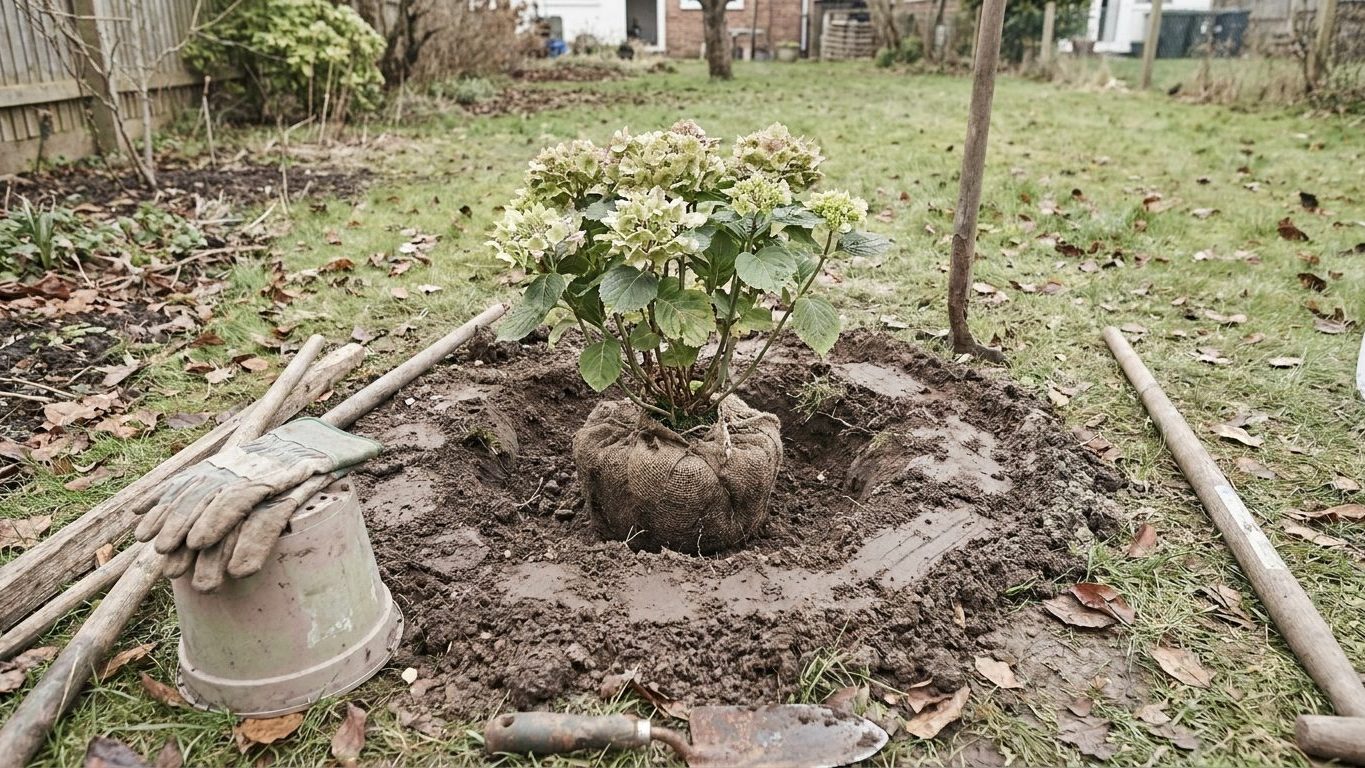
Plant hydrangeas in early spring once the soil thaws, or in early fall while the ground still holds warmth, six or more weeks before the first hard frost. The right week shifts with your USDA zone and with the type in your cart, since old-wood and new-wood bloomers answer to different clocks. The table below gives each state its own window and zone, one box per state, so the guessing stops there.
When to plant Hydrangeas: The Short Answer
Most gardeners plant in a spring window and again in a fall window, skipping high summer heat and hard freezes. NC State Extension Gardener Plant Toolbox puts the genus at USDA zones 3a through 9b, though that range depends entirely on which hydrangea sits in the pot.
Bigleaf and mop-head types run 6a to 11b and set buds on last year’s wood, so a late frost or a spring prune erases the coming bloom. Panicle types run 3a to 8b and flower on wood grown this season, which forgives a hard late-winter cut.
Three things move the actual date: your zone, the type in your cart, and how far your region’s winters and summers swing.
- Zone: how early the ground thaws and how soon frost returns.
- Type: old-wood bloomers need different timing than new-wood bloomers.
- Region: coastal, mountain, and high-plains sites push both windows differently.
The state-by-state table just below turns those three factors into one answer for where you live. Each box lists the months and the USDA zone for that state, nothing more.
From the almanac
When to plant hydrangeas, state by state
The months each state's extension calendar marks for this, kept inside that state's own frost-free season. Open your state for the frost dates, the USDA zone and the rest of the year.
Northeast
- ConnecticutApr–May, Aug–SepUSDA 6a-7b
- MaineApr–May, Aug–SepUSDA 3b-6a
- MassachusettsApr–May, Sep–OctUSDA 5a-7b
- New HampshireApr–May, Aug–SepUSDA 3b-6a
- New JerseyMar–Apr, Sep–OctUSDA 6a-7b
- New YorkMar–Apr, Sep–OctUSDA 3b-7b
- PennsylvaniaMar–Apr, Sep–OctUSDA 5a-7b
- Rhode IslandApr–May, Aug–SepUSDA 6a-7b
- VermontApr–May, Aug–SepUSDA 3b-5b
Southeast
- AlabamaMar–Apr, Sep–OctUSDA 7a-9a
- ArkansasMar–Apr, Sep–OctUSDA 6b-8a
- DelawareApr–May, Aug–SepUSDA 7a-8a
- FloridaFeb–Mar, Sep–OctUSDA 8b-11b
- GeorgiaMar–Apr, Sep–OctUSDA 6a-9b
- KentuckyMar–Apr, Sep–OctUSDA 6a-7a
- LouisianaJan–Feb, Oct–NovUSDA 8a-10a
- MarylandApr–May, Aug–SepUSDA 5b-8a
- MississippiMar–Apr, Sep–OctUSDA 7b-9a
- North CarolinaMar–Apr, Aug–SepUSDA 5b-8b
- South CarolinaFeb–Mar, Sep–OctUSDA 7a-9a
- TennesseeMar–Apr, Aug–SepUSDA 5b-8a
- VirginiaMar–Apr, Sep–OctUSDA 5a-8b
- West VirginiaApr–May, Aug–SepUSDA 5a-7a
Midwest
- IllinoisApr–May, Aug–SepUSDA 5a-7b
- IndianaApr–May, Aug–SepUSDA 5b-7a
- IowaApr–May, Aug–SepUSDA 4b-6a
- KansasApr–May, Aug–SepUSDA 5b-7a
- MichiganApr–May, Aug–SepUSDA 4a-6b
- MinnesotaApr–May, Aug–SepUSDA 3a-5a
- MissouriApr–May, Aug–SepUSDA 5b-7b
- NebraskaApr–May, Aug–SepUSDA 4a-5b
- North DakotaMay–AugUSDA 3a-4b
- OhioMay–Jun, Aug–SepUSDA 5b-6b
- South DakotaApr–May, Jul–AugUSDA 3b-5b
- WisconsinApr–May, Aug–SepUSDA 3b-6a
Southwest
- ArizonaJan–Feb, Oct–NovUSDA 4b-10b
- New MexicoMar–Apr, Aug–SepUSDA 4b-9a
- OklahomaMar–Apr, Aug–SepUSDA 6a-8a
- TexasFeb–Mar, Oct–NovUSDA 6a-10a
West
- AlaskaMay–AugUSDA 1a-8a
- CaliforniaJan–Feb, Oct–NovUSDA 5a-11a
- ColoradoMay–AugUSDA 3b-7b
- HawaiiJan–Feb, Oct–NovUSDA 9a-13a
- IdahoApr–May, Aug–SepUSDA 3b-7b
- MontanaApr–May, Aug–SepUSDA 3a-6a
- NevadaJan–Feb, Oct–NovUSDA 4a-10a
- UtahApr–May, Aug–SepUSDA 4a-9a
- WyomingMay–AugUSDA 3a-6a
Pacific Northwest
Canada
- AlbertaMay–AugZone 4a
- British ColumbiaMar–Apr, Sep–OctZone 9a
- ManitobaMay–AugZone 3b
- New BrunswickMay–Jun, Aug–SepZone 5a
- Newfoundland and LabradorMay–Jun, Aug–SepZone 6a
- Northwest TerritoriesMay–AugZone 1b
- Nova ScotiaMay–Jun, Aug–SepZone 6b
- NunavutJun–AugZone 0a
- OntarioApr–May, Aug–SepZone 7a
- Prince Edward IslandMay–Jun, Aug–SepZone 5b
- QuebecMay–Jun, Aug–SepZone 5b
- SaskatchewanMay–AugZone 3a
- YukonJun–JulZone 1b
Sources: state frost facts and Clemson HGIC factsheet — Hydrangea. A state with no marked month is not shown.
When to plant Hydrangeas, Step by Step

The sequence decides more than the calendar date, since a shrub planted well within a six-week window outperforms one rushed into the ground on the “correct” day.
- Pick the window first: plant in early spring once the soil is thawed and crumbles in your hand, or in early fall while the ground still holds summer warmth.
- Check the soil pH: NC State Extension Gardener Plant Toolbox lists hydrangea soil as ranging from acid, below 6.0, through neutral, 6.0 to 8.0, to alkaline, above 8.0, and on bigleaf and mountain types that same number becomes flower color later.
- Dig wide, not deep: bigleaf and panicle are both shallow-rooted, so a hole twice the width of the root ball beats one dug deep and narrow.
- Match spacing to the mature size: leave 3 to 6 feet around a bigleaf, as much as 25 feet around a panicle, and about 5 feet around an oakleaf.
- Water in, then mulch: soak the root ball at planting and lay mulch over those shallow roots to hold moisture through the first season.
- Leave the pruning shears in the shed: wait until you know whether the shrub blooms on old wood or new before making any cut at all.
None of this fixes one single date. It fixes the order, soil first, hole second, spacing third, water and mulch last, so whichever week you land on, the shrub starts from the same footing.
When to plant Hydrangeas by Hydrangea Type
NC State Extension Gardener Plant Toolbox splits the genus into old-wood bloomers, which set buds the summer before, and new-wood bloomers, which grow and flower in the same season. That difference decides both the planting window and the pruning date.
Bigleaf sets buds on last year’s wood, so anything that damages a stem before bloom, frost or a spring cut, takes the flowers with it. Panicle flowers on wood it grows this year, so a hard late-winter cut only delays bloom, it never cancels it.
| Kind | Flowers on | USDA zones | Sun |
|---|---|---|---|
| Bigleaf / mop-head / lacecap | Last year’s wood | 6a–11b | Dappled to deep shade, protect from afternoon sun |
| Panicle / peegee | Current season’s growth | 3a–8b | Full sun, the only hydrangea that takes it well |
Smooth, oakleaf, mountain and climbing hydrangeas each carry their own old-wood or new-wood rule too, but the other kinds are on their own pages, where their zones and pruning windows get the same treatment.
When to plant Hydrangeas: Mistakes That Cost a Season
Flowers pruned away in spring

Bigleaf sets its buds the previous summer, so a spring cleanup often slices off the shoots that were about to bloom. NC State Extension Gardener Plant Toolbox puts the cutoff at before August 1, once the year’s flowers have faded, never once fall arrives.
Leaves scorched on the sunny side

Bigleaf wants dappled or deep shade and suffers when afternoon sun hits it straight on, while panicle is the one type that takes full sun well. Planting a bigleaf where a panicle would thrive burns the leaf edges by midsummer.
Blue flowers that turn pink anyway

Color shifts with soil pH only on bigleaf and mountain types, blue below about 5.5 and pink above about 6.5, while panicle, smooth, oakleaf and climbing hydrangeas never change no matter the soil. A high-phosphorus fertilizer locks up the aluminum blue flowers need, a feeding choice that shows up as a color problem.
When to plant Hydrangeas in Your State
This national rule sets the two windows, but not the week, since that depends on your USDA zone and your area’s frost dates. Your state’s own page turns those two variables into the months and zone for where you actually garden.
- Your state page: the frost dates and the planting window for your zone, spelled out month by month.
- Which types hold up here: whether bigleaf survives your winter unprotected or a panicle is the safer bet.
- Your local extension office: the nearest source for a soil test and a pest or disease question specific to your county.
Common questions
Can hydrangeas be planted in summer?
Summer heat stresses a shallow-rooted shrub before its roots have spread, so most gardeners hold off until early fall instead. A summer planting can work with regular water, but it asks more of the gardener than either shoulder season does.
Do all hydrangeas need shade?
No, panicle hydrangea is the one type NC State Extension Gardener Plant Toolbox names as taking full sun well, while bigleaf, mountain, oakleaf and climbing types want dappled or deep shade and scorch in direct afternoon sun.
Are hydrangeas toxic to pets?
Only bigleaf hydrangea is documented toxic, and only if a dog, cat or horse eats a large quantity of bark, flowers, leaves or stems, causing nausea, stomach pain, vomiting and sweating. The other types in this genus carry no such documented toxicity.