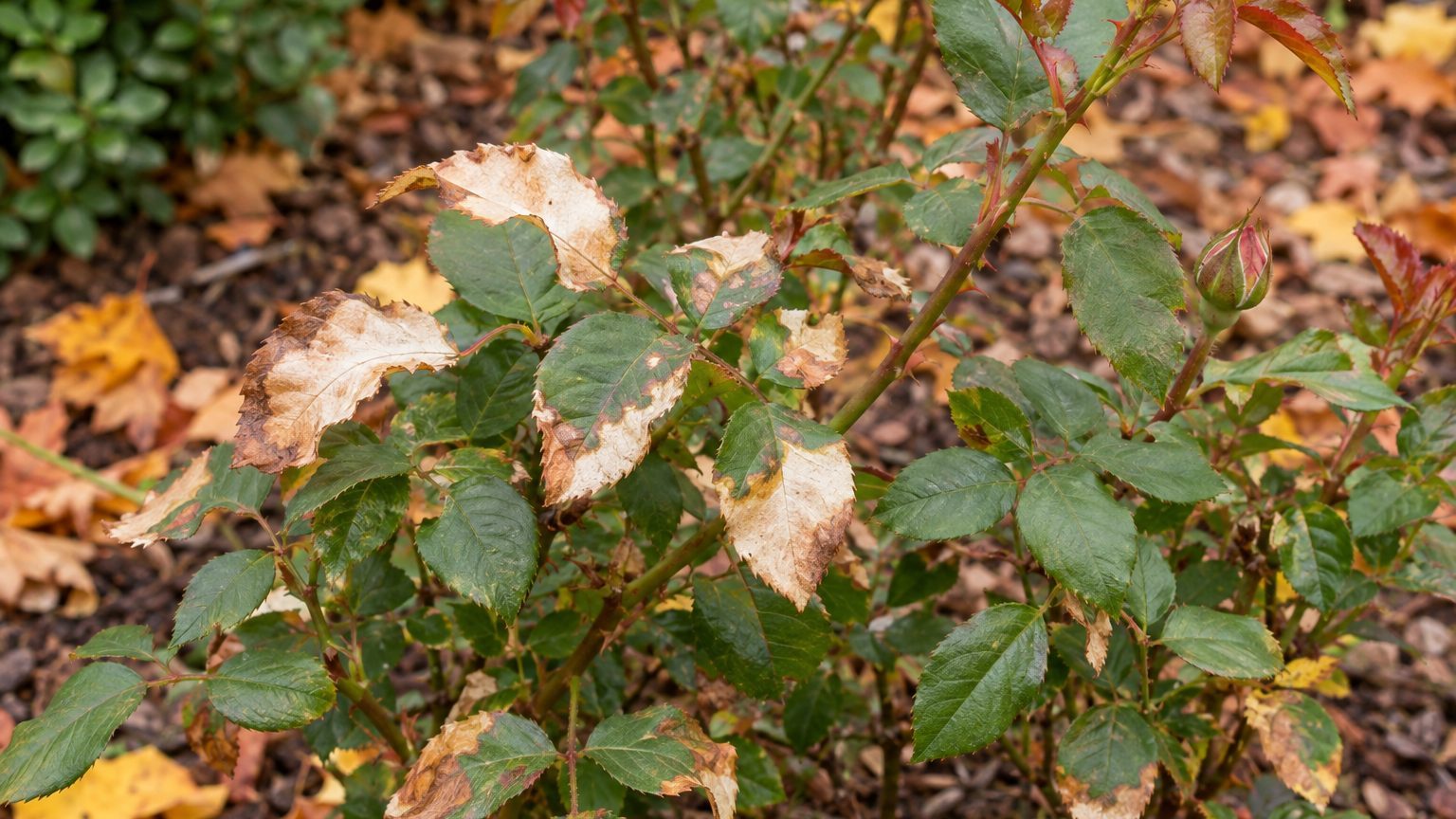
Brown patches on rose leaves can come from environmental stress, black spot, heavy pest damage or powdery mildew; the location and shape of the damage help separate them. Reading where the brown starts and what the leaf does next tells you which one you are dealing with.
Rose Leaves Turning Brown: What You See

The signs that separate one cause from another are shape, color around the spot and what the leaf does afterward.
- Round to irregular spots, light brown to black, form on the leaf surface and the border may look fringed or feathered.
- A yellow halo often surrounds the spot, and the leaf soon turns yellow and drops from the plant.
- Browning that looks like a burn, or angular blotches ranging from yellow through purple to brown, points toward leaf scorch.
- Heavy infestations of tiny pests can turn leaves brown and make them curl.
- Spots can also appear on leaf stalks, twigs and canes, not only on the blade.
- Young leaves curl upward and look deformed, with a white powdery coating or reddish, burgundy tones.
In South Carolina, severely infected plants may have lost all of their leaves by mid-summer, so a few spots in spring deserve attention early.
From the almanac
Roses in your state
The dates on this page depend on where you live. Your state's page carries its frost dates, its USDA zones and the year laid out month by month.
Northeast
Southeast
- Alabama
- Arkansas
- Delaware
- Florida
- Georgia
- Kentucky
- Louisiana
- Maryland
- Mississippi
- North Carolina
- South Carolina
- Tennessee
- Virginia
- West Virginia
Midwest
Southwest
West
Pacific Northwest
Canada
Rose Leaves Turning Brown or Something Else?
Several rose problems start with a brown or dark mark, and some of them are not browning at all. Checking the edge of the spot and the surrounding color settles most doubts.
Gray mold on buds is a good example, since the damage sits on the bud rather than the leaf.
| Looks like | How to tell them apart |
|---|---|
| Black spot | Dark spots with fringed, feathery edges, often with yellowing of the leaflet and leaf drop |
| Powdery mildew | White powdery coating on leaves and stems, with young leaves curling upward and looking deformed |
| Gray mold on buds | Buds turn brown and decay before opening, with gray fuzz inside or over the outside of the bud |
Leaf scorch and mite damage sit apart from these, since scorch looks like a burn on the leaf rather than a spot with a defined border.
What Causes Rose Leaves Turning Brown, and Where It Is Worst
Often the cause is environmental, a mix of water, sunlight and nutrient problems. Roses want regular watering but resent soggy soil, and in containers they dry out faster yet still need good drainage. They also need regular fertilization, so a hungry or waterlogged plant can scorch.
Light matters too. Roses do well with 6-8 hours of sun, ideally with morning sun that dries dew from the leaves and helps prevent powdery mildew. A rose in deep shade may stay damp longer, which can favor disease.
Fungal disease is the other big group. Black spot is common and persistent on roses, and it spreads where leaves stay wet. In Maryland, affected leaves may yellow and fall as black spot progresses.
How to Treat Rose Leaves Turning Brown
Start by checking the symptoms closely, and confirm the cause before reaching for anything to spray.
- Inspect the spots closely, so that you can tell fringed black spot margins from scorch or mite damage.
- Remove infected leaves as soon as they appear in spring, so that the disease has less to spread from.
- Rake up every fallen leaf around the plant, especially in fall, because fallen leaves carry the problem into the next season.
- Adjust watering so the soil stays moist but never soggy, and check that containers drain freely.
- Feed the rose regularly, since a starved plant scorches more easily.
- Ask your state’s extension service which treatments are approved locally if the spotting keeps spreading.
Browning from heavy mite infestations or root trouble, including dark brown roots and a stunted root system, needs a closer look at the plant than leaf cleanup alone.
How to Prevent Rose Leaves Turning Brown Coming Back
Prevention follows the rose’s year, with most of the work done when the plant is waking up and again when it drops its leaves.
- In early spring, remove infected leaves as soon as they appear; this may reduce black spot.
- Once growth starts, give roses the 6-8 hours of sun they need, with morning light to dry the dew.
- Through the growing season, water the soil rather than the leaves and keep the ground damp without letting it turn soggy.
- Across the season, feed regularly so the plant holds up against scorch.
- In fall, clear every fallen leaf from around the plant, since that litter is where trouble waits over winter.
Container roses need more frequent watering than ground roses, so check them more often when the weather warms.
Where This Comes From
Your state’s cooperative extension service can confirm local timing and tell you which treatments are approved where you live.
Common Questions
Why Do Rose Leaves Turn Yellow Before They Turn Brown?
With black spot, infected leaves can turn yellow and drop even when only a few lesions are present.
Can a Rose Recover After Losing Its Leaves?
Leaf loss can be sudden and severe, and it can occur before lesions are even detected. Left alone, severe disease may end in plant death, so act early.
Does Powdery Mildew Make Leaves Brown?
It mostly shows as blistering, twisting, white coating and red-to-burgundy foliage, and in severe cases young shoots may be killed back.