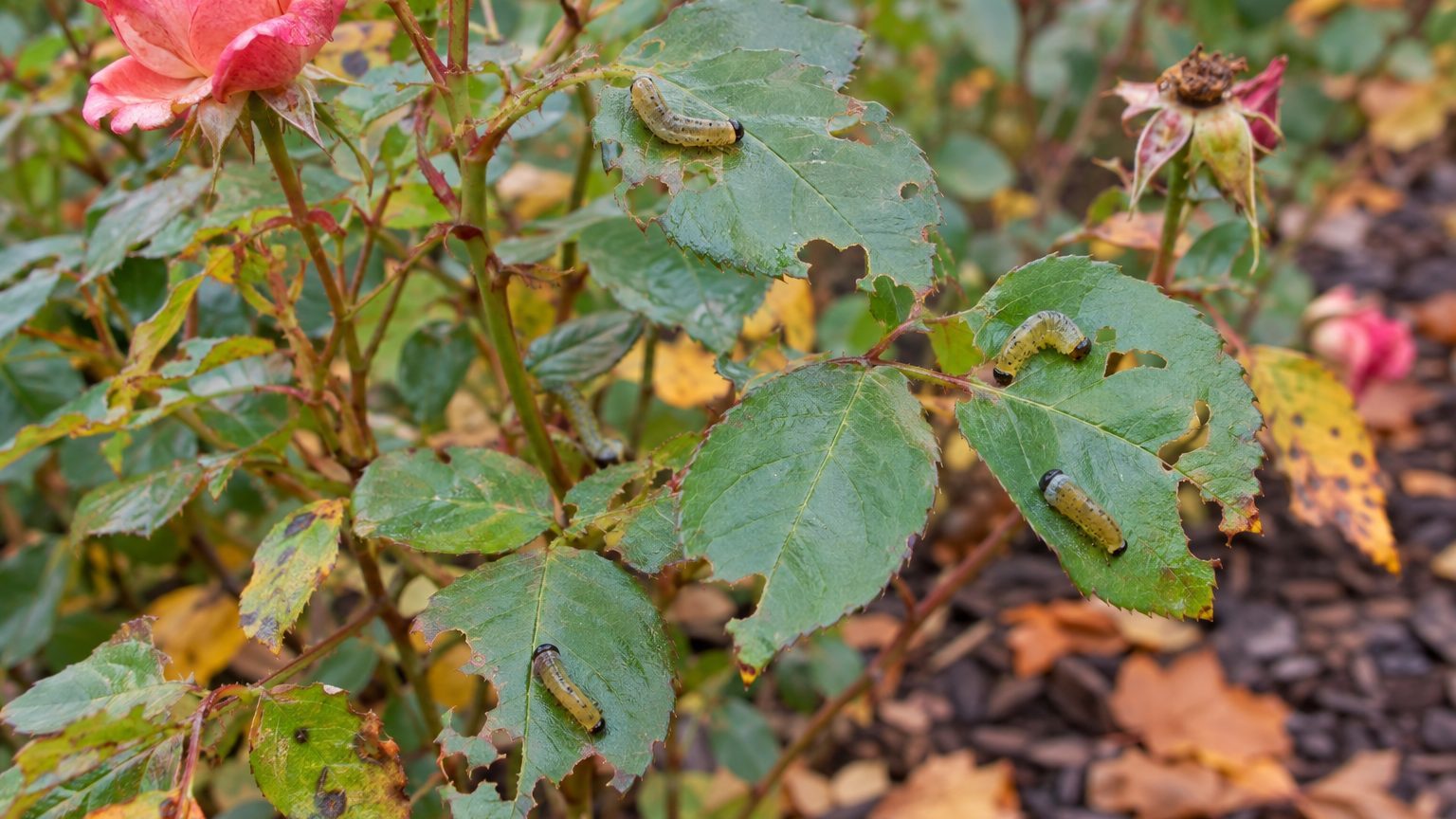
In Oregon, rose leaves held up to the light in late spring can glow as if someone had scraped off the green with a fingernail. Those pale, papery patches usually mean roseslugs, small larvae that feed on the underside of the leaf.
Roseslugs (sawfly larvae): What You See

The damage shows up before the pest does, so start with the leaf and then turn it over.
- Windowpane patches, small areas of thin, papery leaf tissue you can nearly see through, are the sign that sets roseslugs apart from other leaf chewers.
- Held up to the sun, an affected leaf lets light shine through the scraped areas.
- Small, wormy, slug-like larvae sit beneath the leaves, and they are easy to miss.
- Larvae of the bristly kind are about 5/8″ long, greenish-white, with long, stout bristles.
- In heavy infestations, leaves skeletonized down to the veins can turn brown and curl.
- In Maryland, the greenish-yellow larvae are worth looking for in May and June, and in Kentucky the first damage appears in April.
Early damage can look like tiny clear patches, so check the undersides before the leaf looks ragged.
From the almanac
Roses in your state
The dates on this page depend on where you live. Your state's page carries its frost dates, its USDA zones and the year laid out month by month.
Northeast
Southeast
- Alabama
- Arkansas
- Delaware
- Florida
- Georgia
- Kentucky
- Louisiana
- Maryland
- Mississippi
- North Carolina
- South Carolina
- Tennessee
- Virginia
- West Virginia
Midwest
Southwest
West
Pacific Northwest
Canada
Roseslugs (sawfly larvae) or Something Else?
Several leaf problems on roses leave ragged or discolored foliage, and a quick look is not enough to separate them. Pair what the leaf looks like with what you find on its underside.
Black spot and powdery mildew are diseases, while aphids are sap-feeding insects, so none of them scrape leaves into skeletons.
| Looks like | How to tell them apart |
|---|---|
| Black spot | Dark blotches on the leaf surface, with no clear papery windows and no larvae underneath |
| Powdery mildew | A dusty coating on the leaf, and the tissue stays intact rather than thinning to see-through patches |
| Aphids | Clusters of small sap feeders on new growth, with no veins left behind after feeding |
Roseslug damage is the one that leaves the veins standing and the tissue between them thin as paper. If you see that pattern together with small larvae below, you have sawflies.
What Causes Roseslugs (sawfly larvae), and Where It Is Worst
These are insect larvae, not true slugs, and they belong to the sawflies. An adult female lays eggs on rose stems and leaves, and the eggs hatch into the little larvae that do all of the feeding. Bristly roseslug females insert eggs into the leaf stalks in three rows.
Once the tiny larvae hatch, they move to the underside of the leaf and feed on its surface layer. Fully grown larvae drop from the plant and pupate in a cocoon in the soil.
Timing depends on where you garden. In Oregon, the common roseslug skeletonizes leaves in late spring and early summer. The common roseslug has one generation and the curled roseslug two, so the damage in Ohio was fleeting and roses recovered without spraying even with high populations. Kentucky and Maryland describe a longer season, with activity into the fall in Maryland. Roses of every type are fair game.
How to Treat Roseslugs (sawfly larvae)
Treatment starts with finding the larvae, since they hide under the leaves.
- Turn leaves over and look underneath regularly, so that you catch the larvae while the damage is still small patches.
- Pick off the larvae you find by hand.
- Check badly skeletonized leaves and remove the larvae you find.
- Keep watching, because there may be several generations a year in some places and new larvae can follow the first group.
- Get local advice before using any spray, so that you choose a product approved where you live.
Where only one or two generations occur, as in Ohio, roses have recovered on their own without spraying, so a light infestation is no reason to rush.
How to Prevent Roseslugs (sawfly larvae) Coming Back
Prevention follows the insect’s year: eggs on the plant, larvae on the leaf, cocoons in the soil.
- In Kentucky, start checking leaf undersides in April, when damage may first appear.
- In Oregon and Maryland, look closely in May and June for early feeding and larvae.
- Through summer, keep monitoring, since later generations may follow in places with more than one.
- In the fall, keep looking where roseslugs stay active, as they do in Maryland.
- Keep checking leaf undersides so you can remove larvae before they drop to the soil to pupate.
Roseslugs can also be reported on strawberries and raspberries, so check those plants nearby too.
Where This Comes From
The timing here varies among Oregon, Ohio, Kentucky and Maryland. Timing differs from state to state, so seek local advice about dates and approved treatments.
Common Questions
Are Roseslugs Actually Slugs?
No. They are insect larvae in the sawfly group, not slugs.
Will Roseslugs Kill a Rose?
In Ohio, roses recovered without spraying even when populations were high because the damage was brief in spring.
Do Roseslugs Prefer Certain Roses?
They do not discriminate on the type of rose they feed on, so any rose in the yard can be affected.