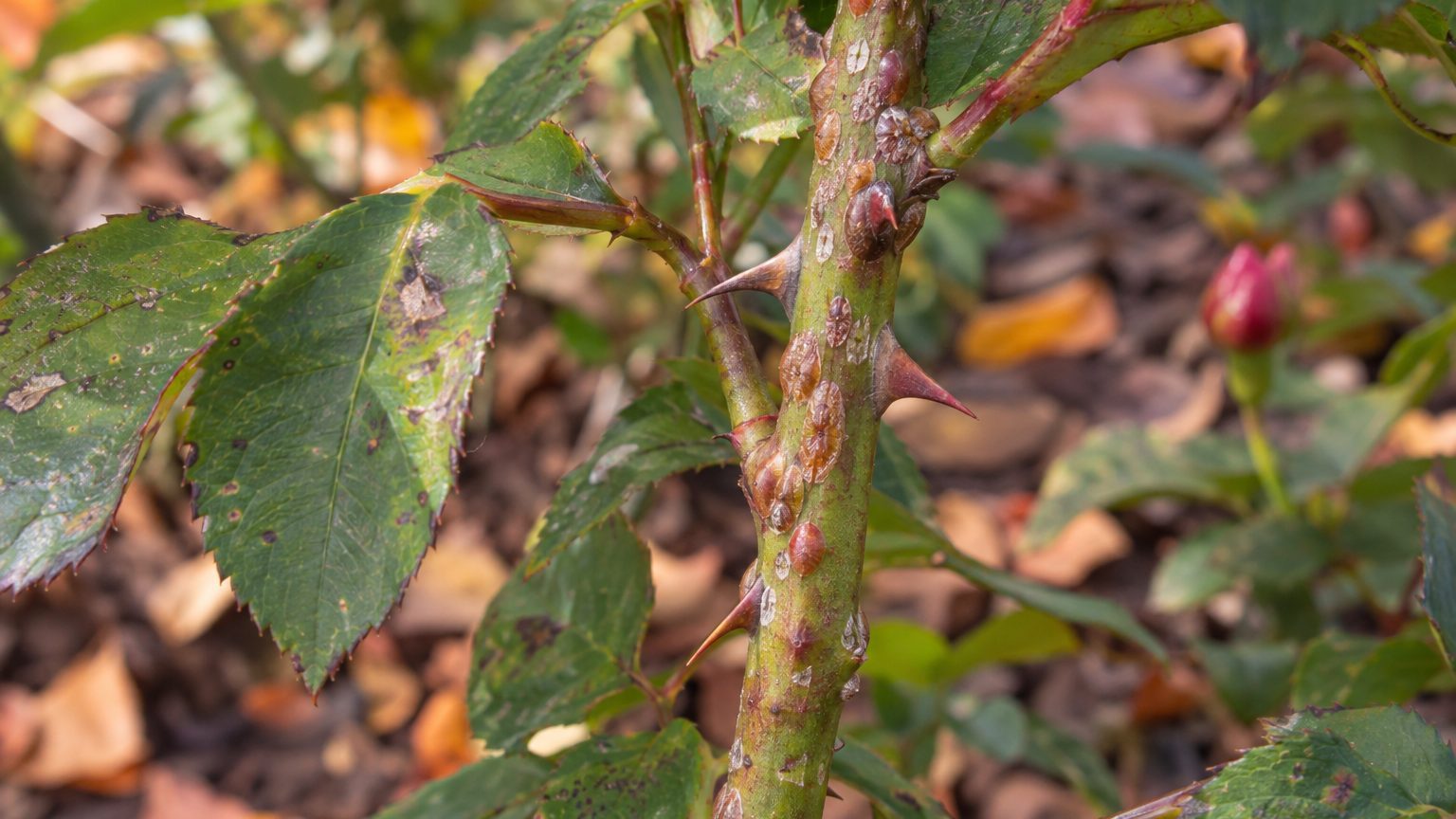
Run a hand along a bare rose cane in winter and you may find small gray-white crusts that look like flecks of old paint. Those crusts are rose scale, an insect that spends nearly its whole life stuck in place, feeding on sap. Knowing what the crusts look like, and when the insect moves, tells you when to act.
Rose Scale: What You See

Look on the canes first, since that is where this insect settles and feeds.
- Round, gray to white crusts on the canes are the females, each about 1/16 inch long.
- Much smaller, narrow white shapes among them are the males, which are elongate rather than round.
- In Virginia, orangish crawlers wander over the bark after temperatures warm in spring, before they settle and begin to build a covering.
- Leaves that yellow or wilt, and growth that looks stunted, show up when the canes are heavily coated.
- A sticky film on the lower leaves, often turning black with sooty mold, comes from the honeydew the insects leave behind.
A cane that looks crusty and a plant that looks tired on the same bush point to scale rather than a passing stress.
From the almanac
Roses in your state
The dates on this page depend on where you live. Your state's page carries its frost dates, its USDA zones and the year laid out month by month.
Northeast
Southeast
- Alabama
- Arkansas
- Delaware
- Florida
- Georgia
- Kentucky
- Louisiana
- Maryland
- Mississippi
- North Carolina
- South Carolina
- Tennessee
- Virginia
- West Virginia
Midwest
Southwest
West
Pacific Northwest
Canada
Rose Scale or Something Else?
Several rose problems leave marks on leaves and stems that get blamed on scale. A quick look at the canes and the leaves together sorts most of them out.
Sooty mold and plain plant stress are the usual mix-ups, and both can sit on a bush that has scale as well.
| Looks like | How to tell them apart |
|---|---|
| Sooty mold, a black film on lower leaves | Scale is behind it when the leaves feel sticky and ants are around, and gray-white crusts sit on the canes above. |
| Yellowing or wilting leaves from plain stress | Scale is likely when the canes carry round crusts and the stunting follows the crusty stems rather than the whole plant. |
In California, San Jose scale is a different armored scale that can also attack roses.
What Causes Rose Scale, and Where It Is Worst
The cause is the insect’s own life cycle. Females lay eggs under the waxy covering of the mother, and the eggs overwinter there, protected on the cane. In Virginia, the crawlers roam freely after temperatures warm in spring, then settle to feed.
Once a crawler settles, it loses its legs and antennae and stays put. Older nymphs begin secreting the waxy cover that makes the insect hard to reach. Adult males are tiny and winged, so they fly in search of females, while the females stay under their scales until they lay eggs and die.
Rose scale is most active in the warmer months. In Virginia, a second generation may appear in August when conditions favor the population. Wherever you garden, check a rose with crusty canes for scale.
How to Treat Rose Scale
Treatment follows the insect’s calendar, because the crawler stage is the one time the insect is mobile and unprotected.
- Inspect the canes closely in winter, when the leaves are gone, so that every crusty stem is easy to find.
- In California, cut back and destroy infested canes in winter, which removes eggs sheltered under the covering.
- Judge the population on the canes that remain. An oil treatment is suggested on remaining infested canes only when the scale population is high.
- If the population stays high, get local advice before choosing a treatment.
- In Virginia, watch the canes after temperatures warm in spring, when orangish crawlers wander before settling.
- Recheck in August, because a second generation may occur in Virginia under good conditions for scale.
Armored scales sit under a hard cover once they settle, so a late treatment reaches less than an early one. Pruned canes should leave the yard rather than sit in a pile near the roses.
How to Prevent Rose Scale Coming Back
Prevention is mostly looking at the right time, since this insect shows itself on the canes before it harms the leaves.
- After leaf drop, check the bare canes for gray-white crusts, because the eggs overwinter under the mother’s covering.
- In Virginia, look for unprotected orangish crawlers moving across the bark after temperatures warm in spring.
- Through the warmer months, glance at the canes regularly, because rose scale is most active then.
- In August, if you garden in Virginia, check again for a second generation on canes that looked clean earlier.
- When lower leaves turn sticky or black at any point in the season, trace the film up to the canes and look for crusts.
A short look at the canes each time you walk past the bed catches the first crusts before they spread.
Where This Comes From
The timing varies by place, so use the state-specific guidance above only where it applies. For dates and approved products that fit your yard, seek local advice.
Common Questions
Can Rose Scale Kill a Rose Bush?
It can. In Iowa, heavy infestations are described as causing death of all or part of the plant, and in California, high numbers may cause cane decline or dieback.
Do Rose Scale Insects Move from Plant to Plant?
The crawlers wander freely over the bush before settling, and adult males are winged and can fly in search of females. The adult females stay put under their scales.
What Do Rose Scale Eggs Look Like?
The eggs are reddish-orange, and they sit hidden under the waxy covering of the mother. This is how the insect gets through winter on the cane.