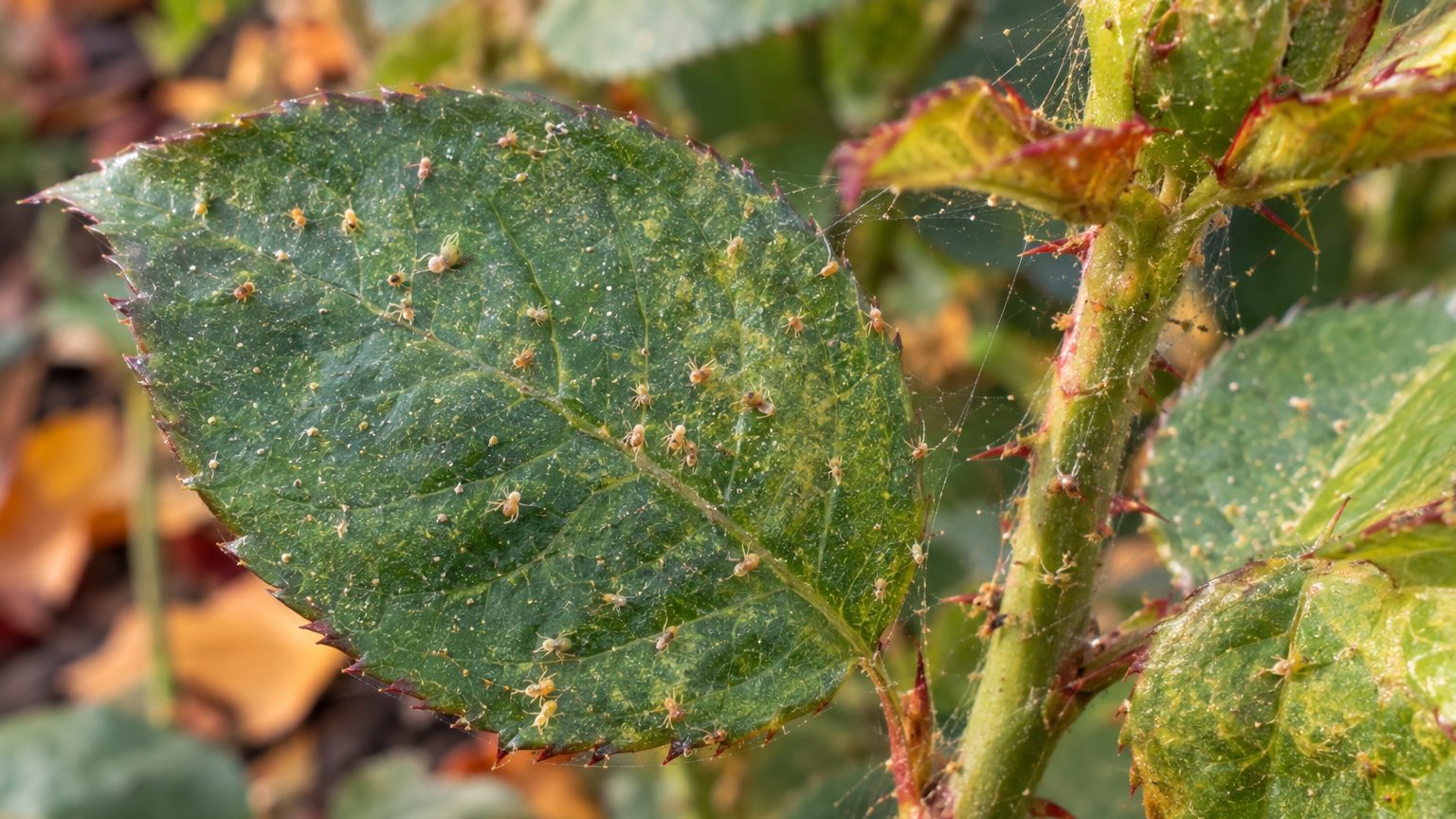
Rose leaves that turn gray or speckled in hot, dry weather, often with fine webbing underneath, usually point to spider mites. These pests feed on the underside of the leaf, so the damage shows from above before the culprit is easy to find. Washing the plant is a useful first move, and regular watering helps keep the rose from becoming drought-stressed.
Spider Mites: What You See

The first sign is on the leaf surface, and the mites themselves are harder to spot.
- Tiny pale spots crowd together on the leaf, a pattern called stippling, and the leaf can look gray or finely speckled.
- Webbing appears on the underside of the foliage, though some species produce none.
- Lower leaves turn a fuzzy yellow with red specks, and those specks are the mites.
- Each mite is about the size of the period at the end of this sentence, so a magnifier helps.
- In California, mites usually appear first on the undersides of leaves and may move to the upper surfaces as their numbers grow.
- Shaken over a sheet of white paper, the leaves drop mites that can be seen scurrying around.
In Arizona, hot and dry weather from May through September is the time to look.
From the almanac
Roses in your state
The dates on this page depend on where you live. Your state's page carries its frost dates, its USDA zones and the year laid out month by month.
Northeast
Southeast
- Alabama
- Arkansas
- Delaware
- Florida
- Georgia
- Kentucky
- Louisiana
- Maryland
- Mississippi
- North Carolina
- South Carolina
- Tennessee
- Virginia
- West Virginia
Midwest
Southwest
West
Pacific Northwest
Canada
Spider Mites or Something Else?
Speckled, off-color leaves have more than one cause, and a speck on the leaf is not enough to name the culprit. Check where the speckling sits and whether anything moves when you shake a leaf over white paper.
Southern red mites are the closest lookalike on roses, and they follow a different seasonal pattern.
| Looks like | How to tell them apart |
|---|---|
| Southern red mites, with the same speckled leaves | In South Carolina, southern red mite numbers climb in cool spring and fall weather and drop in summer, while two-spotted spider mites build in hot, dry spells. |
Powdery mildew is a disease, not a mite. It also troubles roses, especially in greenhouses, but nothing scurries across the paper when you shake a mildewed leaf.
What Causes Spider Mites, and Where It Is Worst
Mites settle where conditions suit them. Dry, dusty air favors them, and females lay more eggs and develop faster at lower relative humidity. A rose that is short of water is more susceptible, which is why a dry summer spell hits so hard.
Warmth speeds the whole cycle. Development from egg to adult shortens as temperatures climb:
- At 54F, it takes 40 days.
- At 70F, it drops to 14 days.
- At 86F, it is only 7 days.
Hot, dry weather is the usual trigger. In Arizona the watch runs from May through September, and in South Carolina two-spotted spider mites flare in hot, dry spells while southern red mites take over in cool spring and fall weather. Roses are among their favored hosts, and a low-level mite population may do no harm.
How to Treat Spider Mites
Confirm the mites first, then start with water, which is the gentlest tool you have.
- Shake leaves over white paper, so that you know you are dealing with moving mites and not another leaf problem.
- Decide whether to treat at all, since a low-level population may not harm the rose.
- Wash the plant with a strong stream of water, aiming at the undersides of the leaves, because that is where the mites feed.
- Try soapy water if plain water does not do enough, since in Arizona it may be more effective.
- Repeat the washing regularly, because mites that survive keep laying eggs and the numbers rebound.
- If washing is not enough, get local advice about treatments registered where you live.
Watch how the numbers behave after any treatment. In North Carolina trials, a high kill that declined within 2 or 3 weeks pointed to surviving mites or eggs, while a high kill soon after treatment meant all stages were hit.
How to Prevent Spider Mites Coming Back
Prevention follows the season, because mites build with heat and dryness and a roughly timed routine keeps them in check.
- Look at the undersides of the lower leaves, where mites usually show up first.
- Before the hot, dry stretch, water the roses well to reduce drought stress.
- Through the hot months (May through September in Arizona), rinse the foliage regularly, which also washes off the dust mites favor.
- In cool spring and fall weather in South Carolina, keep checking, since southern red mites peak then.
Regular checks catch a problem while it can still be washed away.
Where This Comes From
Some timing and treatment details apply only in the states named above. Timing and treatment rules vary by place, so seek local advice before acting.
Common Questions
Can Spider Mites Harm a Rose?
They can. Mites suck the contents of leaf cells and remove chloroplasts, which weakens the leaf’s ability to turn sunlight into food. Heavy feeding can dry leaves up and drop them, as reported in California.
Do Spider Mites Always Leave Webbing?
No. Some species produce webbing and others do not, so a rose can be infested without any silk. Stippling and the white-paper shake test are steadier signs.
What Other Plants Do Spider Mites Favor?
Roses share the list with bee balm, butterfly bush, catmint, dahlia, marigolds, Russian sage, verbena and New Guinea impatiens. Mites are less common on woody trees and shrubs than on semi-woody shrubs like roses, so plants beside your roses are worth a look.