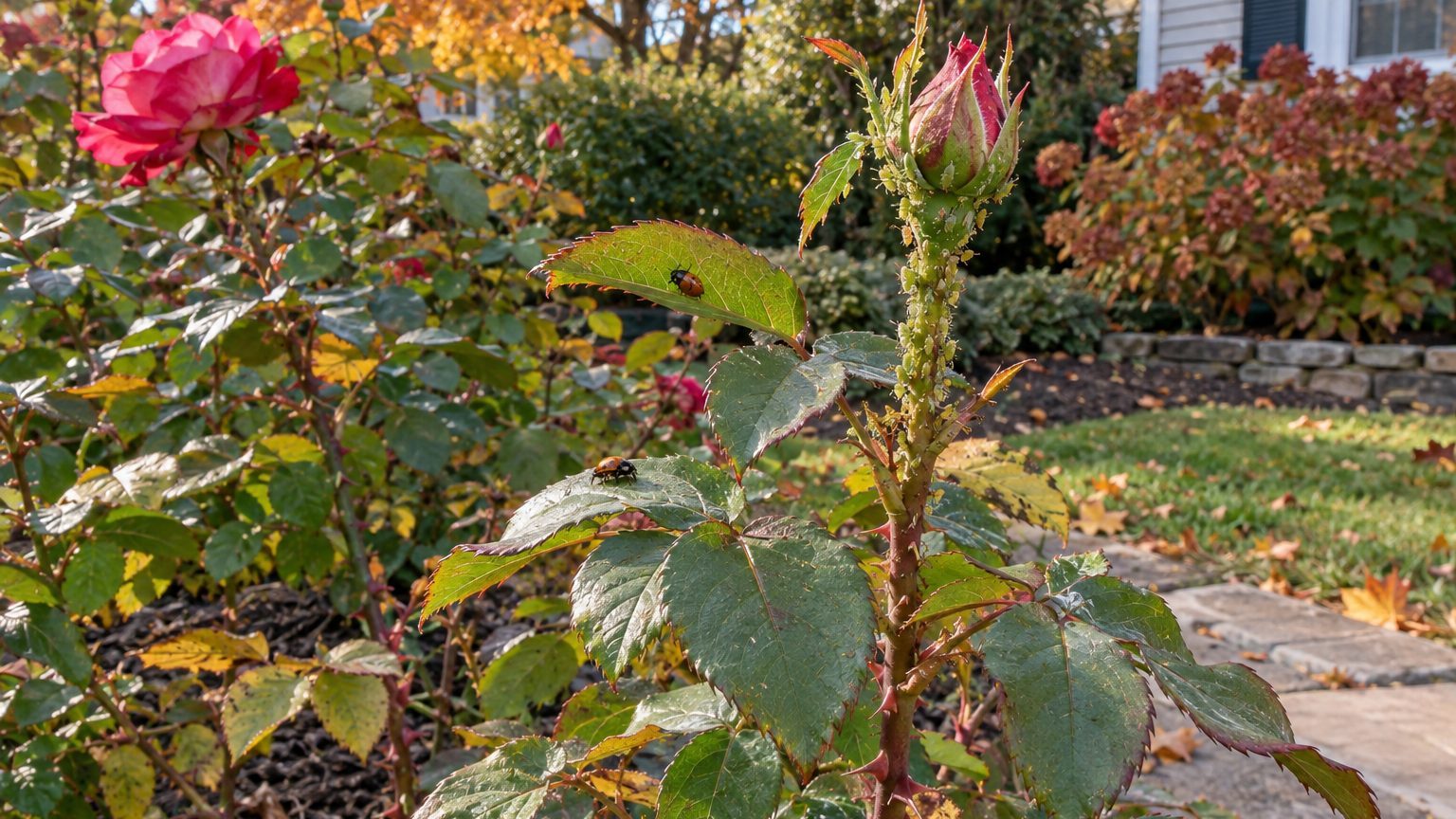
Fine webbing under a leaf, neat round holes along a petal edge, a cluster of soft insects on a new bud: roses show pest trouble early, if you know where to look. Which insects and mites turn up depends on the season and the weather, and so does the right response. Regular checks make it easier to respond while pest damage is still limited.
Which Insects Damage Roses, and When?
Rose pests follow the rose’s growth. Some pests appear with tender spring growth, while others become active under different weather conditions. Pest timing varies with climate, so match your checks to local conditions and the signs on the plant.
Timing shifts with the climate and the kind of rose. In California, summer heat cuts aphid numbers, while in Florida hot, dry weather favors spider mites. A repeat-blooming rose keeps pushing new growth, so there is fresh growth to check for longer than on a rose with a single flush.
Use your state’s rose page for pest guidance suited to your area.
From the almanac
Roses in your state
The dates on this page depend on where you live. Your state's page carries its frost dates, its USDA zones and the year laid out month by month.
Northeast
Southeast
- Alabama
- Arkansas
- Delaware
- Florida
- Georgia
- Kentucky
- Louisiana
- Maryland
- Mississippi
- North Carolina
- South Carolina
- Tennessee
- Virginia
- West Virginia
Midwest
Southwest
West
Pacific Northwest
Canada
How to Find and Control Rose Pests

Start by inspecting the plant, then choose a response for the pest or damage you find.
- Turn leaves over in hot, dry weather and look for fine webbing and discolored leaves, because spider mites are too small to see unaided and these are the signs they leave behind.
- Check buds and tender shoots in spring for clusters of soft insects, since in California aphids are a major problem for about 6 weeks in spring and early summer before high summer temperatures reduce their numbers.
- Spray the underside of the leaves with a forceful stream from the hose, which knocks mites off the plant, and in Illinois the advice is to repeat it every 2-3 days.
- In Florida, a solution of 1 tablespoon liquid dishwashing soap to 1 quart water can be used to control mites.
- Look along leaf edges for neat circular holes, because in Iowa holes 1/2 inch or less across point to leafcutter bees rather than a caterpillar or beetle, helping you avoid an unnecessary treatment.
- Keep checking leaves through summer and into fall, since in Ohio the damage from rose sawflies starts in spring and only ends with the first frost.
Florida advice for mites is the same forceful spray 3 or 4 times a week, a heavier routine than the Illinois one. Start with a forceful water spray before moving to another control.
Rose Pests by Season
Whether a rose repeat-blooms or flowers once changes how long there is fresh growth to watch. That, more than the shape of the plant, sets the rhythm of your pest checks.
| Rose Type | What changes | Why it matters |
|---|---|---|
| Repeat-blooming | New shoots and buds keep coming after the first flush | Aphids, mites and leaf chewers have fresh growth to find, so checks continue through the season |
| Once-blooming | One flush of flowers on last year’s wood | Spring buds and leaves are the first place to look, then leaf undersides as summer heats up |
For any rose, begin by matching the damage to the part of the plant where it appears. For any of them, the weather you have had lately tells you more about what to look for than the label on the tag.
Rose Pest Control Mistakes to Avoid
Spraying Once and Stopping
A single treatment seldom ends a mite problem, and the survivors rebuild on the same leaves. Only repeat a treatment when its directions call for it, and follow those directions until the infestation is controlled. Keep checking the plant until the infestation is controlled.
Waiting to See the Mites

Spider mites are the size of dust particles and need a microscope (more than 40X) to see, according to Tennessee advice. If you wait for a visible bug, leaves are already damaged. Look for discolored leaves together with fine webbing on the underside instead.
Mites also move. In Tennessee, once temperatures reach the mid-80s they release from the plant and float on air currents, so a clean rose can be reinfested after a hot spell. Check again then.
Misreading Round Holes

Circular holes cut from the edge of a leaf or flower, 1/2 inch or less across, are the work of leafcutter bees in Iowa. Spraying for a caterpillar or beetle that is not there costs time and treats the wrong problem. Look at the shape of the hole and where it starts before you reach for anything.
Rose Pests in Your State
The sign that starts pest checks is the rose itself: buds swelling in spring once the frost has passed. The sign that ends them is dormancy, when leaves drop and growth stops. The months for each state are on the page for that state.
- Your state’s page gives the months when pest checks begin and end where you live, so open it before the buds swell in spring.
- It also shows how the season runs in your climate, which is worth a look before hot, dry weather arrives.
Common Questions
How Can You Recognize Flower Thrips on Roses?
Flower thrips are tiny, winged insects, barely bigger than a speck of dust, so they are easy to miss with a quick glance. Look closely inside the open flowers, where they gather, and do not rely on spotting them from a distance.
What Does a Rose Weevil Look Like?
The adult is black with a red back and a long snout, and about 8 mm long. The red back and the snout together set it apart from the other beetles you might see on the canes and buds.
Do Lights Keep Rose Beetles Away?
Some rose growers in Hawaii believe electric lights above the bushes for the first 5 or 6 hours of darkness help repel rose beetles. It is a belief among growers, so treat it as something to try in a small area before relying on it.