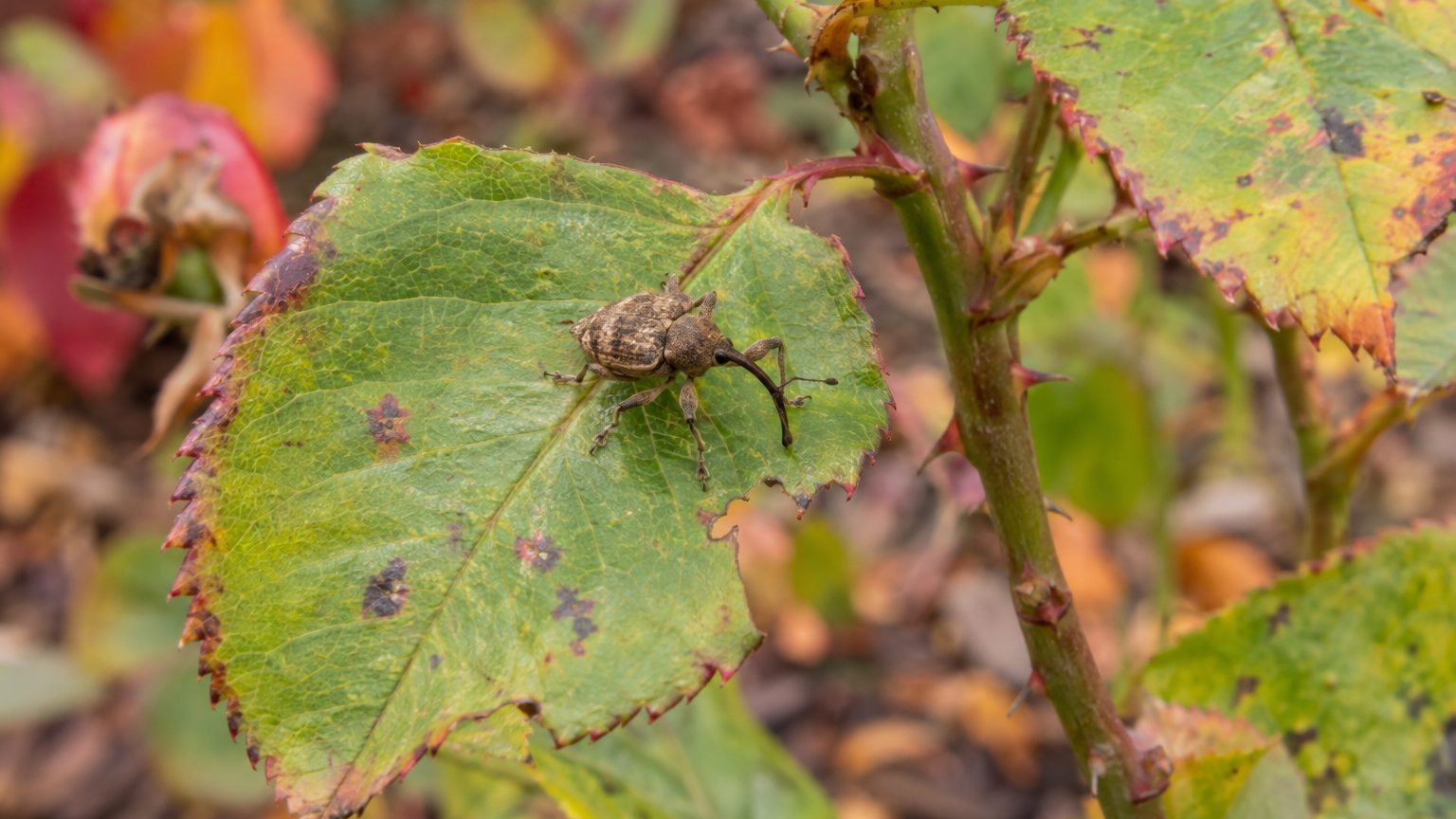
Ragged holes in rosebuds or buds that never open often point to a small red and black weevil feeding on the plant. Rose curculio feeds on buds, petals and cane tips, and its larvae finish the job from inside the bud. The adult is red and black with a long snout, while the larvae remain hidden inside the bud.
Rose Curculio: What You See

Start with the insect itself, because its colors and snout help distinguish it from other insects on a rose.
- The adult has a bright red back and thorax with a black head that stretches into a long snout.
- It is a hard-bodied beetle about 1/4 inch long, with long black legs and distinct antennae.
- In California, adults drill holes in buds, and flowers that open may have ragged petals.
- Stems may bend over just below a bud that has been fed on, as reported in Minnesota.
- Shoot tips die back, and where weevils are numerous in California, terminal shoots may be killed.
- Buds that never open may hold plump, legless, pale orange to whitish larvae with a brown head.
In California, adults emerge from the soil in spring.
From the almanac
Roses in your state
The dates on this page depend on where you live. Your state's page carries its frost dates, its USDA zones and the year laid out month by month.
Northeast
Southeast
- Alabama
- Arkansas
- Delaware
- Florida
- Georgia
- Kentucky
- Louisiana
- Maryland
- Mississippi
- North Carolina
- South Carolina
- Tennessee
- Virginia
- West Virginia
Midwest
Southwest
West
Pacific Northwest
Canada
Rose Curculio or Something Else?
The damage is easy to blame on the wrong insect, because chewed buds have more than one culprit. A hole in a bud tells you something ate it. It does not tell you what.
Check the plant itself and the inside of the bud before you decide.
| Looks like | How to tell them apart |
|---|---|
| Earwig feeding, with holes in buds and sometimes young shoots | Rose curculio shows a red and black weevil with a long snout on the bud, and a bud that stays shut may hold a pale larva with a brown head |
Raspberries and other caneberries can host the same weevil, so cane fruit growing near the roses is worth a glance when buds look chewed.
What Causes Rose Curculio, and Where It Is Worst
The cause is a weevil with one generation a year. Adults feed on buds, and females lay eggs inside them. The eggs hatch into larvae that keep feeding inside the bud, often killing it before it opens.
Mature larvae drop to the ground and pass the winter as pupae in the soil around the base of the plant. In California, adults emerge from that soil in spring, and the cycle starts again right under the same shrub.
Wild roses are the main host for this native weevil. Garden roses with hips draw adults, and pink and yellow ones are named as favorites. Yellow and white roses are also described as preferred hosts.
How to Treat Rose Curculio
How to Prevent Rose Curculio Coming Back
- In early spring, watch for the first red and black adults as they come out of the soil, since in California that is when they emerge.
Where This Comes From
Wild roses are the main host of this native weevil.
Common Questions
Do Rose Curculios Attack Raspberries Too?
Yes, though less commonly than roses. Both the rose curculio and the western rose curculio feed on caneberries and roses.
How Many Generations of Rose Curculio Are There Each Year?
One. The weevil has a single generation, so the larvae you see in buds will become the adults of next spring.
What Do Rose Curculio Eggs Look Like?
The eggs are oval and about 1/25 inch long. They sit hidden in the bracts and buds of the flowers, so you are far more likely to notice the damage than the eggs.