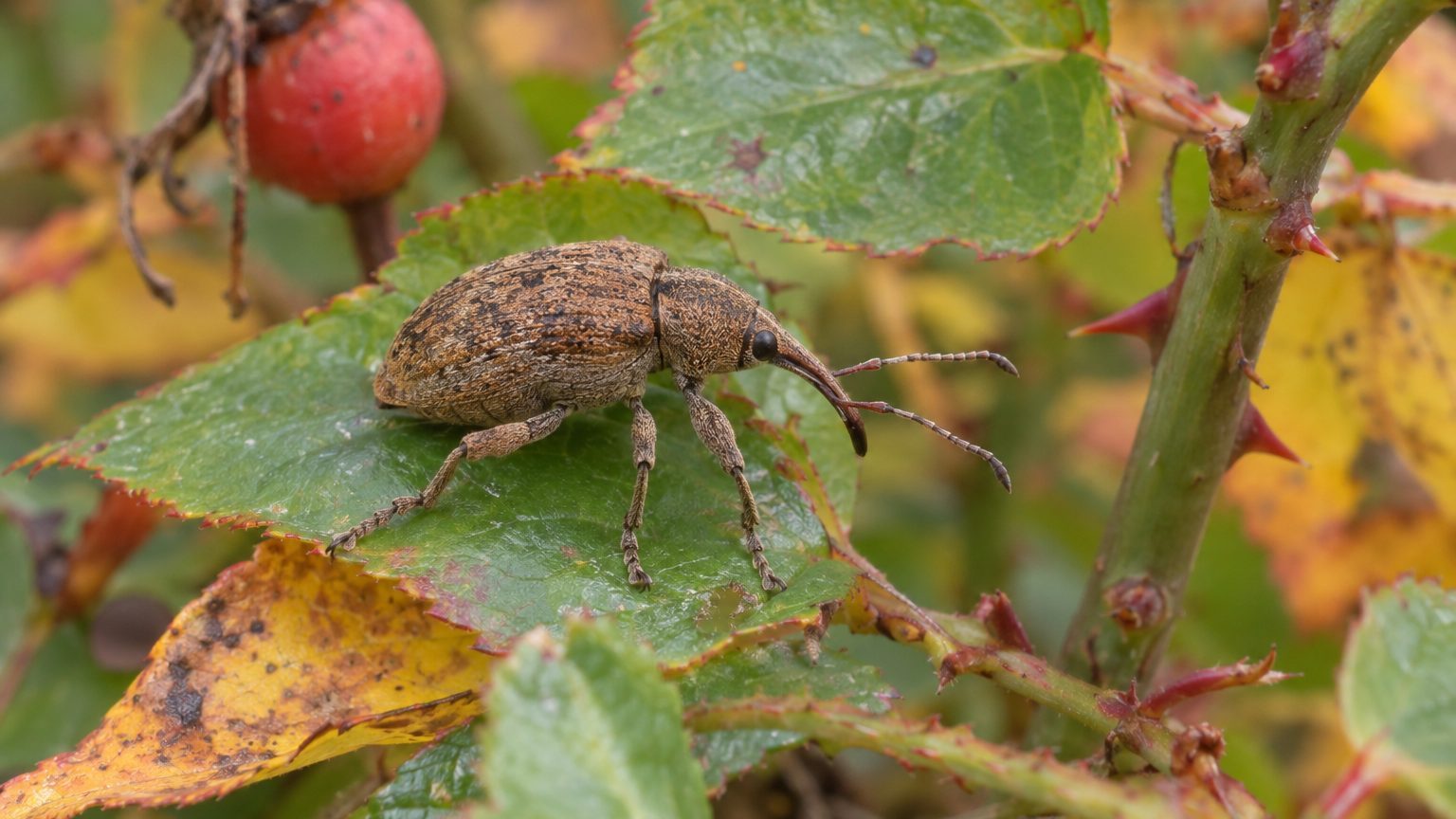
Rose leaves with ragged, scalloped edges and no insect in sight usually mean something is feeding after dark. The likely culprit is the fuller rose beetle, a flightless weevil that chews leaves, buds and flowers at night and, in California, is known to hide by day. Knowing its look and its habits makes it much easier to confirm.
Fuller Rose Beetle: What You See

Start with the faint white band along each side of its wing covers.
- A faint white band runs along each side of the body, on the wing covers.
- The body is light brown to ash-gray, with a short snout and elbowed antennae that spring from it.
- Adults measure about 3/8 inch long, small enough to vanish among the leaves.
- Leaf edges look notched, serrated and ragged, and flowers get chewed too.
- During the day the adults sit on the undersides of leaves, and they cannot fly (a habit noted in California).
- In North Carolina, adults first appear in July and keep emerging through November.
A flashlight after dark, aimed at the leaf edges, can help you catch one at work.
From the almanac
Roses in your state
The dates on this page depend on where you live. Your state's page carries its frost dates, its USDA zones and the year laid out month by month.
Northeast
Southeast
- Alabama
- Arkansas
- Delaware
- Florida
- Georgia
- Kentucky
- Louisiana
- Maryland
- Mississippi
- North Carolina
- South Carolina
- Tennessee
- Virginia
- West Virginia
Midwest
Southwest
West
Pacific Northwest
Canada
Fuller Rose Beetle or Something Else?
Ragged leaves can come from many chewing pests, and stunted growth has many causes, so one clue is never enough. Pair what you see on the plant with when and where you see it.
The pairs below separate this weevil from the usual look-alikes.
| Looks like | How to tell them apart |
|---|---|
| Another chewing insect, with notched leaf edges | A fuller rose beetle feeds at night; in California, adults often hide on leaf undersides during the day. |
| A rose that grows poorly and looks short of water or nutrients | Damaged roots cause that stunting, so check the leaf margins for notches too. If they are clean and the beating test below turns up nothing, the symptoms may have another cause. |
Notched edges together with weevils that drop from the canes when you shake them point to this beetle. Clean leaves and no weevils point elsewhere.
What Causes Fuller Rose Beetle, and Where It Is Worst
The adults emerge from the soil and crawl up the rose to feed, since they cannot fly. Males of this species have never been found. Eggs are laid in groups, in protected plant parts or in or on the soil.
The host list is very long. Citrus, strawberry, beans, peach, rhubarb and potato are all on it, along with azalea, begonia, gardenia and hibiscus. A rose growing near any of these can be visited by the same weevils.
Timing depends on where you garden. In North Carolina, most beetles overwinter as larvae in the soil, then pupate in spring near the surface. Adults appear from July onward. Fuller rose beetles feed on roses and many other host plants.
How to Treat Fuller Rose Beetle
Work in the order below, starting with confirmation and ending with local advice on what is approved for your state.
- Check the undersides of leaves by day to look for hiding adults.
- Go out after dark with a flashlight, because feeding happens at night and the weevils are easiest to catch in the act.
- Beat the shrub over a light sheet or tray and collect the adults as they drop, which shows you whether weevils are present at all.
- Watch for fresh leaf damage or set ground traps, since both tell you when adults are emerging in your yard.
- Water through dry spells, because roots damaged by larvae cannot take up water well, and in Florida severely damaged plants have died in drought.
- Contact your state’s extension service before using any spray, so that you get only what is registered where you live.
Keep your expectations modest. Most of what you see is leaf damage, and a bush that is otherwise growing steadily can carry some notched edges.
How to Prevent Fuller Rose Beetle Coming Back
Because the cycle runs from soil larvae to leaf-feeding adults, prevention is mostly about watching at the right moments.
- In North Carolina, larvae pupate near the soil surface in spring, and adults first appear in July.
- Look under the leaves by day for adults hiding there.
- From July through November in North Carolina, shake the canes over a tray once in a while, since adults keep emerging through the fall.
- Severely damaged roots can leave the plant vulnerable during drought.
Repeat the same night walk when fresh leaf damage appears.
Where This Comes From
The facts here come from university extension and government pages written for places such as North Carolina, Florida and California.
Timing and local advice change from state to state, so confirm dates and approved treatments with your own state’s extension service.
Common Questions
Do Fuller Rose Beetles Kill Roses?
Rarely. The weevils do little serious harm beyond how the plant looks. Under a heavy attack, adults can eat the whole leaf except the midrib. The dangerous case is a root system damaged badly enough that the plant dies in drought or picks up a fungal infection, as reported in Florida.
Are the Larvae in the Soil a Problem for Roses?
Not usually. The larvae are root feeders, but they do not seriously damage roses. Poor, stunted growth is the sign that root damage has become heavy.
What Else Does This Weevil Feed On?
Many plants. Citrus, strawberry, beans, peach, rhubarb and potato are among the main hosts. Apple, azalea, begonia, blackberry, gardenia, hibiscus, lily, raspberry and others also get chewed.