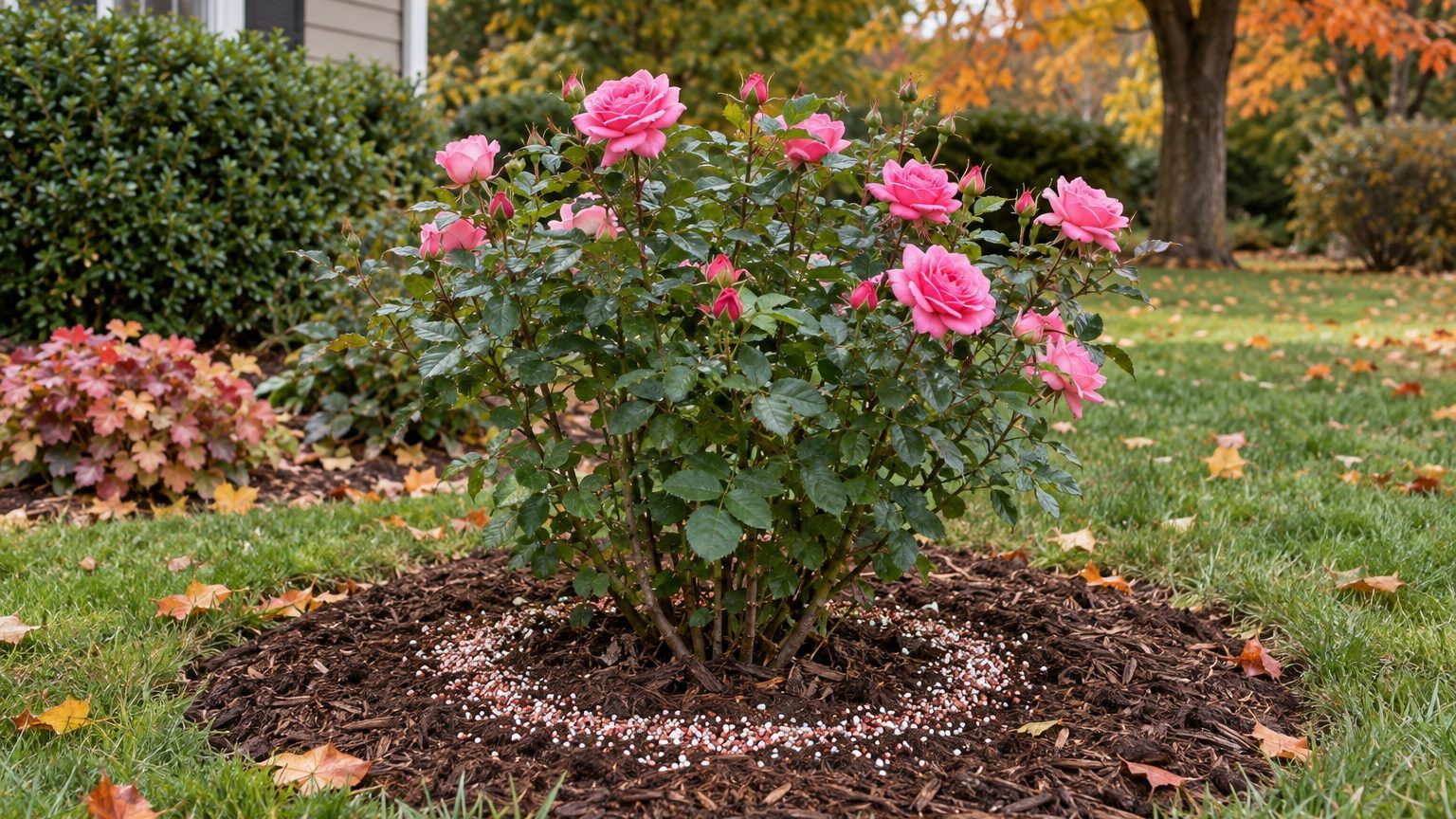
Rose canes turn a glossy red as new leaves unfold in spring, and that flush of growth is the cue to feed. A rose that needs nutrients may show weak growth and fewer flowers. When to fertilize roses depends on that first growth and on the late-summer slowdown that tells you to stop.
When Should You Fertilize Roses?
Feed roses after new growth begins, then follow the feeding and cutoff schedule for your climate. Climate moves both ends of that window, and so does the type of rose.
Warm regions start earlier and quit later, while cold ones wait for buds to swell and stop sooner so the canes can harden before frost. Repeat-blooming roses keep making flowers and take regular feedings. Once-blooming types do their work in one spring flush.
Use your state’s rose page to find the feeding window for your climate.
From the almanac
When to feed roses, state by state
The months each state's extension calendar marks for this, kept inside that state's own frost-free season. Open your state for the frost dates, the USDA zone and the rest of the year.
Northeast
- ConnecticutApr–JulUSDA 6a-7b
- MaineApr–JulUSDA 3b-6a
- MassachusettsApr–JulUSDA 5a-7b
- New HampshireApr–JulUSDA 3b-6a
- New JerseyApr–JulUSDA 6a-7b
- New YorkApr–JulUSDA 3b-7b
- PennsylvaniaApr–JulUSDA 5a-7b
- Rhode IslandApr–JulUSDA 6a-7b
- VermontApr–JulUSDA 3b-5b
Southeast
- AlabamaMar–SepUSDA 7a-9a
- ArkansasMar–AugUSDA 6b-8a
- DelawareApr–AugUSDA 7a-8a
- FloridaFeb–NovUSDA 8b-11b
- GeorgiaMar–SepUSDA 6a-9b
- KentuckyApr–AugUSDA 6a-7a
- LouisianaMar–SepUSDA 8a-10a
- MarylandApr–AugUSDA 5b-8a
- MississippiMar–SepUSDA 7b-9a
- North CarolinaMar–AugUSDA 5b-8b
- South CarolinaMar–SepUSDA 7a-9a
- TennesseeApr–AugUSDA 5b-8a
- VirginiaApr–AugUSDA 5a-8b
- West VirginiaApr–AugUSDA 5a-7a
Midwest
- IllinoisApr–JulUSDA 5a-7b
- IndianaApr–JulUSDA 5b-7a
- IowaApr–JulUSDA 4b-6a
- KansasApr–JulUSDA 5b-7a
- MichiganApr–JulUSDA 4a-6b
- MinnesotaApr–JulUSDA 3a-5a
- MissouriApr–AugUSDA 5b-7b
- NebraskaApr–JulUSDA 4a-5b
- North DakotaApr–JulUSDA 3a-4b
- OhioApr–JulUSDA 5b-6b
- South DakotaApr–JulUSDA 3b-5b
- WisconsinApr–JulUSDA 3b-6a
Southwest
West
- AlaskaMay–JulUSDA 1a-8a
- CaliforniaMar–Apr, Sep–OctUSDA 5a-11a
- ColoradoMay–JulUSDA 3b-7b
- HawaiiAll yearUSDA 9a-13a
- IdahoMay–JulUSDA 3b-7b
- MontanaMay–JulUSDA 3a-6a
- NevadaFeb–Jun, Sep–OctUSDA 4a-10a
- UtahMay–JulUSDA 4a-9a
- WyomingMay–JulUSDA 3a-6a
Pacific Northwest
Canada
- AlbertaApr–JulZone 4a
- British ColumbiaMar–JulZone 9a
- ManitobaApr–JulZone 3b
- New BrunswickApr–JulZone 5a
- Newfoundland and LabradorApr–JulZone 6a
- Northwest TerritoriesMay–JulZone 1b
- Nova ScotiaApr–JulZone 6b
- NunavutMay–JulZone 0a
- OntarioApr–JulZone 7a
- Prince Edward IslandApr–JulZone 5b
- QuebecApr–JulZone 5b
- SaskatchewanApr–JulZone 3a
- YukonMay–JulZone 1b
Sources: state frost facts and Iowa State University Extension ; K-State Research and Extension (Johnson County) · Penn State Extension · University of Georgia CAES · Clemson Cooperative Extension, HGIC. A state with no marked month is not shown.
How to Fertilize Roses

The order matters here, because each step sets up the next one, from the soil to the last feeding of the year.
- Check the soil before buying anything, because roses do best in slightly acidic ground with a pH of 6.0 – 6.5 in Maryland guidance, and a test tells you whether feeding alone will be enough.
- Hold off until new growth appears, since feeding a dormant plant wastes the fertilizer, and in Oregon the first feeding goes on when new shoots are 4 inches long.
- Measure the dose instead of guessing, and follow the fertilizer label because products differ.
- In Illinois, spread the fertilizer in a band that begins six inches from the crown, keeping the granules away from the base of the stems.
- Repeat on a steady schedule through the season, since a rose that keeps blooming keeps using nutrients, and Colorado guidance suggests every 4 to 6 weeks.
- Stop feeding on time, because late fertilizer encourages soft, succulent growth that frost damages, and in Colorado the last feeding falls on August 15.
In Illinois, the band reaches out to about 18 inches from the crown. The stop date shifts with the climate, and in Oregon feeding ends in late August or early September as the roses begin to go dormant. A rose planted this year is handled differently, as the next section explains.
Fertilizer Timing by Rose Type
Type changes the pace more than the principle. A rose that blooms repeatedly draws on its reserves again and again, so it gets fed more often than one that flowers once and rests.
Local guidance gives specifics for a few groups, and the rest follow the general schedule.
| Rose Type | What changes | Why it matters |
|---|---|---|
| Hybrid roses (Wyoming) | Feeding starts after growth begins in late May and repeats every 2 weeks | Frequent feeding gives these roses the best results in a short season |
| Shrub roses (Montana) | Feeding begins the year after planting with a complete fertilizer, applied at a modest yearly rate spread across the bed according to its size | A new shrub spends its first season settling in, so it waits |
| Newly planted roses (Arizona) | A balanced fertilizer goes on after the first bloom, then every 6 weeks | The first bloom shows the plant is established enough to use it |
For climbing, old garden and rugosa roses, follow local feeding guidance for your climate. For a once-blooming rose, follow the local feeding schedule rather than using the end of bloom as a universal cue. If you grow a mix, follow the appropriate local schedule for each rose.
Rose Fertilizing Mistakes to Avoid
Feeding into Late Summer
Fertilizer after midsummer prompts a late flush of tender shoots that have no time to harden. Frost then kills the tips and can set the plant back. In Iowa the cutoff is July 31, so mark it on the calendar and put the fertilizer away.
Copying Another Region’s Schedule
A schedule from a warm, long-season state does not suit a cold one. In California, young plantings get nitrogen at the rate of 1 pound per 1,000 square feet in spring and fall. Oregon guidance instead feeds every 6 to 8 weeks through the growing season. Use the plan written for your climate and adjust it to how the plant looks.
Feeding Newly Planted Roses Too Soon

Fresh roots are tender, and a bush still recovering from transplanting cannot use much. Oklahoma advice is to feed around April 1 or four to six weeks after spring planting. Arizona advice is to wait for the first bloom. The safe course in either place is to let the plant leaf out and settle before the first feeding.
When to Fertilize Roses in Your State
Watch the plant before you look at the calendar. Swelling buds and the first new leaves after the last hard frost signal the start. Slowing growth and the approach of dormancy signal the end.
- Each state’s page gives its months for the first feeding, so check it in late winter, before the buds swell.
- The same page gives the stop date, which is worth a look in midsummer, before you reach for another bag.
Common Questions
Do Roses Need a Second Feeding After the Spring Bloom?
In Illinois, roses benefit from another application around June 15 or at the end of the spring bloom period. In New Mexico, feed when new growth reaches 4 to 6 inches and again when the first blossoms have faded.
How Much Should You Feed Roses Without a Soil Test?
In Georgia, the general advice without a test is three tablespoons per plant each month from March through September, using a fertilizer made for roses or shrubs. A soil test lets you cut back or adjust.
Can You Fertilize Roses in Midsummer?
In Oklahoma, high-nitrogen fertilizer should not go on after July 15 unless the rose is quite hardy and will be thoroughly irrigated. A plant that is stressed or dry is better left alone.