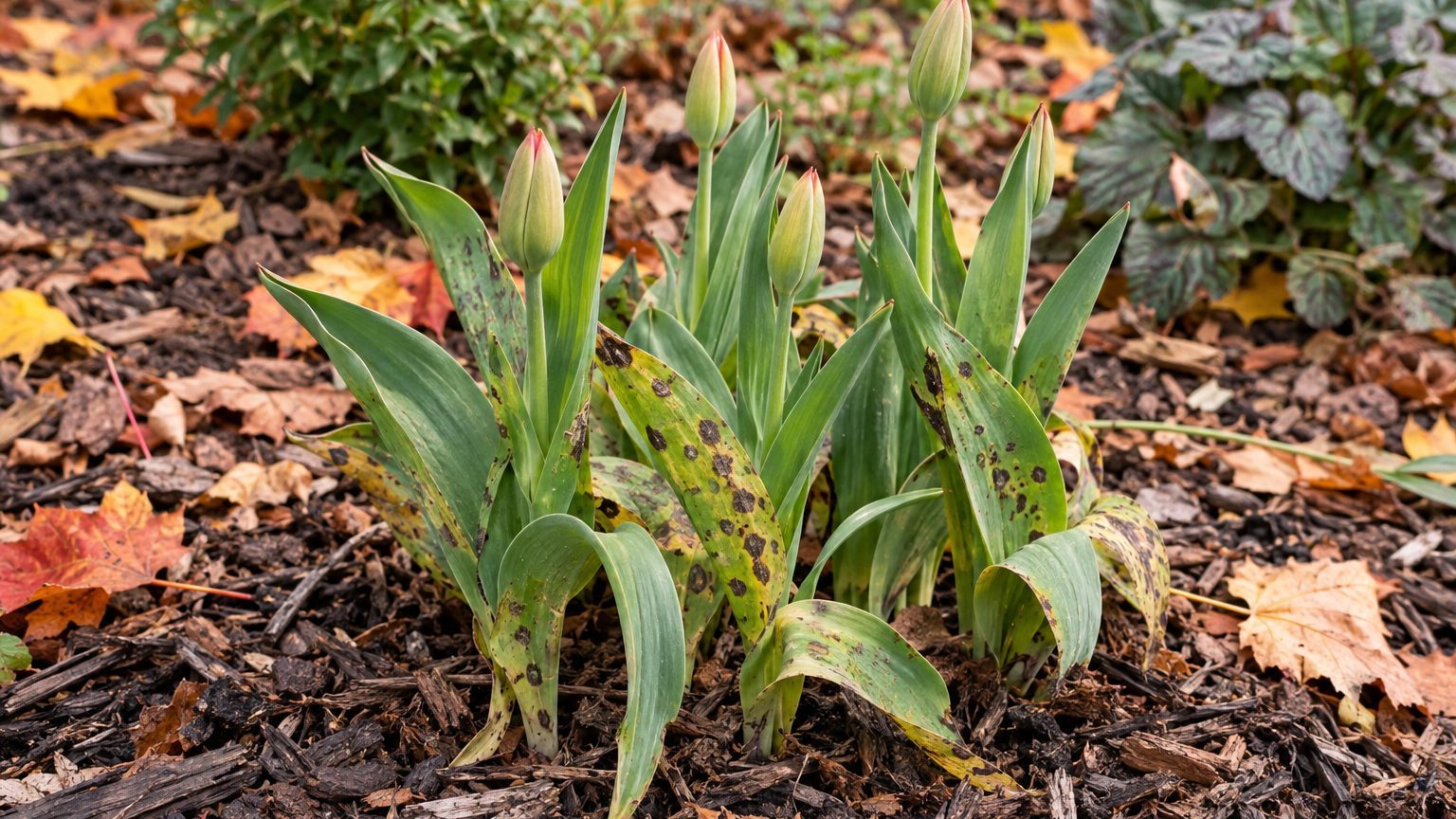
Tulips that thrilled you the first spring often send up a tired show the next, with fat leaves and few flowers or none at all. Modern hybrid tulips spend most of their stored energy on that first bloom. The bulb then has to rebuild in the ground, and it often cannot.
Tulips Not Coming Back: What You See
The signs show up in spring, as the clump emerges and the buds should be forming.
- Big, floppy leaves rise from the ground with no flower stalk at all, which is how a weak bulb behaves.
- Flowers do appear, but fewer and smaller than in the first year, since performance usually drops starting in the second year.
- Nothing comes up in some spots, or the shoots are stunted with yellow or reddish leaves, which can mean the bulb underneath has rotted.
- Large, light tan patches show on the leaves, sunken and yellow at the edge with a water-soaked rim, most noticeable on light-colored varieties.
- Flower buds form and then shrivel before opening, a pattern linked to ripening fruit gas around the bulbs before planting.
Where the problem sits in the bed tells you a lot, so note whether it is scattered bulbs, one damp corner or the whole planting.
From the almanac
Bulbs in your state
The dates on this page depend on where you live. Your state's page carries its frost dates, its USDA zones and the year laid out month by month.
Northeast
Southeast
- Alabama
- Arkansas
- Delaware
- Florida
- Georgia
- Kentucky
- Louisiana
- Maryland
- Mississippi
- North Carolina
- South Carolina
- Tennessee
- Virginia
- West Virginia
Midwest
Southwest
West
Pacific Northwest
Canada
Tulips Not Coming Back or Something Else?
Poor flowering from an exhausted bulb is the most common story, but other problems produce similar disappointment. A few clues separate them, and most take only a look at the leaves, the petals or the bulb itself.
| Looks like | How to tell them apart |
|---|---|
| Tulip fire disease | Leaves are malformed with sunken, yellow to light tan patches ringed by a water-soaked area, and petal spots look white on colored flowers and brown on white ones. |
| Rotted bulb | Shoots fail to come up or the leaves are yellow or reddish and stunted, and the bulb is rotted when you dig it up. |
| Buds aborted by fruit gas | Buds start and then fail in bulbs that were chilled in a refrigerator alongside ripening fruit, because the ethylene gas stops flower development. |
A tired bulb differs from all of these because its leaves stay clean and healthy looking. They are simply large and flowerless.
What Causes Tulips Not Coming Back, and Where It Is Worst
The cause is usually spent reserves. Once a tulip has flowered, it has often used so much energy that little remains in the original bulb, and modern hybrids decline in vigor rather quickly. Shallow planting, heavy soil, little feeding and cutting leaves too early all deepen the shortfall.
Warm climates make it harder. In North Carolina, tulips lose floral vigor when soil temperatures reach 70 degrees F, so a hot spring cuts the bulb’s recovery short. Species tulips often hold up better there as perennials than hybrids do.
In Florida, bulbs need chilling to bloom, about 60 days at 40°F or 120 days at 50°F, and even in northern Florida they often flower poorly or not at all. Northern gardens fare better, but sun and drainage matter. In Iowa, a site with at least 6 hours of direct sun and well-drained soil keeps tulips blooming longest.
How to Treat Tulips Not Coming Back
Work through the bed in the order the season gives you, starting at bloom time.
- Snip off spent flowers as soon as the petals fall, so that seed pods do not draw away the food the leaves are making for the bulb.
- Feed the clump after flowering, because that is when the bulb is rebuilding and has the most use for nutrients.
- Leave the foliage alone until it dies back naturally, since green leaves are still feeding next year’s flower.
- Clean up any diseased leaves and petals when they are dry, not wet, so that you do not spread the problem on damp tissue, and destroy infected plants rather than composting them.
- Dig up tulips that no longer bloom and discard the bulbs, because saving them for another year rarely pays off.
- Replant with good size, disease-free bulbs in loose, well-drained soil at a generous depth, handling them gently to avoid bruising.
Your state’s extension service can tell you what is approved for treating tulip fire where you live, and which fresh bulbs suit your winters.
How to Prevent Tulips Not Coming Back Coming Back
Prevention follows the bulb’s year, from planting through the weeks after the petals drop.
- At planting in fall, choose a spot with full sun and good drainage, set the bulbs deeper than you might think, and start with firm, good size bulbs.
- If you chill bulbs yourself in a warm climate, keep them out of any refrigerator that holds ripening fruit, which can make the buds abort.
- In spring, space the planting so air moves between plants, and avoid crowding the bed with other perennials.
- During wet spells, keep water off the leaves, and do not water tulips from above, since splashing helps disease spread.
- Right after bloom, remove the spent flowers and feed the clump, then let the leaves yellow on their own.
Planting fresh bulbs in a new spot every few seasons keeps the display full without waiting for the old clump to fade.
Where This Comes From
The guidance here draws on university extension publications written for gardeners in states such as Florida, Texas, North Carolina and Iowa.
Chilling needs, soil temperatures and disease treatment vary by place, so confirm timing and approved treatments with your state’s extension service.
Common Questions
Can You Save Tulip Bulbs to Replant Next Year?
It is not recommended, because recovered bulbs rarely flower again. Park districts and public gardens treat tulips as annuals for that reason, since it is rare for an entire planting to return with the same display.
Do Species Tulips Come Back Better than Hybrids?
Species types tend to be more long-lived than hybrids. In North Carolina, species tulips often perform better as perennials than hybrid plants do.
How Many Years Do Tulips Bloom?
Most modern tulip cultivars bloom well for 3 to 5 years. Some tulip types, called classes, keep blooming well over a longer period, so a class label on the bulb package is worth reading.