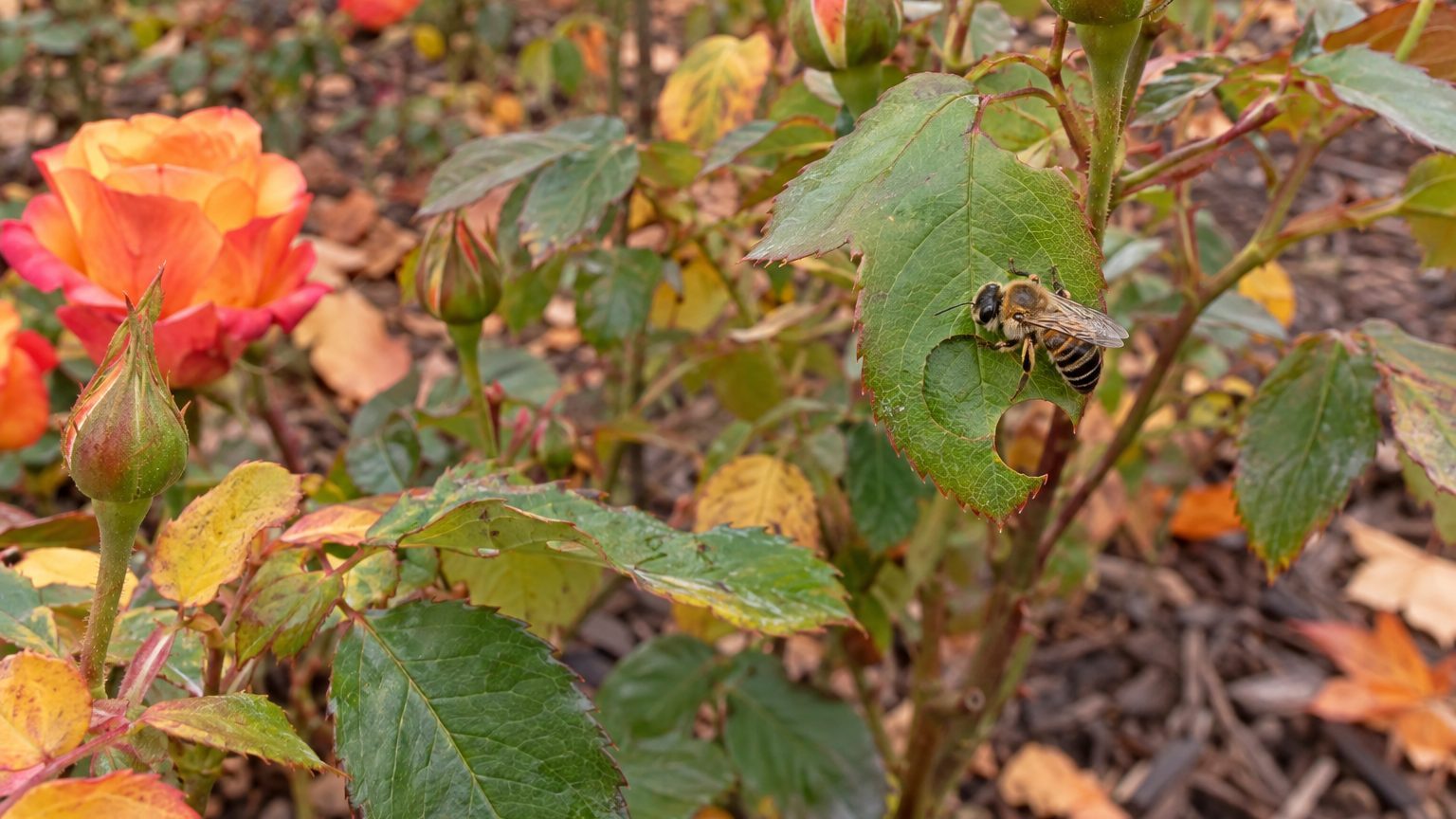
A rose leaf with a neat, round-edged bite missing from its margin is the signature of a leafcutting bee at work. The cut looks deliberate because it is. The bee carries the piece away to line a nest, and the damage on a healthy rose is usually more curiosity than threat.
Leafcutting Bees: What You See

The clearest sign is on the leaves, and the bee itself is easy to overlook while the cuts are not.
- Smooth half moon or semicircular holes appear along the edge of the leaf, about 3/4 inch across, with a clean cut unlike the ragged edge chewing insects leave.
- Precise ovals or circles may be missing from the foliage, and flower petals can be trimmed the same way.
- Look for holes that begin at the leaf margin rather than in the middle of the blade.
- The bee looks like a honey bee but is often darker in color, and it is seen near the roses while the cutting is going on.
- In Minnesota, the cutting shows up from late May to early June.
Other plants nearby, such as lilac, redbud and ash, can carry the same notches.
From the almanac
Roses in your state
The dates on this page depend on where you live. Your state's page carries its frost dates, its USDA zones and the year laid out month by month.
Northeast
Southeast
- Alabama
- Arkansas
- Delaware
- Florida
- Georgia
- Kentucky
- Louisiana
- Maryland
- Mississippi
- North Carolina
- South Carolina
- Tennessee
- Virginia
- West Virginia
Midwest
Southwest
West
Pacific Northwest
Canada
Leafcutting Bees or Something Else?
Notched leaves have more than one possible author, and the edge of the cut tells most of the story. A bee removes a clean piece, while chewing insects leave a torn outline.
The bee’s nesting habit gives a second check. Look for a drilled hole in a freshly pruned cane or in nearby soft, rotted wood.
| Looks like | How to tell them apart |
|---|---|
| Leaf-feeding insects | Ragged, uneven edges on the leaf, where the bee’s cut is very smooth and semicircular |
| Honey bees visiting the flowers | Honey bees are often paler, while leafcutting bees tend to be darker and are the ones leaving round notches on the foliage |
Pith-boring insects in cut canes can also be blamed for tunnels, but a bee nest sits inside the pith of a pruned cane and is lined with round pieces of foliage.
What Causes Leafcutting Bees, and Where It Is Worst
The cause is a native solitary bee building nests. Females do not form colonies. Each one excavates a tunnel several inches deep in rotted wood, hollow twigs, bee nest boxes or the pithy stems of thick-caned plants such as roses.
Once the tunnel is ready, she cuts leaf pieces to line individual cells, then stocks each with pollen and nectar for the young. Your rose is simply the source of the lining material.
Damage is more serious in isolated rural plantings, and where the bees are abundant and concentrate on cultivated plantings. On most garden roses, the damage is minor.
How to Treat Leafcutting Bees
Treatment is mostly a matter of deciding whether anything is needed, because the bees pollinate and rarely do major harm. If you want to act, work in this order.
- Confirm the cut, looking for smooth semicircles at the leaf edge, so that you are not treating a different pest.
- Leave the bees alone, because they are beneficial pollinators and should not be killed.
- Skip insecticides, since they are ineffective for preventing leaf cutting and harm helpful insects.
- Drape cheesecloth or other loose netting over the roses during the weeks when the bees are most active, so that they cannot reach the leaves.
- Keep the plant healthy with good culture, so that it tolerates the lost tissue easily.
Netting is the only known control for leaf injury. In most yards the notched leaves are an aesthetic blemish that harms no otherwise healthy plant.
How to Prevent Leafcutting Bees Coming Back
Prevention is limited, but a few timed habits reduce nesting in your canes and keep the plants strong.
- Whenever you prune, seal the cut ends of canes with wax or a couple drops of white glue.
- Before late May, have netting ready if you want to protect prized plants, since in Minnesota the cutting begins then.
- Through the growing season, water and feed regularly so the plant stays healthy enough to shrug off notches.
- Whenever you prune later in the year, seal those fresh cane ends again so bees cannot excavate the pith.
- In fall cleanup, leave sprays in the shed, since pesticides harm the bees you want to keep.
Sealing matters because bees excavate the pith of pruned canes, though the largest canes suffer little since tunneling rarely girdles the cambium.
Where This Comes From
The examples here cover Minnesota, New Hampshire and Iowa. Timing and local advice may differ elsewhere.
Common Questions
Are Leafcutting Bees Harmful to Roses?
Seldom. They are native, largely beneficial pollinators, and a healthy rose easily tolerates some lost leaf tissue.
Can Leafcutting Bees Kill a Rose Cane?
Unlikely. They sometimes nest in the largest canes but restrict tunneling to the pith and rarely girdle the cambium.
Do Leafcutting Bees Sting?
The evidence here does not address stinging.