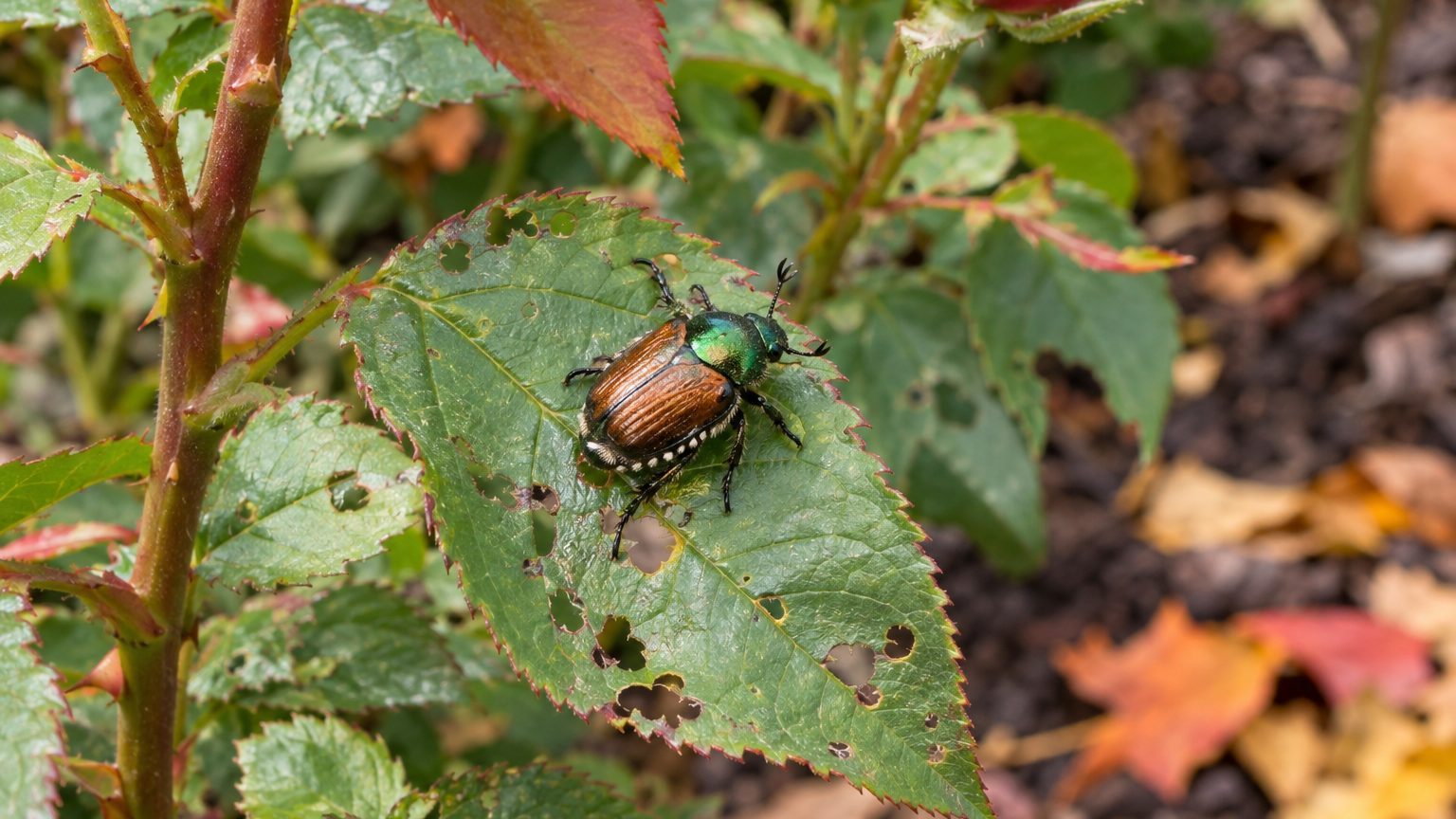
Beetles clustered on rose blooms in the middle of a summer day are a familiar sight in much of the country. Japanese beetles feed on over 250 plant species, and roses rank among their favorites, so the rose bed is often where you spot them first. Knowing what they look like, when they arrive and how to respond keeps the damage in check.
Japanese Beetle: What You See

Start with the adult beetle itself, since it is the part you can catch in the act.
- Tufts of white hair show around the abdomen, just below the wing covers, and that is the sign that sets this beetle apart from similar ones.
- The beetles work on the topmost, youngest leaves first, whatever the height of the plant.
- In Georgia, they feed during the day and are most active from midmorning to early evening, so a midday check finds them where an evening check may not.
- Flowers and buds get eaten along with the foliage, and roses are among the plants they go for first.
- Adults usually turn up from late June through September in Indiana.
- In Indiana, the grubs live in the soil and measure 1/4 to 1 inch long, which is why they get mistaken for other white grubs.
Because the feeding starts at the top of the bush, a quick look at the newest growth tells you more than a glance at the lower canes.
From the almanac
Roses in your state
The dates on this page depend on where you live. Your state's page carries its frost dates, its USDA zones and the year laid out month by month.
Northeast
Southeast
- Alabama
- Arkansas
- Delaware
- Florida
- Georgia
- Kentucky
- Louisiana
- Maryland
- Mississippi
- North Carolina
- South Carolina
- Tennessee
- Virginia
- West Virginia
Midwest
Southwest
West
Pacific Northwest
Canada
Japanese Beetle or Something Else?
Several beetles visit roses, and a few grubs in the soil look much the same. A chewed leaf alone does not settle the question, so pair what you see with where and when you see it.
| Looks like | How to tell them apart |
|---|---|
| Other beetles feeding on rose blooms and leaves | Look at the rear of the beetle for tufts of white hair at the end of the abdomen, and note whether it feeds in daylight. |
| May/June beetle and masked chafer grubs in the soil | In Indiana, the Japanese beetle grub is 1/4 to 1 inch long and resembles them, so the grub alone proves little. Adults with white tufts feeding on the bush above point to Japanese beetle. |
If the grubs turn up in soil but you see no adults with white tufts on your plants, other beetles may be behind them. If you are unsure, have the specimen identified locally.
What Causes Japanese Beetle, and Where It Is Worst
The cycle starts in the ground. Adults lay their eggs in the soil, and the grubs overwinter deep down, then finish their growth the following spring. In Indiana, the adults emerge from the ground in mid-summer. Once emergence begins, a bed that looked clear can soon fill with beetles.
The timing shifts with the place. In South Carolina, adults begin emerging in mid-May and are present through August. In central Maryland, emergence begins in mid-June and peaks in early July, and the beetles stay active for about 4-6 weeks. In Wisconsin, they typically begin to emerge in late June and early July.
Your neighbors’ yards matter too, because adults can fly an average of 1 to 2 miles. This continuous migration means beetles keep arriving after you clear a bush. Japanese beetles are not established in California, so gardeners there are not dealing with them.
How to Treat Japanese Beetle
Treatment is mostly steady attention during the weeks when beetles are present, and it follows this order.
- Check the bushes early in the season before damage appears, so that you catch the first beetles before they draw others in. Begin scouting at that stage.
- Handpick beetles and drop them into soapy water, which removes them from the bush without any chemicals.
- Clip off buds when beetles are abundant, since roses unfold too fast and are too attractive for sprays to protect the flowers fully.
- Spray the bushes to protect the leaves, using only a product approved for roses and Japanese beetles in your area.
- Repeat the spraying when beetles keep arriving. In Maryland, 2 or 3 spray applications may be needed to prevent serious injury to roses and grapes.
- Let the bushes bloom again once beetles become scarce, so the plant can put its energy back into flowers.
Beetle bags from the store are not the answer, and beetles are hard to control once established, especially at population peaks. Community-wide programs that bring neighbors into integrated pest management can reduce their influence to a great extent.
How to Prevent Japanese Beetle Coming Back
Prevention follows the beetle’s calendar, from the soil in spring to the last adults of late summer.
- In Georgia, scout for adults and grubs from early spring.
- Before the first flight, which begins in mid-May in South Carolina, look over the bushes so that you find the first beetles quickly.
- When beetles are abundant in summer, clip the buds and protect the leaves instead of trying to save every flower.
- Once the beetles become scarce, let the bushes bloom again.
- Into late summer, keep checking, as adults can still be found through September in Indiana.
- Throughout the season, talk with neighbors about a shared plan, since the beetles move between yards.
Adult beetles seldom become a problem when a regular spray schedule already controls other insects.
Where This Comes From
The timing and treatment details here are specific to the states named in the text. Timing, spraying advice and approved products vary by state.
Common Questions
What Other Plants Do Japanese Beetles Eat?
Beyond roses, preferred hosts among garden plants include crape myrtle, zinnia, marigold, canna, evening primrose and dahlia. Grapes are a favorite too, and during population peaks the beetles can defoliate entire trees.
How Long Do Japanese Beetles Live?
In South Carolina, adults can live from 30 to 45 days. Since emergence stretches over weeks, new beetles keep replacing the old ones through the season.
Are Japanese Beetles a Problem in California?
Japanese beetles are not established in California. A beetle on a California rose is more likely something else, so check for white tufts at the end of the abdomen before treating.