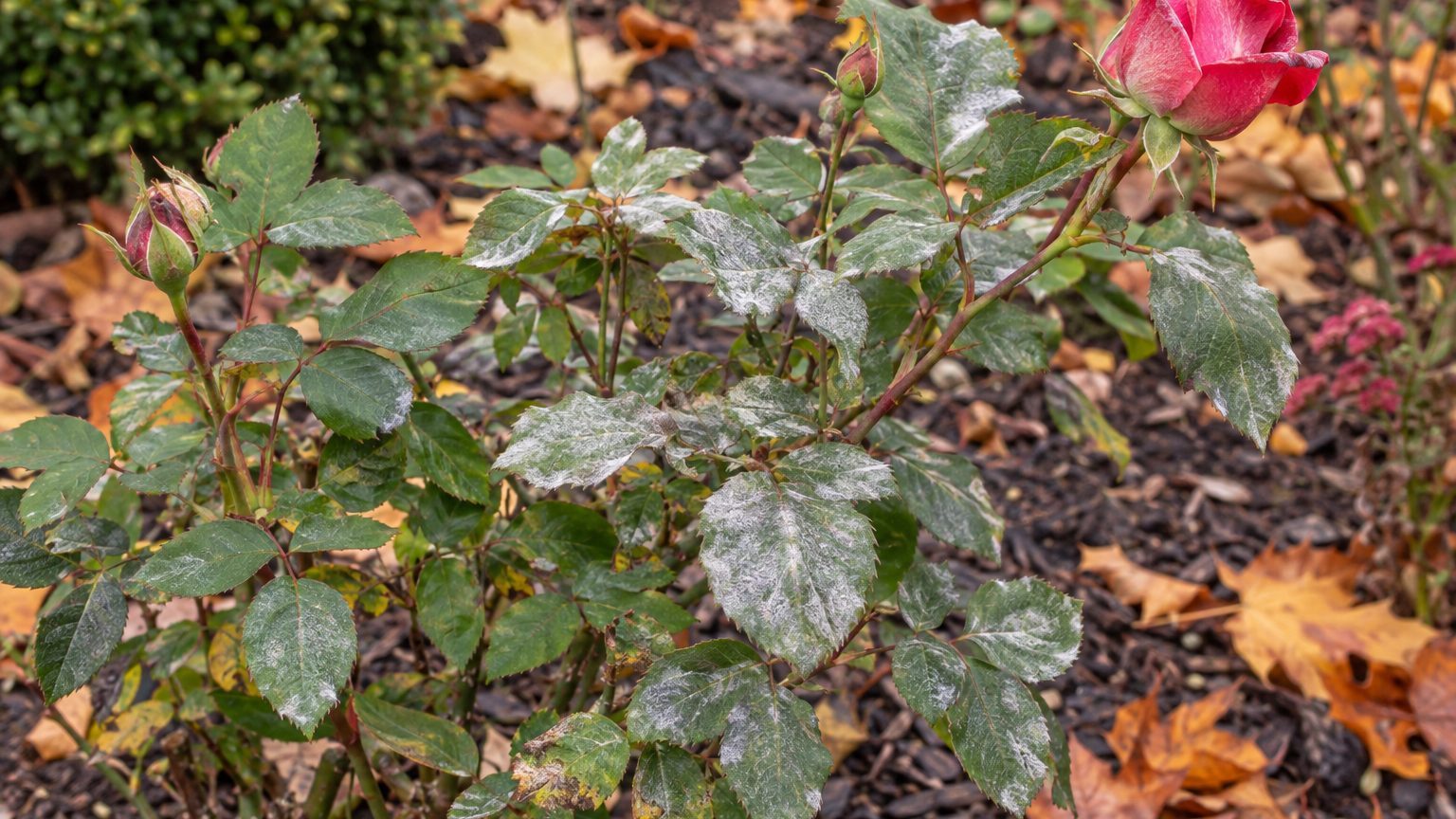
A white, dusty film on new rose leaves and buds is powdery mildew. It comes from a fungus that lives on the plant’s surface, spreads on the wind, and can be slowed with well-timed garden care.
Powdery Mildew: What You See

Start with young growth, where powdery mildew attacks buds, shoots, flowers, and leaves.
- Small, round, white powdery spots appear first, and they spread until they run together.
- A grayish-white mat sits on the surface of young leaves, shoots and buds, and it can also coat the petals.
- In Illinois, affected leaves may become stunted or curled, turn pale yellow, and drop early.
- Flower buds may fail to open, and those that do can give poor-quality flowers.
- Older patches turn mealy or felt-like and fade from gray to tan, and tiny black dots may show on leaves or stems.
Notice what is missing: there are no black blotches, which is what separates this problem from black spot.
From the almanac
Roses in your state
The dates on this page depend on where you live. Your state's page carries its frost dates, its USDA zones and the year laid out month by month.
Northeast
Southeast
- Alabama
- Arkansas
- Delaware
- Florida
- Georgia
- Kentucky
- Louisiana
- Maryland
- Mississippi
- North Carolina
- South Carolina
- Tennessee
- Virginia
- West Virginia
Midwest
Southwest
West
Pacific Northwest
Canada
Powdery Mildew or Something Else?
Different rose troubles leave pale or spotted foliage, so no clue is decisive by itself. Pair what the leaf looks like with where it appears and what the weather has been doing.
Downy mildew is a common look-alike because it also affects roses and has a similar name.
| Looks like | How to tell them apart |
|---|---|
| Downy mildew | Starts as an oily spot on the leaf, in roses as in grapes, rather than a dry white powder on the surface. |
| Black spot | Shows black blotches on the leaves, while powdery mildew is a white powder without those blotches. |
| Mildew from the vegetable patch | Watermelon powdery mildew will not infect roses, though it hits cantaloupe and squash, so a mildewed squash plant nearby is not the source. |
Because each powdery mildew fungus sticks to its own kind of plant, the white film on your squash and the film on your roses are separate problems.
What Causes Powdery Mildew, and Where It Is Worst
The cause is a fungus. In California, on roses it overwinters as strands inside plant buds or as small black fruiting bodies called chasmothecia, which release the spores that first infect plants in spring. In South Carolina, spore production begins once daytime temperatures climb above 60°F, and wind and splashing rain carry spores to new growth.
Weather sets the pace, and it differs by place. In South Carolina, it can appear almost anytime in the growing season when temperatures are mild, from 70 to 80 °F, with humid nights and drier days. In Oregon, it tends to arrive as the season moves into summer’s driest stretch, especially when dry days are followed by humid nights. In Utah, it generally shows up in late summer and early fall, when days are warm and nights are cool.
Shade makes it worse, as do cooler periods and heavy dews, which encourage spores to form and infect. Rose varieties differ greatly in how susceptible they are, so a bush that struggles every year may simply be a poor match for your yard.
How to Treat Powdery Mildew
Start with the plant itself, then bring in a spray only if your state’s guidance supports it.
- Clip off badly affected shoots and leaves, so that fewer spores are left to spread to healthy growth.
- Bag the clippings and send them out with the trash rather than composting, because spores travel by wind and can resettle on nearby plants.
- Thin crowded stems so sun reaches the center and air moves through, which lets foliage dry quickly after rain or irrigation.
- Water at the base of the plant and early in the day, so that leaves are not left damp through the humid night hours.
- Contact your state’s extension service to find out which fungicides are approved and labeled for roses where you live, so that you buy only what is legal and suited to your bush.
Cutting back does not cure leaves that are already coated, but it slows the spread to new growth. Check the bush regularly through the weeks when weather favors the fungus, since new shoots are the first to be hit.
How to Prevent Powdery Mildew Coming Back
Prevention follows the rose year, with each task timed to support the plant.
- In Oregon, remove fallen leaves and diseased stems during late-winter cleanup so that overwintering spores have less to cling to.
- Before spring growth, space or thin plants so sun penetrates and air circulates around every bush.
- In California, begin watching new shoots and buds as the weather warms in spring, when the first spores are released.
- Through summer, water at the soil line and avoid wetting leaves late in the day, so that foliage is dry before humid nights.
- When you plant new roses, choose a sunny spot rather than shade, since shade favors the disease.
When adding a rose, ask your state extension service or a local nursery about varieties that do well in your area, because susceptibility varies so widely.
Where This Comes From
Confirm timing and product rules with your own state’s extension service, since conditions and approved treatments differ from place to place.
Common Questions
Can Powdery Mildew from Other Plants Spread to Roses?
Usually not. Each powdery mildew fungus affects specific kinds of plants, so mildew on cucurbits will not move to roses. Roses do share the disease with some other plants, including oak, sycamore, crape myrtle and euonymus, but the fungus on each stays tied to its own host.
Does Powdery Mildew Kill Roses?
The disease can be serious on woody plants like roses, where it attacks buds, shoots, flowers and leaves. The usual damage is distorted leaves, early leaf drop, and poor flowering.
Why Does Powdery Mildew Show Up When Leaves Are Dry?
Unlike many leaf diseases, it does not need a soaked leaf. Dry days followed by humid nights favor the disease; heavy dews also help spores form and infect, so dry-looking weather can still bring it on.