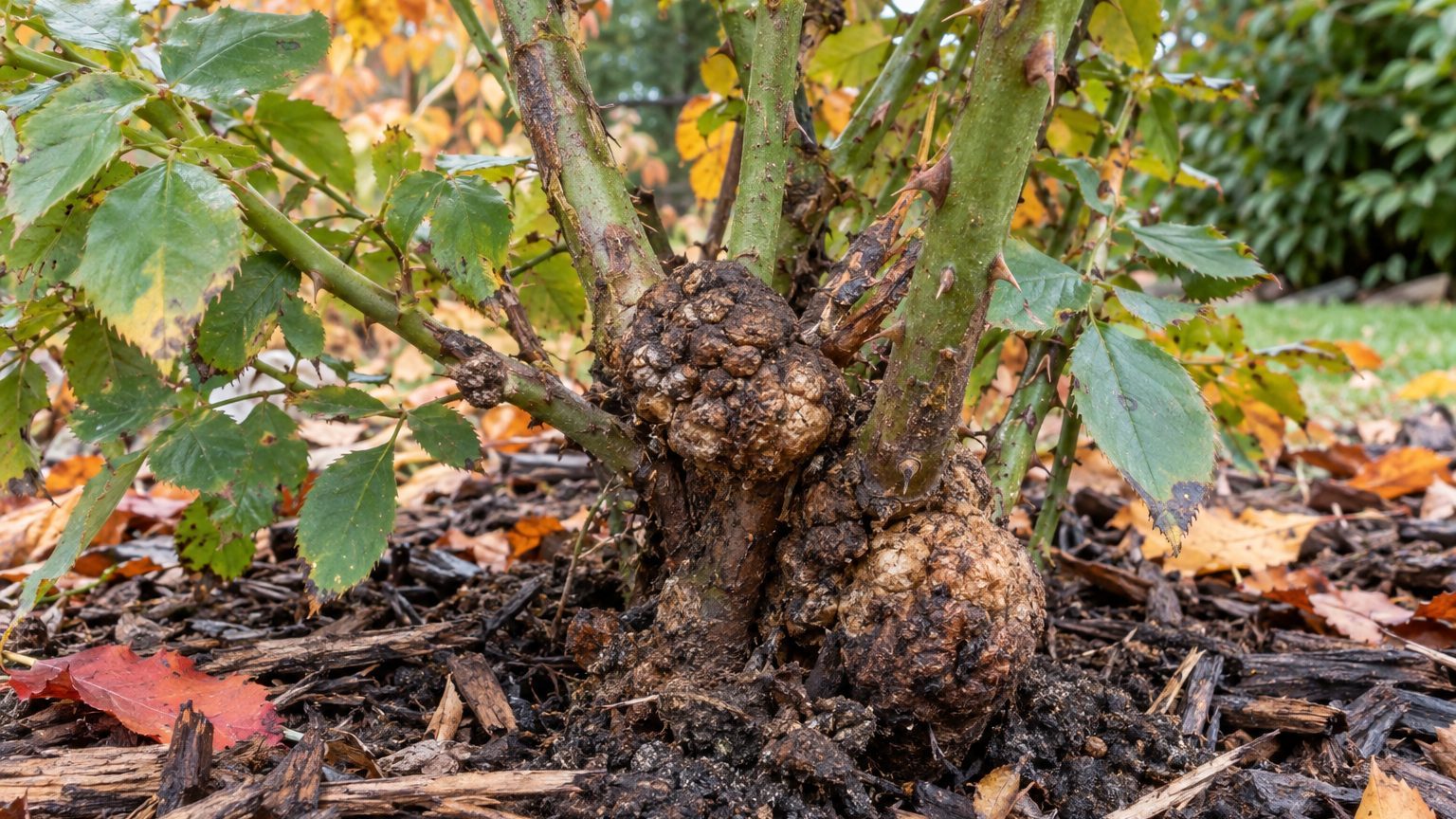
A hard, lumpy swelling at the base of a rose cane, right where it meets the soil, tends to turn up while you mulch in spring or tidy the bed in fall. That growth is usually crown gall, a bacterial disease of roses.
Crown Gall: What You See

The clearest sign is a rough, rounded growth on the plant, and it helps to know how that growth changes with age.
- Crown gall is solid throughout, unlike the hollow chambers of an insect gall.
- A young gall is light tan or fleshy white, smooth, and somewhat spongy to the touch.
- An older gall turns brown to black, hardens into a woody or corky lump, and often cracks and sloughs off in pieces.
- Most sit at the soil line or at the graft union, but galls also form on roots, on canes, and on twigs well above the ground.
- Size runs from less than an inch to several inches across.
- Canes on an infected plant can look stunted and discolored.
Galls have also been reported at pruning sites, so check old cuts as well as the base.
From the almanac
Roses in your state
The dates on this page depend on where you live. Your state's page carries its frost dates, its USDA zones and the year laid out month by month.
Northeast
Southeast
- Alabama
- Arkansas
- Delaware
- Florida
- Georgia
- Kentucky
- Louisiana
- Maryland
- Mississippi
- North Carolina
- South Carolina
- Tennessee
- Virginia
- West Virginia
Midwest
Southwest
West
Pacific Northwest
Canada
Crown Gall or Something Else?
Lumps on a rose are not all crown gall. Insect galls are the usual confusion, and a healing swelling at a graft union or pruning cut can fool you too, since crown gall may appear in those same spots.
Location alone never settles it, so pair what you see on the outside with what you find inside.
| Looks like | How to tell them apart |
|---|---|
| Insect gall on a stem | Crown gall is solid throughout, and an older one is dark and corky outside but light-colored inside. |
| Rough knob at the soil line | Look at the surface and the age. Crown gall starts light tan or white and spongy, then darkens, hardens, and cracks. |
If a swelling at a graft union or pruning cut still leaves you unsure, your state extension service can confirm what it is.
What Causes Crown Gall, and Where It Is Worst
A soil-dwelling bacterium, Agrobacterium tumefaciens, causes the disease. It occurs worldwide and attacks over 600 plant species in more than 90 plant families, so no region is clear of it. It is common in agricultural soils, and rose is named among the commonly infected plants in Illinois.
The bacterium is a weak pathogen and cannot simply walk in. It needs a natural opening or a fresh wound less than twenty-four hours old, on the crown, the roots, or the branches. Once inside, it passes some of its genetic material into the plant’s cells, which then build the gall. Water moving through infected soil can carry the bacteria along.
Roses are especially vulnerable because the disease is especially common in the rose family. Plants growing nearby can carry it too, including:
- Cherry, apple, peach, pear, and plum
- Raspberry and blackberry
- Euonymus
A rose planted beside an infected plant from this list has more reason to be watched.
How to Treat Crown Gall
No gesture here promises a cure, so the aim is to confirm the problem, limit damage, and keep from spreading it.
- Do not cut into a swelling on a living rose just to identify it; the cut leaves a fresh wound.
- Check the crown, the roots if you can see them, and every cane, so you know how far the galls reach.
- Ask your state extension service whether cutting galls out of a cane is worth trying on your plant, since a fresh cut is itself a new wound.
- Remove the plant, roots included, if a gall circles the lower stem or main roots, because in Texas that kind of girdling is reported to kill the plant.
- Clean and sanitize pruning tools and spades after working near a gall before using them around healthy roses.
- Bag the removed canes or plant and keep them out of the compost, so the galls do not sit near healthy roots.
A young rose that was infected early may stay stunted and never grow properly, as reported in California. A stunted plant like that is often better replaced than nursed.
How to Prevent Crown Gall Coming Back
Because the bacterium only gets in through wounds, prevention comes down to when and how you cut and dig around your roses.
- At planting time, look over the canes and roots for swellings and leave any gall-bearing rose at the nursery.
- As buds swell, prune repeat-blooming roses with clean, careful cuts and keep each cut to what the plant needs.
- Right after bloom, prune once-blooming roses the same careful way, since they flower on last year’s wood.
- Through the growing season, keep spades, edgers, and weed trimmers away from the crown, so you do not open fresh wounds.
- Check that runoff from a bed with a diseased plant does not flow toward your roses.
- In fall cleanup, look at the base of every cane before you mulch, because a young gall is easier to spot.
Keeping roses away from infected neighbors in the yard helps protect them.
Where This Comes From
These notes draw on plant disease pages from university extension services and government sources in Illinois, Maine, South Carolina, Washington, California, and Texas.
Rules and timing vary from place to place, so confirm details with your own state’s extension service before you dig anything out.
Common Questions
Will a Rose with Crown Gall Die?
Not always. The galls disrupt the flow of water and nutrients up from the roots, which weakens and stunts the top of the plant. Death is the risk when a gall girdles the lower stem or main roots.
Can You Plant a New Rose Where an Infected One Grew?
Susceptible plants should not go into infested soil or next to infected plants. Rose is one of them, so choose a different spot or ask your extension service what to plant there.
Are Galls on the Canes as Serious as Galls at the Soil Line?
Galls higher up on twigs and branches come from the same bacterium and are just as much a sign of infection. Those at the base usually draw more attention because they sit on the crown and main roots. Either location deserves a close look and a call to your extension service.