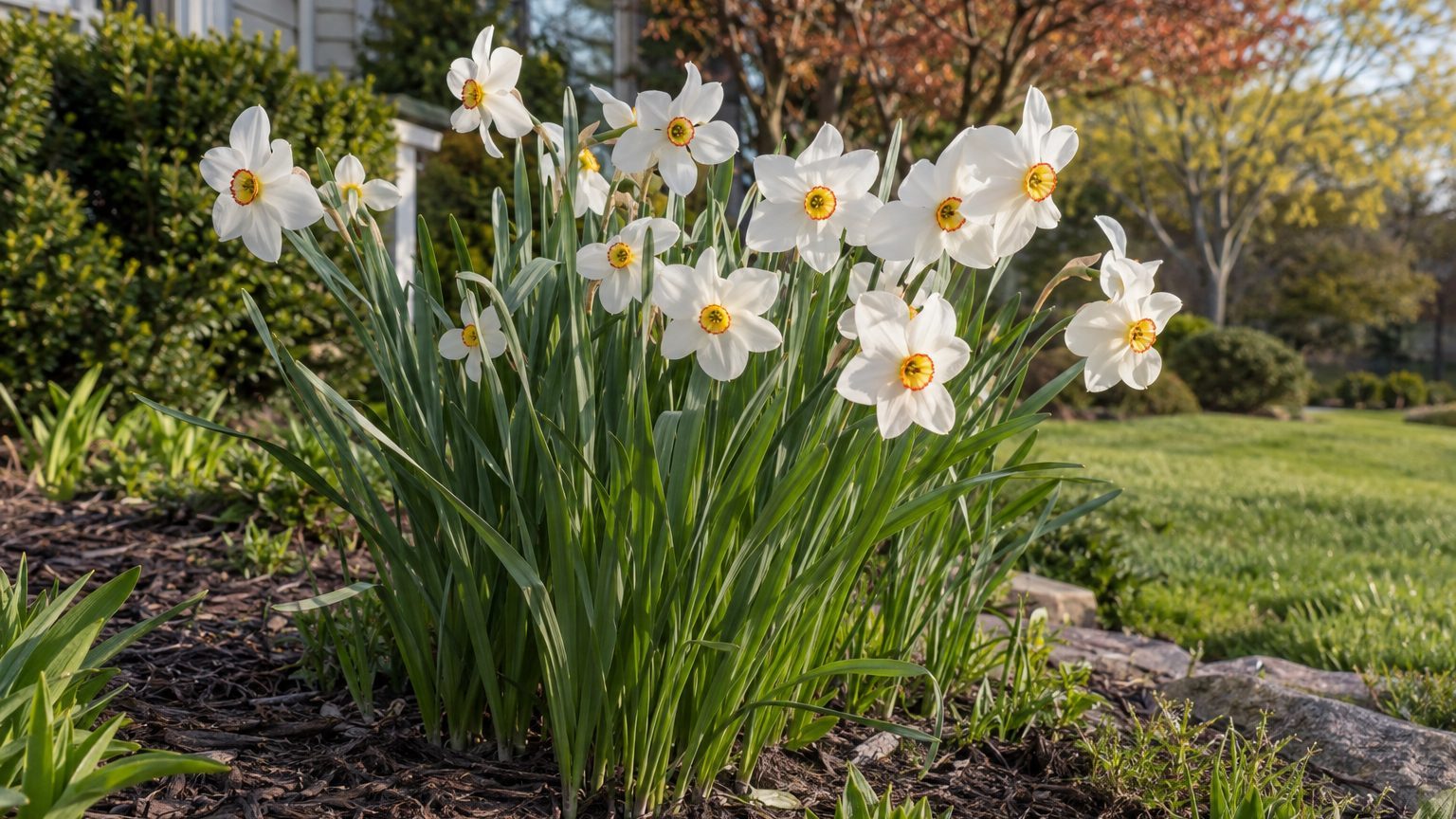
A pheasant’s eye daffodil opens white petals around a small yellow cup edged in red, and the scent carries across the yard. It is a spring bulb you plant in fall and then mostly leave alone.
What Is the Pheasant’s Eye Daffodil?
Pheasant’s eye daffodil, also sold as poet’s narcissus (Narcissus poeticus), is a herbaceous perennial bulb in the onion family. It tops out at 1 foot 5 inches, so it sits comfortably at the front of a border.
The flower is easy to recognize. White petals surround a yellow corona rimmed in red, which is what gives the plant its name and sets it apart from solid yellow daffodils.
It blooms in mid spring and the flowers are strongly fragrant. The bulb spreads over time, which is why it suits naturalizing.
From the almanac
Bulbs in your state
The dates on this page depend on where you live. Your state's page carries its frost dates, its USDA zones and the year laid out month by month.
Northeast
Southeast
- Alabama
- Arkansas
- Delaware
- Florida
- Georgia
- Kentucky
- Louisiana
- Maryland
- Mississippi
- North Carolina
- South Carolina
- Tennessee
- Virginia
- West Virginia
Midwest
Southwest
West
Pacific Northwest
Canada
Where Does the Pheasant’s Eye Daffodil Grow Best?
This bulb is hardy in USDA zones 3a, 3b, 4a, 4b, 5a, 5b, 6a, 6b, 7a, 7b. That spans very cold winters to moderate ones, so a large share of American yards falls inside the range.
Within those zones it does well planted in masses, along the front of borders and under trees. Under trees it gets its spring show before the canopy fills in, which suits a bulb that blooms in mid spring.
Most spring bulbs need about 12 to 16 weeks of cold to flower. In zones at the warm end of the range, winters that stay mild can leave a spring bulb with too little chill, and the page for your state tells you how your area compares.
How to Plant and Care for the Pheasant’s Eye Daffodil Through the Year
Fall
Plant once the soil has cooled below about 60°F. Roots then have time to form before the ground freezes, and the bulbs do not send up shoots too early. Set the bulbs in groups rather than single rows, since this daffodil looks best as a drift.
Winter
Nothing needs doing. Skip winter fertilizer and let the ground rest.
Mid Spring Bloom
Flowers open in mid spring, and the fragrance is strongest on warm days. Plant a clump near a path or a patio where you will catch the scent. Cut a few stems for a vase if you like, and leave the foliage in place.
After Bloom
Remove only the faded flowers. Leave the leaves on the plant until they turn brown, because they are feeding the bulb for next spring. Cutting or tying green leaves shortens that feeding and weakens next year’s bloom.
Summer
Once the foliage has browned, it pulls away easily and you can tidy it. The bulbs rest underground until the next cycle. Because the plant spreads, a patch tends to widen with time, so plan neighboring perennials that will cover the gap left by the fading leaves.
Pheasant’s Eye Daffodil Weak Points: Animals, Diseases and Staying Power
This is a low-trouble bulb. Its tissues carry poisonous alkaloids, and that is why pests and disease leave it largely untouched.
The same chemistry keeps animals away, and daffodils tend to last far longer in the ground than tulips do.
| Issue | How the Pheasant’s Eye Daffodil handles it |
|---|---|
| Pests and disease | Resistant because of its poisonous alkaloids |
| Voles, squirrels, rabbits and deer | Daffodils are left alone, unlike tulips and crocus |
| Return from year to year | Lasts longer than tulips and spreads to form larger clumps |
Because the bulbs are poisonous, keep them out of reach of pets and children who might chew a bulb.
Is the Pheasant’s Eye Daffodil Right for Your Yard?
It suits a yard where you want a fragrant, white and yellow patch that returns on its own. It is less suited to a spot that needs lasting color through the whole season, since the bloom is a mid spring event.
- Gardeners in the colder zones and in moderate ones through 7b will find it dependable.
Common Questions
Can You Grow Pheasant’s Eye Daffodil in a Pot?
Yes. It does well in containers as well as in the ground. Use a pot with drainage holes, and let the leaves die back naturally after bloom, as you would in a border.
What If the Bulbs Are Still in the Bag After the Soil Has Cooled?
Plant them anyway. A bulb in the ground, even a late one, has a better chance than one stored over winter, so keep digging as long as the soil is workable.
Will Pheasant’s Eye Daffodil Spread on Its Own?
It has a spreading habit and is good for naturalizing, so the planting thickens over the seasons. Under trees and along the front of borders, you can leave the clumps in place and let them fill in.