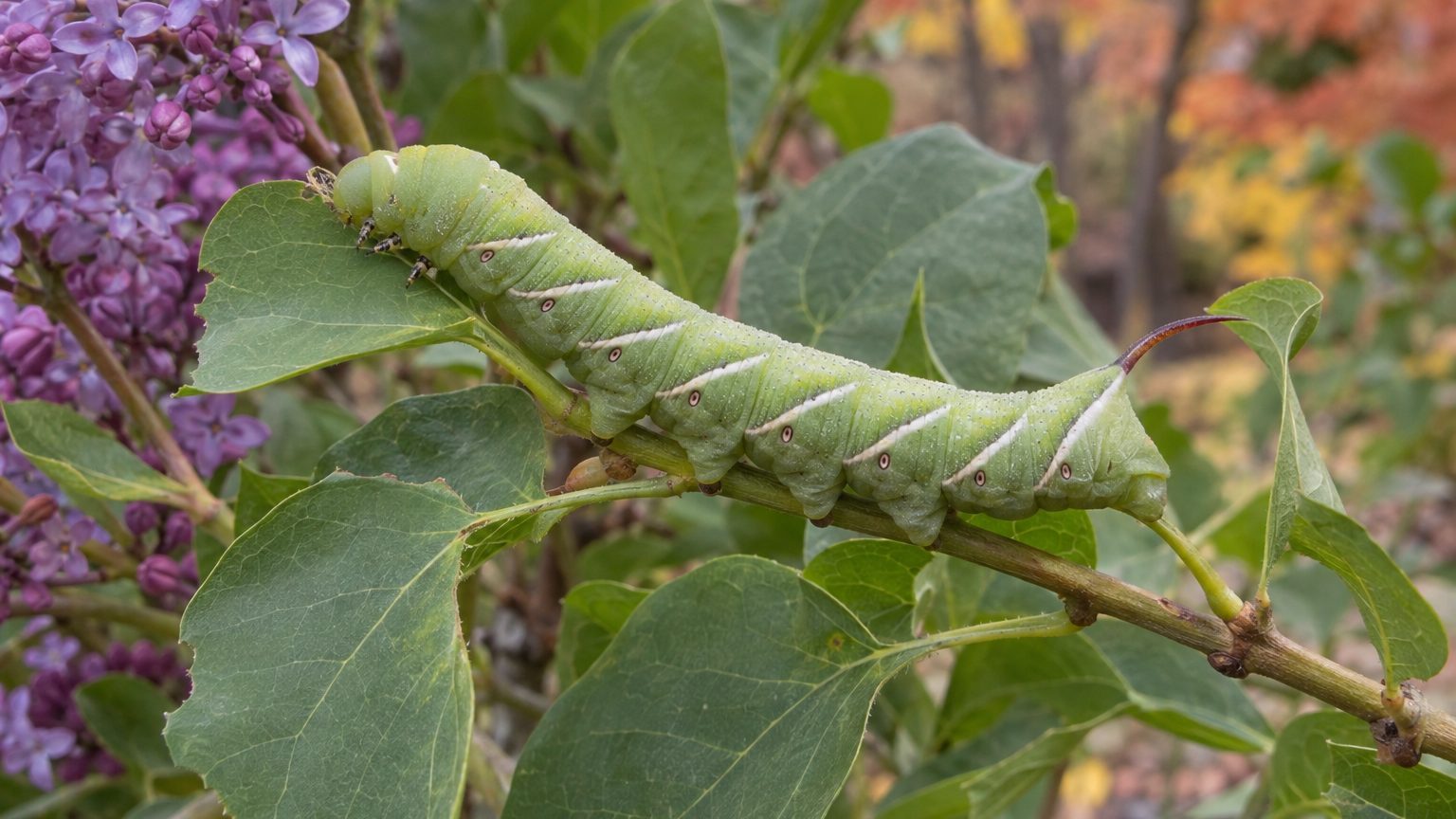
A lilac that loses vigor stem by stem, with swollen areas on the bark and emergence holes, may be hosting a borer rather than suffering from drought or disease. The damage comes from the larva of the lilac borer, a clearwing moth rather than a sphinx moth.
Lilac Sphinx Moth Caterpillars: What You See

The caterpillar itself stays hidden in the wood, so you spot it mostly through the marks it leaves on the stems.
- Inside a cut or split stem, the larva is white with a brown head and grows to about an inch long.
- Swollen, unsightly areas on the stems mark the places where borers are working.
- Small emergence holes appear in the bark, and the empty pupal skins often stay stuck to the bark at those holes.
- Larger lilac stems are the ones attacked, so check the thick canes first.
- The adult is a clearwing moth with brown forewings and clear hind wings, and it looks like a paper wasp.
- The plant weakens gradually as the tunnels spread under the bark.
The adult is the part of the life cycle you may notice flying around the shrub, but the larval stage is the one that does the harm.
From the almanac
Lilacs in your state
The dates on this page depend on where you live. Your state's page carries its frost dates, its USDA zones and the year laid out month by month.
Northeast
Southeast
- Alabama
- Arkansas
- Delaware
- Florida
- Georgia
- Kentucky
- Louisiana
- Maryland
- Mississippi
- North Carolina
- South Carolina
- Tennessee
- Virginia
- West Virginia
Midwest
Southwest
West
Pacific Northwest
Canada
Lilac Sphinx Moth Caterpillars or Something Else?
The adult moth can be mistaken for a paper wasp. It behaves and looks so much like a wasp that people often mistake it for a stinging insect near the shrub.
| Looks like | How to tell them apart |
|---|---|
| Paper wasp hovering around the lilac | Look for brown forewings with clear hind wings, and note that it cannot sting. It is active around the bark in April and May in North Carolina. |
| Leaf-eating caterpillar on the foliage | A caterpillar chewing leaves in the open is a different insect. The borer larva stays inside the stem, where you find it only by splitting the wood, and it leaves swollen bark with emergence holes. |
Ordinary stem dieback from drought or winter injury can also look similar from a distance. Check the base of the dying stem for holes and pupal skins before blaming the weather.
What Causes Lilac Sphinx Moth Caterpillars, and Where It Is Worst
The cause is the adult moth. Females lay eggs in cracks, crevices and damaged areas of the bark, often at the base of major branches. The eggs hatch soon after, and the tiny larvae tunnel under the bark and feed on the layer that carries sap.
Rough bark and wounds are the invitation. A stem scarred by a mower, a trimmer or a broken branch gives the female a place to lay. Ash and privet are attacked the same way as lilac.
Timing shifts with the place. In North Carolina, adults emerge in April and May to mate and lay. In Iowa, the moths emerge in mid-May.
How to Treat Lilac Sphinx Moth Caterpillars
Treatment starts with confirming the borer and then removing what it has already damaged.
- Inspect the base and the thickest stems for swollen areas, emergence holes and pupal skins, so that you treat the right pest.
- Mark the infested stems, so that you can find them again after the leaves drop.
- Remove badly damaged stems only with timing suited to the lilac’s bloom habit and local moth activity.
- Remove the cut wood from the yard or destroy it, because larvae left in a brush pile can still finish their cycle.
- Check the remaining stems for fresh wounds and leave the healthy bark alone, so that the female has no new place to lay.
- Ask a qualified local gardening professional which controls are legal and appropriate where you live.
Infested stems may continue to weaken as larvae tunnel through the wood.
How to Prevent Lilac Sphinx Moth Caterpillars Coming Back
Prevention centers on avoiding bark wounds and watching for adult activity.
- In late winter, walk the shrub and look for emergence holes and pupal skins from last year, so you know whether borers are present before the moths fly.
- In April and May, avoid cutting into lilac, ash or privet bark, because fresh wounds attract egg-laying females during the flight period in North Carolina.
- Through spring and summer, keep mowers and string trimmers away from the base of the stems, since scarred bark gives the moth a place to lay.
- Remove infested cut wood from the yard, because larvae overwinter inside the wood near the ground.
Avoid bark wounds, because females lay eggs in cracks, crevices and damaged areas.
Common Questions
How Many Generations Do Lilac Borers Have in a Year?
There is usually only one generation per year. In the northern part of the range, a two-year cycle can occur, so signs may show up less often there.
Where Do Lilac Borers Spend the Winter?
They overwinter as larvae in the wood, usually near the ground. In Idaho, after a summer feeding under the bark, they move toward the heartwood for winter.
Which Other Plants Do Lilac Borers Attack?
The larvae damage lilac, ash and privet. If you grow any of these near each other, check all of them for swollen bark and emergence holes.
Where This Comes From
The details here come from university extension pages written for North Carolina, Idaho and Iowa. Local timing varies, so confirm dates and approved controls with your own state’s extension service.