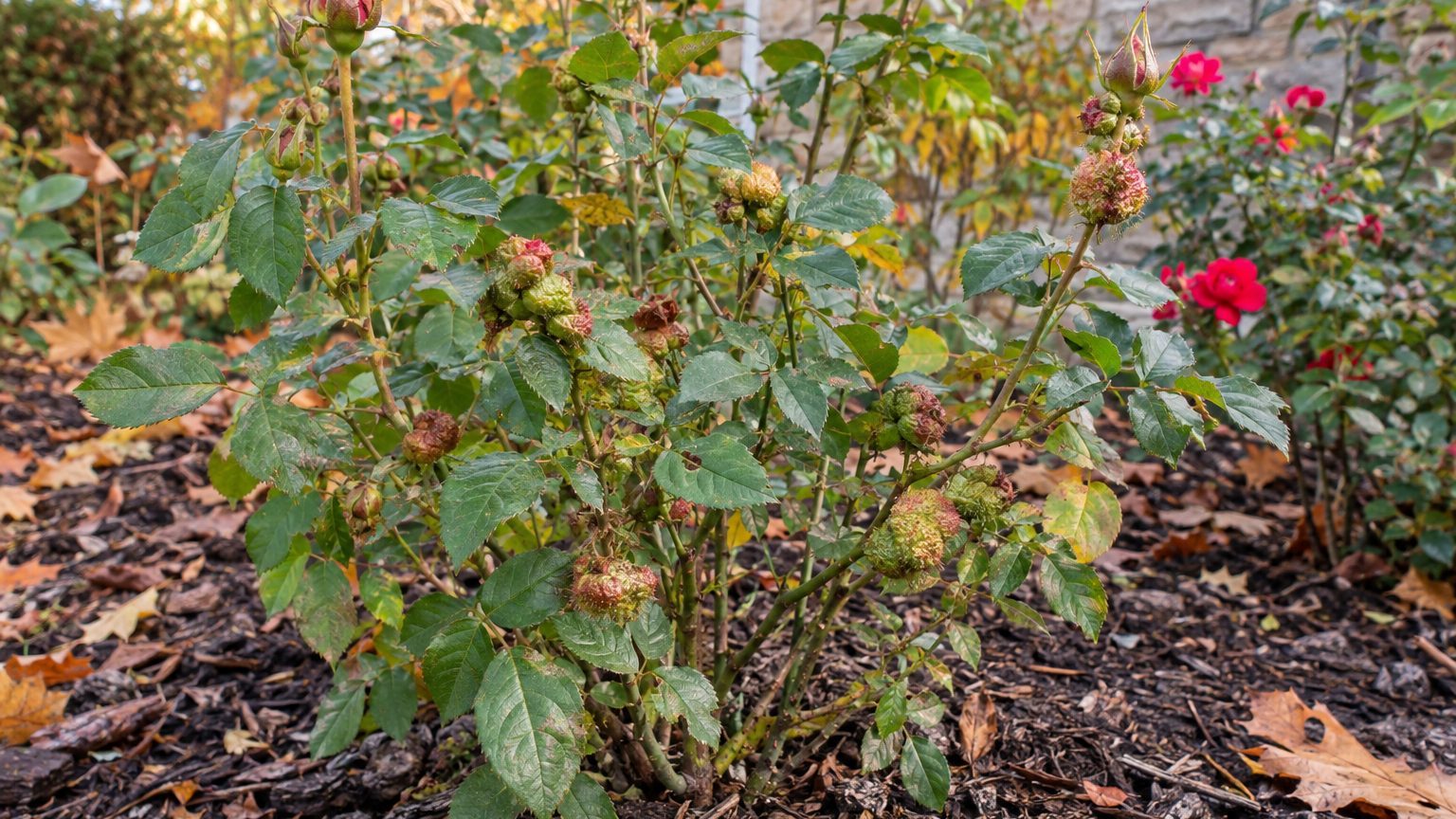
Roses that form fat, healthy-looking buds and then stall can have several causes. Opening one affected bud is a quick way to check whether thrips are the problem. Dry soil, wet weather and fungus can also hold buds closed.
Rose Buds Not Opening: What You See

A useful clue is a bud that sits closed while its neighbors open, and the details around it can point to the cause.
- A bud that stays shut or droops, and when you pull it apart, yellow or black insects run between the layers of petals.
- Buds that look deformed or fuse together, which can follow weather that was unusually cold and wet while they were forming.
- Buds that turn brown or black, wither, or drop before they are fully developed, often on new growth that looks distorted.
- Spotted petals with woolly gray fuzz on decaying tissue, or blotched petals and drooping buds in warm weather.
- Small holes or tunnels in the petals of a bud that will not open.
Check whether every bud is affected or only some, because that detail narrows the cause quickly.
From the almanac
Roses in your state
The dates on this page depend on where you live. Your state's page carries its frost dates, its USDA zones and the year laid out month by month.
Northeast
Southeast
- Alabama
- Arkansas
- Delaware
- Florida
- Georgia
- Kentucky
- Louisiana
- Maryland
- Mississippi
- North Carolina
- South Carolina
- Tennessee
- Virginia
- West Virginia
Midwest
Southwest
West
Pacific Northwest
Canada
Rose Buds Not Opening or Something Else?
Several problems leave a bud shut or ruined, and they call for different fixes. Look at the bud’s color and texture, then at where on the plant the damage sits and what the weather has been doing.
| Looks like | How to tell them apart |
|---|---|
| Rose midge damage | Buds blacken, wither and fall, and shoots may be blind with no buds at all; tiny white maggots feed in the tips of new growth. |
| Botrytis blight | Gray-brown fuzzy growth on decaying tissue with blotched petals, mostly in spring and fall in most of California, or in summer along cool, foggy coasts. |
| Beetle feeding | Tunneling or holes in the petals, and no insects running between the petal layers when you open the bud. |
Herbicide drift from your own spraying or a neighbor’s can also distort buds, so think about what has been applied near the bushes. Aphids and mites are worth a look too.
What Causes Rose Buds Not Opening, and Where It Is Worst
Thrips can interfere with a bud opening. These insects live inside the bud and can keep it from opening, and in some cases the plant gives no other obvious reason. Weather, thirst and fungus are the other common contributors.
Rose midge is a tiny fly whose females lay eggs in developing buds. The white larvae feed on the tissue, and there are several generations per year. The insect overwinters in cocoons in the soil, and once it infests a garden it can be hard to get rid of.
Dry conditions slow things down as well. Where a plant relies only on rainfall and precipitation runs short, blooms can develop and open slowly. Poor nutrition is not the usual reason buds stay closed. Buds that fail to open often come with poor-quality flowers on the ones that do.
How to Treat Rose Buds Not Opening
Work from the simplest check to the larger cleanup, and verify that any treatment is approved where you live.
- Open a bud, pulling it apart or cutting it in half, to see whether yellow or black insects are moving between the petals, so that you know whether thrips are the cause.
- Clip off the buds if insects are there, so that the plant sends up a fresh batch that will hopefully carry few or no thrips.
- Feel the soil several inches deep, and soak the root zone well when it is dry to the touch, so that rain-dependent plants are not slowed by drought.
- Remove and dispose of fallen leaves and petals, and prune out infested canes, buds, and flowers as part of fungal cleanup.
- Lower the humidity around the plant by adjusting irrigation, pruning and thinning ground cover, so that gray mold has less chance to spread.
In Maryland, remove old mulch in late winter and put down fresh mulch in early spring to target midges in the soil. After disbudding for thrips, watch the next batch of buds to see whether they open normally.
How to Prevent Rose Buds Not Opening Coming Back
Prevention follows the year, with the soil work done while midges are dormant and the watering and cleanup done during the growing season.
- In Maryland, remove the mulch under and around the shrubs in late winter.
- In early spring, lay fresh mulch to bury any remaining midges even deeper, again following Maryland advice.
- Prune for open airflow and keep ground cover thin so humidity around the canes stays lower.
- Through dry spells in the growing season, check the soil by hand and soak the root zone rather than waiting for buds to stall.
- Remove fallen leaves and petals as part of fungal cleanup.
Inspect half-open buds regularly, since thrips can cause damage at that stage as well.
Where This Comes From
Local timing and treatment options vary. Confirm which treatments and dates fit your yard before you act.
Common Questions
Can You Cut Off Rose Buds That Will Not Open?
Yes. If insects are inside, clipping off the buds makes the plant produce another batch that will hopefully carry few or no thrips.
Do Buds Fail to Open Because of Poor Feeding?
A lack of nutrients is not the usual issue. Check for insects, dry soil and fungus first.
Can a Neighbor’s Spraying Affect Your Roses?
It can. Herbicide that drifts onto the bushes is one potential cause of distorted buds, so think about what has been applied nearby.