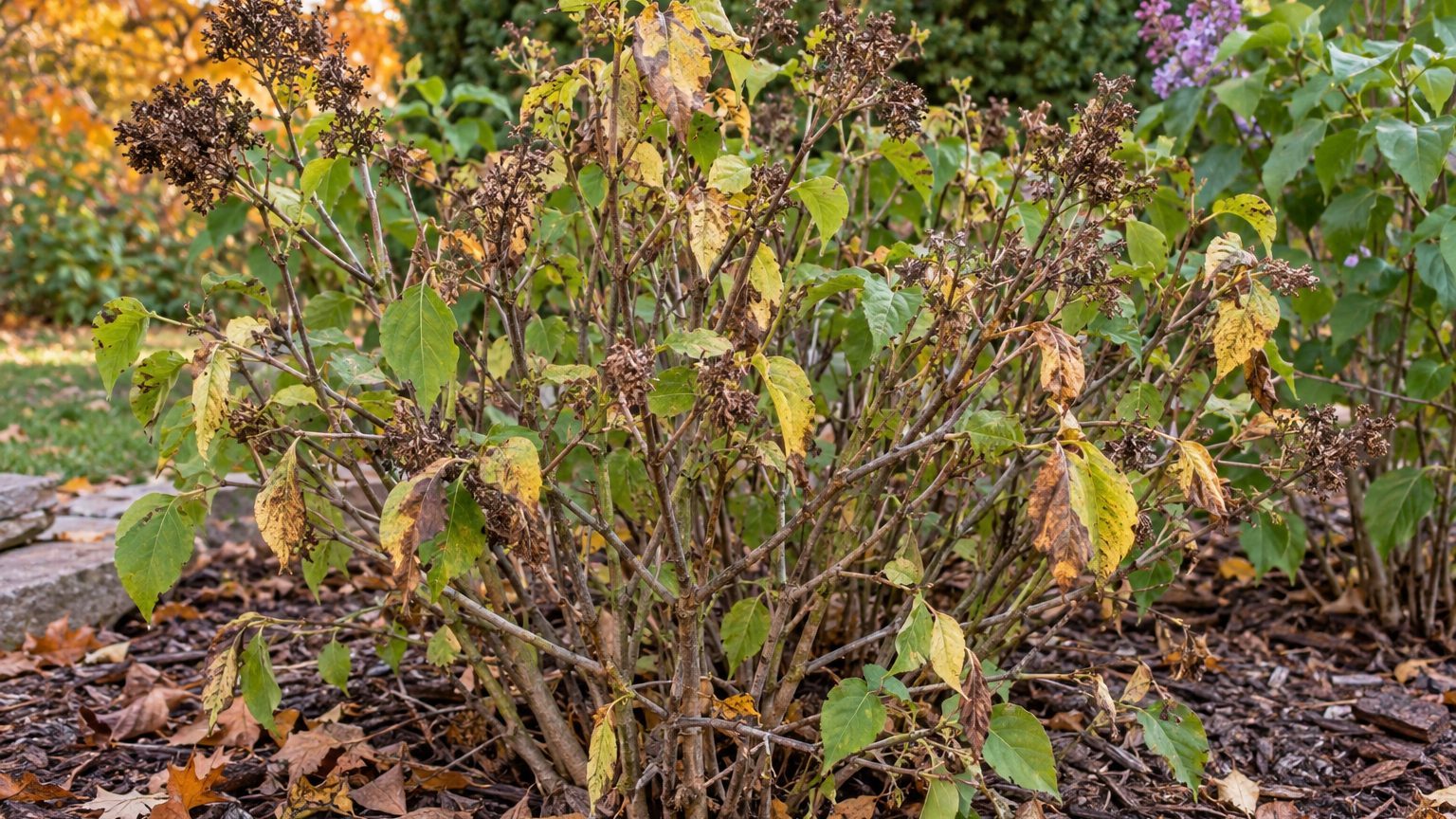
Lilac stems can turn dark and wilted when something damages the shoots, wood or roots. Sometimes the damage is a disease moving through the leaves and shoots. Sometimes it is a borer working inside the wood, or roots that have sat too long in wet ground. Each one leaves a different trail.
Lilac Branches Dying: What You See

Bacterial blight can cause these symptoms, appearing on leaves and young shoots before a whole branch dies back.
- Leaves look healthy at first, then suddenly appear singed, as if an open flame had passed over them.
- Dark black streaks form on one side of young shoots.
- Leaf spots are brown with a yellowish halo, and they can merge into dark brown to black patches that die quickly.
- Flowers wilt and turn brown, and unopened buds blacken.
- Dead leaves often dry up fast and stay hanging on the branch instead of dropping.
Left alone, spotting that starts on the leaves can progress to fully brown foliage and branches dying back.
From the almanac
Lilacs in your state
The dates on this page depend on where you live. Your state's page carries its frost dates, its USDA zones and the year laid out month by month.
Northeast
Southeast
- Alabama
- Arkansas
- Delaware
- Florida
- Georgia
- Kentucky
- Louisiana
- Maryland
- Mississippi
- North Carolina
- South Carolina
- Tennessee
- Virginia
- West Virginia
Midwest
Southwest
West
Pacific Northwest
Canada
Lilac Branches Dying or Something Else?
Blight is not the only reason a lilac stem fails. Borers tunnel inside the wood, and waterlogged roots can leave the top of the plant unable to cope with summer heat.
A useful way to sort them out is to look at the base of the stem and at the ground around it, not only at the leaves.
| Looks like | How to tell them apart |
|---|---|
| Borer damage | The base of the stem is swollen and dotted with ¼ inch exit holes, with sap, sawdust and frass oozing out. Reddish-brown pupa cases sometimes poke from the holes. |
| Root suffocation from soggy soil | Water stands on the spot after a rainstorm, and in Illinois the leaves dry up and hang on once hot, dry summer weather arrives. |
Blight can also resemble fire blight on fruit trees, since the blackened, scorched look is much the same. Spots on the leaves and streaks on the shoots point toward blight rather than borers or roots.
What Causes Lilac Branches Dying, and Where It Is Worst
Bacterial blight is caused by a bacterium, Pseudomonas syringae pv. syringae. It causes leaf spots, blossom blast, shoot blight and canker, and it can enter stems through the leaves or straight through the bark.
In Oregon, cool, wet springs favor it, especially when rain follows a late frost or winter injury. Chinese, Japanese, Persian and common lilacs are the more susceptible ones, especially white-flowered varieties.
The same disease also affects walnut, apple, pear, plum and cherry, so a lilac near fruit trees is not isolated from it. Extra nitrogen, particularly on young plants, favors the disease too.
Borers and wet roots add their own trouble. Lilacs want soil that drains well and sits between slightly acid and alkaline, and spots where water stands after a storm are poor places for one. Excessive rain can saturate the ground and suffocate part of the root system.
How to Treat Lilac Branches Dying
Blight is hard to control, so treatment is mostly about removing what is infected and easing the conditions that helped it spread.
- Cut out infected shoots and branches as soon as you notice them, so that the bacteria have less tissue to spread from.
- Destroy the cuttings, burning them where local rules allow, because leaving them under the shrub keeps the problem close.
- Water at the base and skip overhead irrigation, because wet leaves make it easier for the disease to get in.
- Avoid overfertilizing young plants, since excess nitrogen favors blight, and avoid injuring the plant while you work.
- Open up crowded stems to improve air circulation, which helps foliage dry faster after rain.
- Look at the base of the stem for swollen spots with exit holes, and test the soil if it is acidic, so that you know whether borers or the site itself are part of the story.
Your state extension office can tell you whether any spray is labeled for lilacs where you live, and when it would apply.
How to Prevent Lilac Branches Dying Coming Back
Prevention follows the season, and most of it comes down to keeping the plant healthy, because healthy plants resist disease better.
- When planting, choose resistant varieties and give each lilac room, since blight is hard to control once it is established.
- In Oregon, ask whether a preventive treatment is labeled for lilacs before buds break in early spring; elsewhere, ask your state extension office about local timing.
- For a once-blooming lilac in Maryland, prune after flowering in early summer, removing ⅓ of the oldest stems at ground level each year. Lilacs left unpruned turn leggy and unproductive.
- Through the growing season, water at the base and keep nutrition steady without overfeeding.
- Avoid fertilizing late in the season because excess nitrogen favors disease development.
Cutting the whole shrub to the ground may sound like a clean start, but you will not have blooms for a couple of years.
Where This Comes From
The guidance here includes information written for Oregon about cool, wet springs and fertilizer. Rules on timing and treatment vary by place, so check with your own state’s extension service before acting.
Common Questions
Is It Normal for a Lilac to Lose Its Lower Branches?
Yes. Lilacs lose their lower branches as they age, which is why a plant that has not been renewed can look bare at the bottom and leggy on top.
Can Blight on a Lilac Spread to Apple or Pear Trees?
The same bacterial disease affects apple, pear, plum, cherry and walnut as well as lilac. A lilac with blight growing near fruit trees is worth watching closely.
What Does the Adult Borer Look Like?
The adult is a clear wing moth that resembles a paper wasp, with smoky brown forewings and clear hindwings edged in brown. The larvae are creamy white with a light brown head.