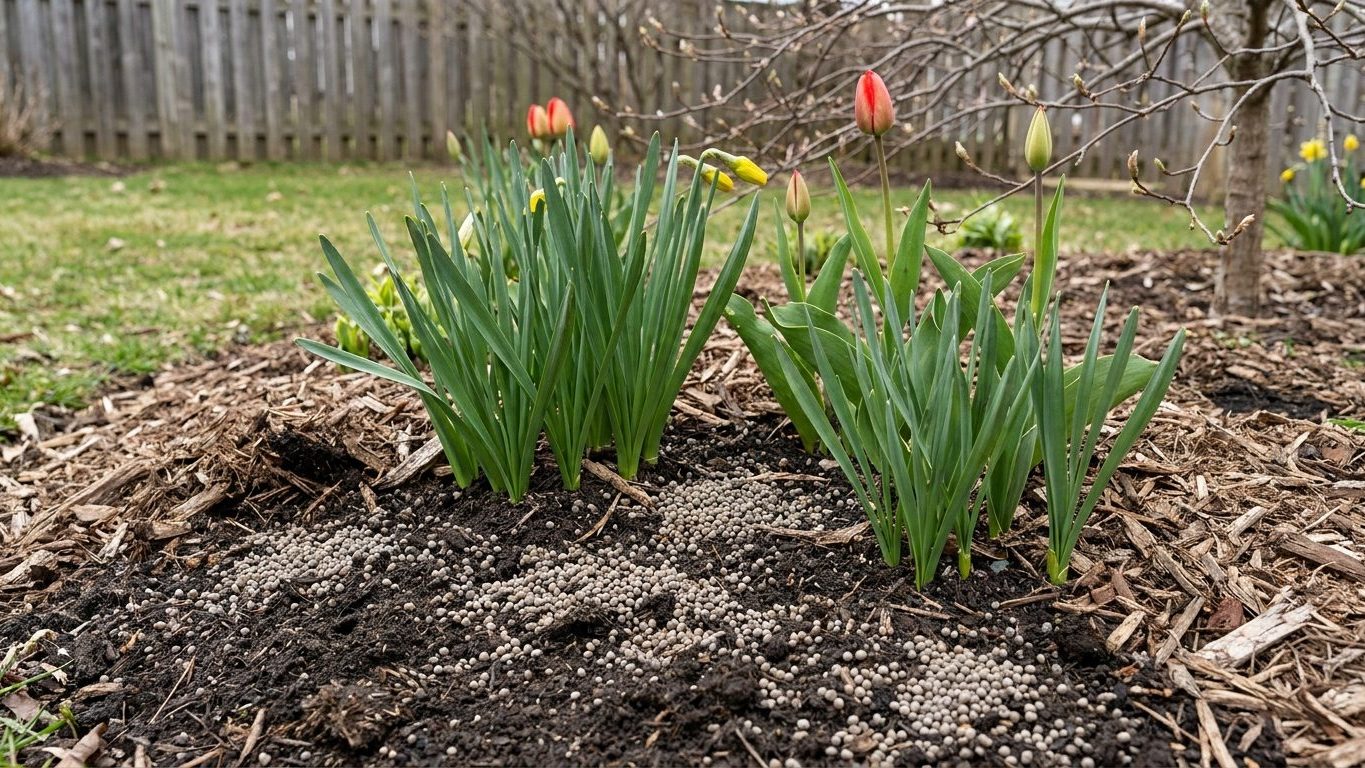
Green shoots pushing through cold soil in spring are the first sign that bulbs planted the previous fall are working. What they find in that soil decides how much energy goes into the flowers and into next year’s bulb. Fertilizing spring bulbs is a short job with a clear rhythm, and timing and amounts matter more than the label on the bag.
Do Spring Bulbs Need Fertilizer?
Often yes, though not always. A feeding at planting and another as growth starts helps bulbs rebuild for next year, but the rule shifts with the type of bulb, how long you want the planting to last, and the climate that sets your planting and growing seasons.
In Utah, tulips you plan to replace each year need no fertilizer at all. Tulips you want to return as perennials get well-rotted manure dug in during fall, then a 10-10-10 fast-release fertilizer worked in come spring.
The state selector just below this section takes you to your own state’s page.
From the almanac
Bulbs in your state
The dates on this page depend on where you live. Your state's page carries its frost dates, its USDA zones and the year laid out month by month.
Northeast
Southeast
- Alabama
- Arkansas
- Delaware
- Florida
- Georgia
- Kentucky
- Louisiana
- Maryland
- Mississippi
- North Carolina
- South Carolina
- Tennessee
- Virginia
- West Virginia
Midwest
Southwest
West
Pacific Northwest
Canada
How to Fertilize Spring Bulbs

The routine runs across fall and spring, and every step has a job to do for the bulb.
- Spread a balanced fertilizer such as 10-10-10 over the bed at planting time, so the roots have nutrients nearby as they form.
- Work it into the upper 4 to 6 inches of soil, as is done in Wisconsin, so it sits where roots grow instead of washing off the surface.
- Feed again in spring when shoots emerge in South Carolina, or while the flowers are still in the bud stage in Georgia, so the plant can use the nutrients while it builds leaves and buds.
- Add nitrogen before the foliage withers, at 1/4 pound per 100 square feet in Colorado, so the green leaves can carry it down into the bulb.
Green leaves are the bulb’s kitchen, which is why feeding belongs to fall and to the weeks when shoots and leaves are active. After the foliage has yellowed, the bulb has finished refilling, and fertilizer has no working leaves to pass through.
Fertilizing Needs by Bulb Type
Most spring bulbs share the same fall feeding, but tulips come with a choice that depends on how long you plan to keep them. Summer- and fall-flowering bulbs run on a different schedule altogether.
| Bulb Type | What changes | Why it matters |
|---|---|---|
| Tulips replaced each year | No fertilizer needed (Utah) | The bulb is discarded after one season, so there is nothing to rebuild |
| Tulips left to perennialize | Rotted manure in fall, 10-10-10 fast-release in spring (Utah) | The bulb has to refill each year to flower again |
| Summer- and fall-flowering bulbs | Feeding every 4 to 6 weeks through the growing season (South Carolina) | These bulbs grow through the warm months and need a steady supply |
Decide before planting whether tulips are a one-season display or a long-term planting, because that choice settles whether fertilizer is worth buying. Other spring bulbs follow the general fall and spring routine described above.
Bulb Fertilizing Mistakes to Avoid
Fertilizer Touching the Bulbs

In Maryland, tulip growers apply fertilizer at planting while making sure it never contacts the bulbs. Concentrated granules sitting against a bulb can injure it, and the roots only need nutrients in the surrounding soil. Mix the fertilizer into the bed before setting bulbs, so the granules end up in the soil and not against them.
Guessing the Rate
Rates vary from place to place, and overshooting wastes fertilizer. In Georgia, without a soil test, 1 to 2 pounds of a balanced fertilizer per 100 square feet is the guide.
In Iowa, 2 to 3 pounds of a 5-10-5 or similar analysis goes on the same area. Wisconsin gardeners add about one pound of 5-10-5 or 5-10-10 per one hundred square feet. Measure the bed, weigh the fertilizer, and use a soil test if you can get one.
Cutting Leaves Too Soon

A tidy bed is tempting once the flowers fade, but the leaves are still feeding the bulb. Cutting or tying them while green leaves the bulb short for next spring and wastes the fertilizer already spread. Let them stand until they turn yellow, then remove them.
When to Fertilize Bulbs in Your State
The signals come from the garden itself: planting time in fall for the first feeding, and the first green shoots in spring for the next. Exact months shift with climate, which is why each state has its own page.
- Open your state’s page to find the months that fit your climate before you buy fertilizer.
- Return to it when shoots break the surface in spring to confirm the window for the second feeding.
- Then work the fertilizer into the bed as soon as the signs match.
Common Questions
Is Bonemeal Enough for Spring Bulbs?
Bonemeal is usually paired with a general fertilizer. In Illinois and Pennsylvania, it goes into the fall mix at two cups per ten square foot area, alongside a soluble 10-10-10 fertilizer. In Colorado, adequate phosphorus can also come from 1/2 pound of 0-46-0 per 100 square feet.
How Do You Feed Tulips Grown in Rows for Cutting?
In Maryland, after shoots emerge in spring, the recommendation for rows is one pound of actual nitrogen per 1,000 square feet (1.6 oz per 100 sq ft). That feeding supports the leaves and stems while the plants are actively growing.
What Do the Numbers on a Fertilizer Bag Mean?
They list nitrogen, phosphorus and potassium, always in that order. Fertilizers sold for bulbs often carry a higher middle number, as in 5-10-10, because phosphorus supports root growth. A balanced 10-10-10 is also widely used for spring bulbs.