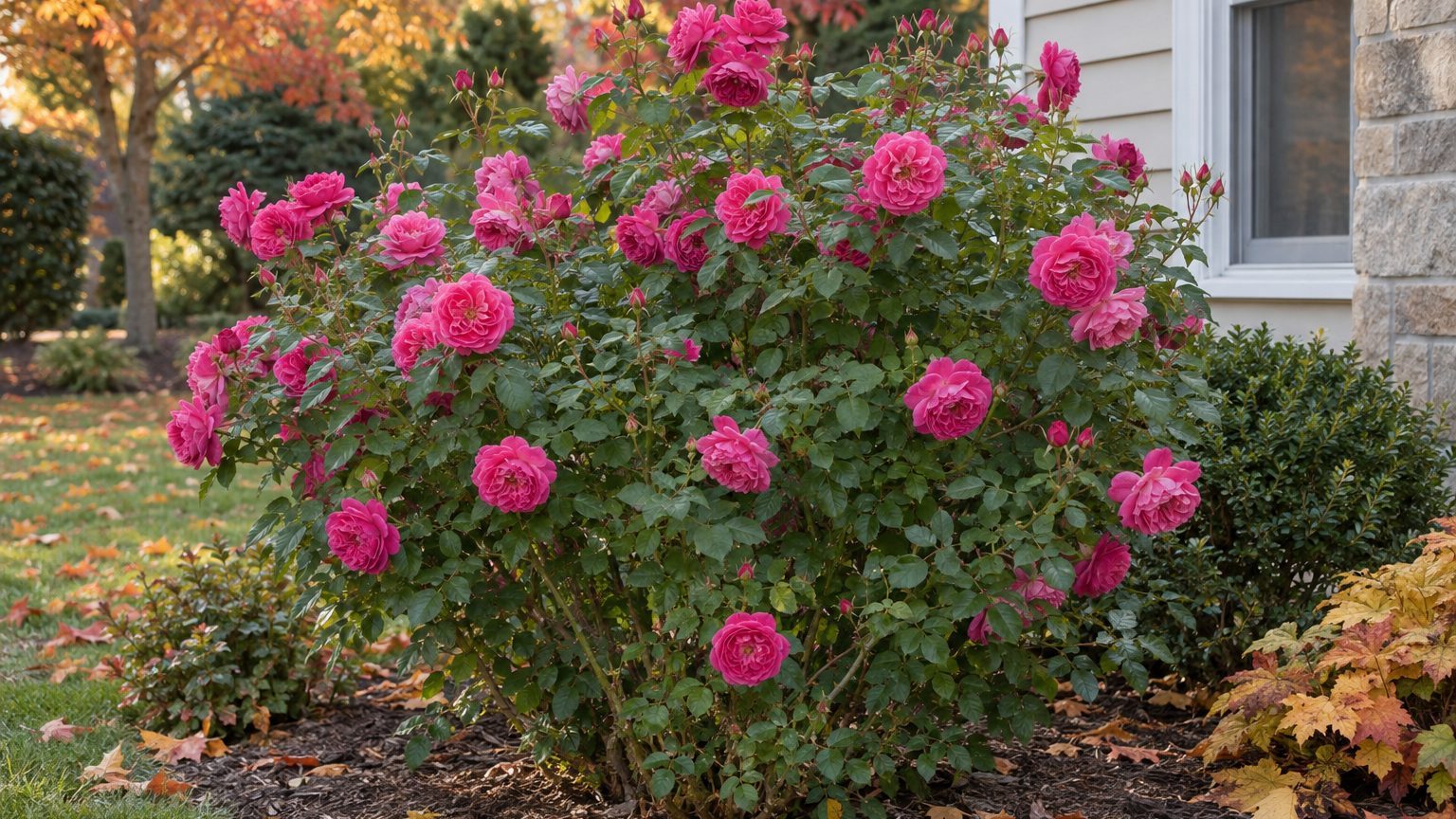
A William Baffin in full June bloom carries large clusters of deep pink flowers. This hardy climbing rose suits cold-winter yards, climbs a fence or arbor with a little help, and keeps flowering after the big first show.
What Is the William Baffin Rose?
William Baffin is a repeat-blooming climbing rose that grows on its own roots, so it is not grafted. It can be grown as a large shrub or trained as a climber, and it reaches 8 to 10 feet in height with a wide spread.
The flowers are semi-double, deep pink and 3 inches across, with bright gold stamens in the center. They open in large clusters, and each flower carries 15 to 20 petals.
Growth is very vigorous and upright. Without support it sprawls, so a trellis, fence or arbor does real work for this rose.
From the almanac
Roses in your state
The dates on this page depend on where you live. Your state's page carries its frost dates, its USDA zones and the year laid out month by month.
Northeast
Southeast
- Alabama
- Arkansas
- Delaware
- Florida
- Georgia
- Kentucky
- Louisiana
- Maryland
- Mississippi
- North Carolina
- South Carolina
- Tennessee
- Virginia
- West Virginia
Midwest
Southwest
West
Pacific Northwest
Canada
Where Does the William Baffin Rose Grow Best?
William Baffin is hardy in USDA Zones 3 to 7, which makes it a dependable climber for cold climates. Its exceptional hardiness makes it a dependable climber for cold climates.
- Upper Midwest: Compare your local USDA zone with the rose’s listed range. Canes that suffer in a hard winter are simply pruned back in spring.
- Northeast and New England: Compare your local USDA zone with the rose’s listed range. Plant it where it gets support, since it sprawls without it.
- Mountain West: Compare your local USDA zone with the rose’s listed range. Prune this bush early to remove winter damage and deadwood.
- Mid-South and Lower Midwest: Compare your local USDA zone with the rose’s listed range.
The state selector just below this section leads to the page for your state, where the local timing is spelled out.
How to Care for the William Baffin Rose Through the Year
Waking Up
When buds begin to swell, check the canes for winter damage. Dead or blackened wood is easy to spot against green, living stems. Tie in any long canes that came loose from their support over winter.
Pruning
Prune early in the season to remove winter damage and deadwood. Then cut out old, weakened long canes as needed, which leaves room for fresh growth. Because this rose repeat-blooms, a light hand keeps the climbing framework intact.
Bloom

The heaviest flowering comes in June, followed by lighter bloom through summer. The bloom season runs from June to October, since the plant sets more buds and keeps going until frost.
Summer
Suckers may appear around the base. Because the plant grows on its own roots, they are simply the plant spreading and expanding, so there is nothing to fix. Keep long canes tied to their support as the growth gets heavy.
Autumn
Flowering continues into October, so leave the last blooms alone and let the plant wind down with the first frosts. Pull any dead or fallen cane debris from the base before winter.
Winter
Exceptional hardiness makes this rose suitable for cold climates. Leave the canes on their support through winter, and wait for spring to see what damage, if any, needs cutting out.
William Baffin Rose Diseases and Weak Points
Disease resistance is a strength of this rose. It is a climber known for exceptional hardiness and disease resistance.
Its vigorous, sprawling habit needs room and support.
| Threat | How William Baffin handles it |
|---|---|
| Black spot | Resistant |
| Mildew | Resistant |
| Winter cold | Exceptional hardiness, with some cane damage still possible |
Sprawling is the real habit to manage. Without support the plant flops, and a vigorous upright grower of 8 to 10 feet can crowd a small bed quickly.
Is the William Baffin Rose Right for Your Yard?
This rose suits a yard with a sturdy fence, arbor or wall and enough room for a plant that grows wide. It fits gardeners who want color from June to October and have room for its vigorous growth.
- A cold-winter yard in Zones 3 to 7 gets a dependable climber; prune it early to remove winter damage and deadwood.
- A small patio or tight border is a poor match, since the height and spread outgrow it fast.
- Your state page gives the local months for pruning and planting, so open it through the state selector before you buy.
Common Questions
Is William Baffin a Climbing Rose or a Shrub?
It can be grown either way. As a climber it needs support, and unsupported it grows as a large, sprawling shrub.
Does William Baffin Bloom More than Once?
Yes, it is a repeat bloomer. The heaviest flush comes in June, with lighter bloom through summer into October.
Why Is My William Baffin Sending Up Shoots Away from the Main Plant?
The rose grows on its own roots and is not grafted, so the shoots are the plant spreading and expanding. They are not a sign of a problem.