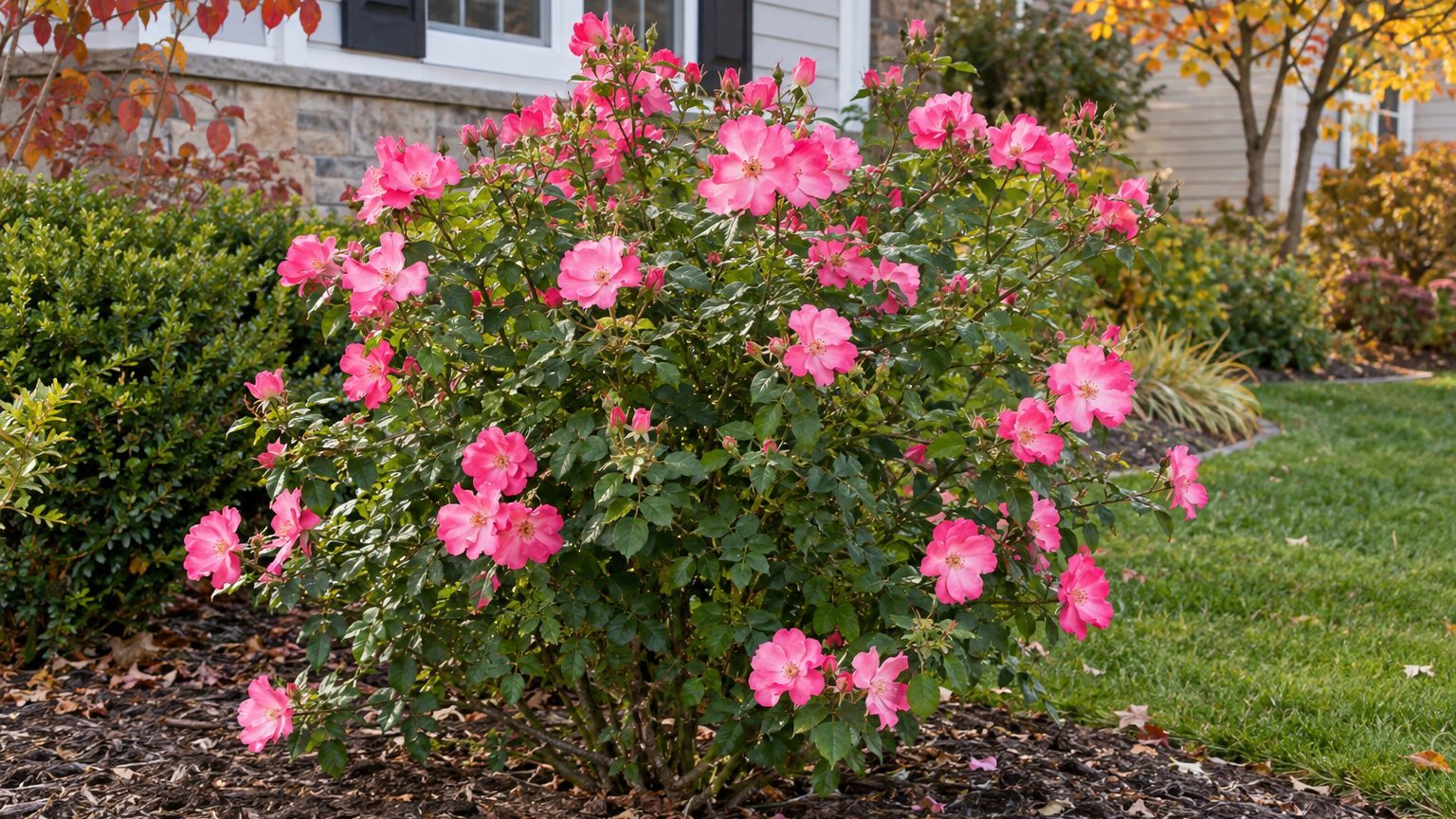
Carefree Beauty has flat, deep pink flowers with a loose tuft of petals at the center. It is a tough shrub rose that blooms from spring to frost without much fuss.
What Is the Carefree Beauty Rose?
Carefree Beauty is a shrub rose with a vigorous, somewhat open habit. It reaches about 5′ tall and 5′ wide, which puts it in the medium shrub class. Introduced in 1977, it is not a climber or a tight little bedding rose.
The flowers are deep, rich pink and semi-double, up to 4″ across. They open flat, with a few irregular, loose petals at the center and an occasional white stripe running through them.
Large orange hips form from nearly every flower. They give the shrub a second kind of color after the blooms, and they are part of why it looks good in a perennial border.
From the almanac
Roses in your state
The dates on this page depend on where you live. Your state's page carries its frost dates, its USDA zones and the year laid out month by month.
Northeast
Southeast
- Alabama
- Arkansas
- Delaware
- Florida
- Georgia
- Kentucky
- Louisiana
- Maryland
- Mississippi
- North Carolina
- South Carolina
- Tennessee
- Virginia
- West Virginia
Midwest
Southwest
West
Pacific Northwest
Canada
Where Does the Carefree Beauty Rose Grow Best?
This rose is hardy in zones 4-9. It was bred in Iowa to handle cold, long winters, and it also copes with hot, dry summers in Texas. Its limits sit at the extremes of the map.
- Upper Midwest: Minnesota, Wisconsin and Iowa have the long winters this rose was bred for, and it is a fit for yards on the colder edge of its range.
- Texas Hill Country and the Panhandle: Hot, dry summers are where this rose has proven itself, as long as the planting site gets full sun and good air circulation.
- Gulf Coast: Spacing and airflow matter in humid conditions.
- Northern Minnesota and the high Rockies: Check your hardiness zone before planting.
The state selector just below this section leads to the page for your state, with local months and timing.
How to Care for the Carefree Beauty Rose Through the Year
Spring

New canes leaf out as the weather warms. Pick a spot in full sun with good air circulation, because both sun and moving air do much of the work of keeping the foliage healthy.
Pruning
Use your state page for local pruning guidance.
Bloom

Flowers come in successive flushes through spring, summer and fall. Leaving spent flowers allows the large orange hips to form.
Summer
Summer heat is where Carefree Beauty shows its toughness. A new rose still needs regular water until established. A mature shrub can handle hot, dry summers.
Autumn
Blooms continue until frost. As the weather cools, leave spent flowers so the large orange hips can develop.
Winter
Check your state page for local winter protection guidance.
Carefree Beauty Rose Diseases and Weak Points
This rose was selected for toughness, but no shrub is immune to a poor site. A poor site can still create problems.
Shade and poor airflow are the most likely troubles. The table pairs each threat with how the rose handles it.
| Threat | How Carefree Beauty handles it |
|---|---|
| Long, cold winters | Bred in Iowa to withstand Midwest winters, hardy in zones 4-9 |
| Hot, dry summers | Performs well in Texas, where summers are hot and dry |
| Shade and stagnant air | Needs full sun and good air circulation to do well |
Beyond these, check the plant tag or ask your county extension office about disease pressure in your area, since local humidity changes what shows up.
Is the Carefree Beauty Rose Right for Your Yard?
It suits a yard with a sunny spot and room for a shrub 5′ across. It fits gardeners who want repeat flowers without a demanding routine. It is a poor match for a shady corner or a tiny bed.
- Choose it for a perennial border or as a single focal plant, where the pink flowers and orange hips show across the seasons.
- Skip it for deep shade or tight spaces, where airflow suffers and the shrub outgrows its place.
- Open your state page and check the months for planting and pruning before you buy.
Common Questions
How Far Apart Should You Plant Carefree Beauty Roses?
Space them 7′ apart on centers. For a sea of color, plant groups of 3 to 5 plants.
Where Does Carefree Beauty Fit in the Garden?
It works as an accent in perennial borders and beds. It can also be massed or used as a single specimen to create a focal point.
Who Developed Carefree Beauty?
Dr. Griffith Buck bred it, and it was introduced in 1977. It was named the 2006 Earth-Kind Rose of the Year.