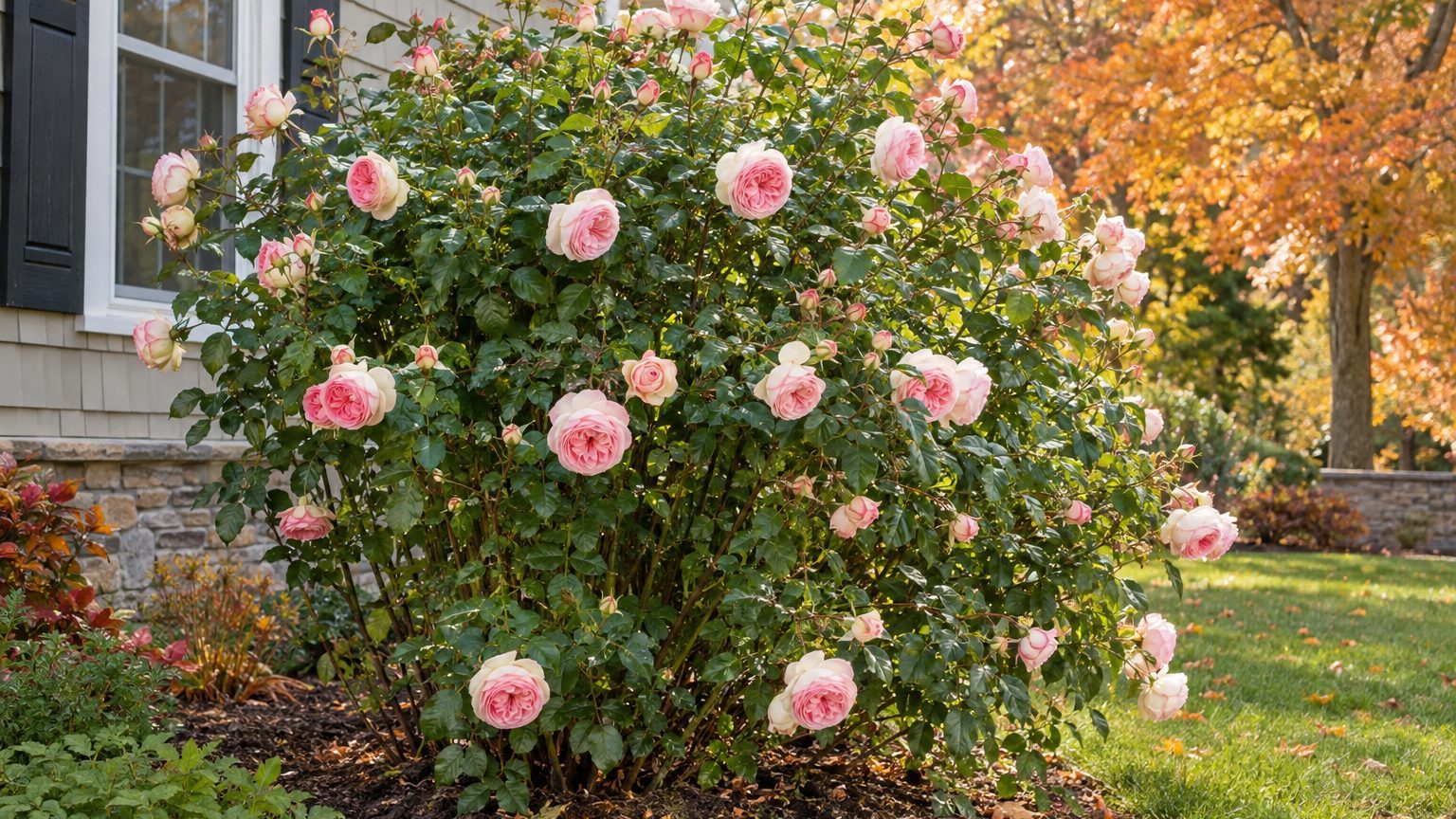
A heavy flush of cupped, pink-blushed blooms in spring gives this climbing rose a strong presence on an arch or pillar. Pierre de Ronsard repeats its bloom through fall, bringing color and fragrance to a vertical space.
What Is the Pierre de Ronsard Rose?
Pierre de Ronsard is a shrub or climber in the rose family, bred by Marie-Louise Meillan and introduced in France in 1985. It is sold under other names too, including Eden rose and Eden Climber. Grown on a trellis, it behaves as a climber.
The double flowers are pink blended with white, 3-4 inches across, and packed with 40-70 petals. They are fragrant and cut well, so a few stems indoors cost the plant little.
Height runs from 4 feet as a bushy shrub to 20 feet on a support, with a width of 5-6 feet. Check the plant tag, and plan the wall or arch before you plan the hole.
From the almanac
Roses in your state
The dates on this page depend on where you live. Your state's page carries its frost dates, its USDA zones and the year laid out month by month.
Northeast
Southeast
- Alabama
- Arkansas
- Delaware
- Florida
- Georgia
- Kentucky
- Louisiana
- Maryland
- Mississippi
- North Carolina
- South Carolina
- Tennessee
- Virginia
- West Virginia
Midwest
Southwest
West
Pacific Northwest
Canada
Where Does the Pierre de Ronsard Rose Grow Best?
This rose is rated for USDA plant hardiness zones 5a, 5b, 6a, 6b, 7a, 7b, 8a, 8b, 9a, and 9b. Local conditions inside that range still change how it behaves, so think about winter cold and summer humidity in your part of the state.
- Upper Midwest and New England: zone 5a sits at the cold edge of its range.
- Mid-Atlantic and the Southeast: Check your local USDA plant hardiness zone before planting. Humid summers make airflow around the canes worth planning for.
- Gulf Coast and the Southwest: zone 9b is the warm limit.
- Pacific Northwest and California:
The state selector just below this section leads to the page for your state, where the months for planting and pruning are set for where you live.
How to Care for the Pierre de Ronsard Rose Through the Year
Waking Up
Pruning
This rose blooms continuously through the season.
Bloom
The first flush is the heaviest, in spring, and then the plant keeps blooming continuously through fall.
Summer
Water deeply at the base and keep leaves dry. Remove spent blooms regularly to keep new buds coming.
Fall
Blooms continue into fall, so there is no rush to cut anything back. Stop feeding as the season winds down so the canes can harden before cold arrives. Rake up fallen leaves from around the base.
Winter
Pierre de Ronsard Rose Diseases and Weak Points
Roses as a group are prone to fungal leaf diseases when foliage stays wet.
Give the plant sun, space and air movement, and water at the soil level.
| Threat | How Pierre de Ronsard handles it |
|---|---|
| Winter cold | Rated for USDA plant hardiness zones 5a, 5b, 6a, 6b, 7a, 7b, 8a, 8b, 9a, and 9b |
| Heavy wind on long canes | Tall growth to 20 feet needs a firm support |
Watch the leaves through the season, remove affected foliage soon, and clean up fallen leaves in fall so problems do not carry over.
Is the Pierre de Ronsard Rose Right for Your Yard?
It suits a yard with a wall, fence, pergola or arch that gets sun, and a gardener who enjoys tying canes in spring. It is a poor match for a tiny bed or a spot with no support.
- Choose it if you want fragrant, cut-worthy flowers from spring through fall on a vertical space.
- Skip it if you want a low, tidy shrub, since a plant that can reach 20 feet will outgrow a small border.
- Open the page for your state before you plant, and set the planting and pruning months for your area.
Common Questions
Can You Grow Pierre De Ronsard in a Large Pot?
Does Pierre De Ronsard Have a Scent?
Yes, the flowers are fragrant. They are also good for cutting, which makes it a good rose to plant near a path or a door.
How Wide Does Pierre De Ronsard Spread?
Width runs 5-6 feet, so leave that much room along a wall or fence. Plant it a little away from the wall so air can move behind the canes.