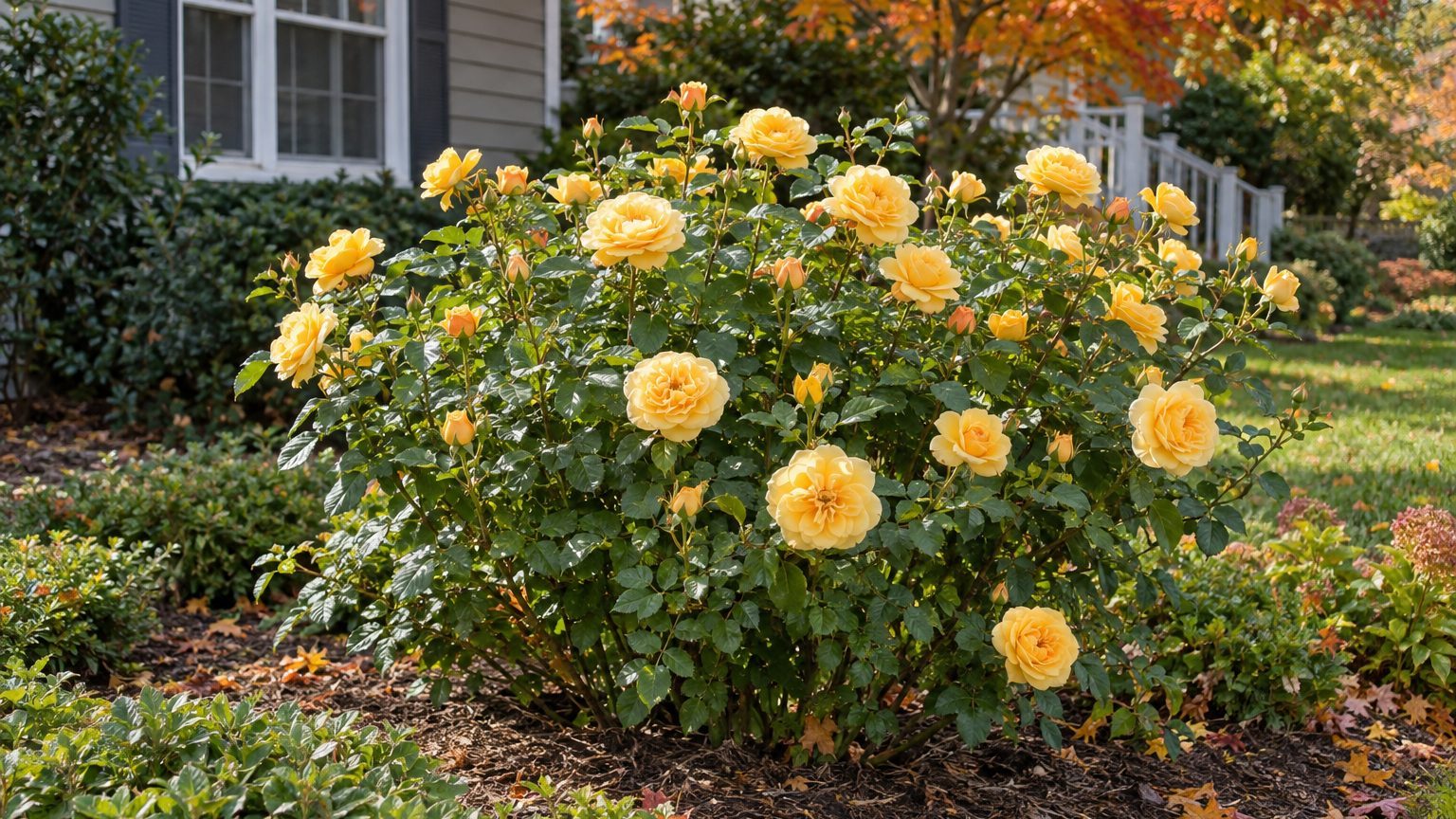
A low mound of buttery yellow roses beside a front walk or a mailbox bed is how the Julia Child rose usually shows up in a yard. It stays compact and flowers repeatedly through the warm months.
What Is the Julia Child Rose?
Julia Child is a hybrid floribunda shrub in the rose family, bred by Tom Carruth. It grows as a compact, rounded mound, so it fits a bed edge or a large pot better than a back fence.
The flowers are fully double, buttery yellow, and open in small clusters. They look old-fashioned, with ruffled petals, and carry a strong licorice and clove scent.
The shrub grows 2-3 feet tall and wide. In warmer climates it can reach 5 feet tall, which changes how much room to leave around it.
From the almanac
Roses in your state
The dates on this page depend on where you live. Your state's page carries its frost dates, its USDA zones and the year laid out month by month.
Northeast
Southeast
- Alabama
- Arkansas
- Delaware
- Florida
- Georgia
- Kentucky
- Louisiana
- Maryland
- Mississippi
- North Carolina
- South Carolina
- Tennessee
- Virginia
- West Virginia
Midwest
Southwest
West
Pacific Northwest
Canada
Where Does the Julia Child Rose Grow Best?
Hardiness zones 5 – 9 are listed for Julia Child. Check your local hardiness zone before planting.
- Upper Midwest: In Illinois and Wisconsin, winters sit at the cold edge of the rose’s range. Plant it where it gets sun and shelter, and expect a more modest mound than in the South.
- Mid-Atlantic and Southeast: In North Carolina and Virginia, the shrub fits comfortably in its zones. Warm seasons here push it taller, so give it room to reach 5 feet.
- Gulf Coast and Florida: In Alabama and the Florida Panhandle, the warm end of the range applies. Expect a larger shrub than the compact mound seen farther north.
- Southern California and the Desert Southwest: In coastal Southern California and Arizona, check your local hardiness zone before planting. In warmer sites, plan for taller growth.
The state selector just below this section leads to the page for your state, where timing is set for your own climate.
How to Care for the Julia Child Rose Through the Year
Spring Wake-Up

New growth appears as the weather warms, and this is the moment to look the shrub over. Cut back anything that is plainly dead or darkened so energy goes into healthy canes.
Pruning
Prune in late winter or early spring, before the buds push far. The goal is to remove old, dead or diseased canes and to shape the shrub into its rounded form.
Prune in late winter or early spring to remove old, dead or diseased canes and to shape. Cutting back into healthy wood sets up the first flush.
Bloom

Flowers begin in late spring and continue in flushes into fall. Each flush comes in small clusters with a strong licorice-clove scent.
Deadheading encourages additional blooms, so snip spent flowers back to a healthy leaf. Clip cluster by cluster, as flowers fade at different times.
Summer
Between flushes the shrub works on new buds. Water at the base in the morning so the leaves stay dry, and keep up with deadheading so the next round arrives on schedule.
Fall
Blooming runs into October, so there is no need to rush the shrub to rest. Once flowers thin out, clear fallen leaves from the base so old foliage does not sit against the canes.
Winter
In colder zones, a mound of mulch over the base protects the crown through hard freezes. Leave the main pruning for late winter, when you can see which canes came through the cold alive.
Julia Child Rose Diseases and Weak Points
Black spot is the disease that troubles many roses, with dark blotches on the leaves and early leaf drop. Julia Child stands out here, which cuts down on spraying and leaf cleanup.
Resistance helps most when the rose has sun and airflow. Space plants so the leaves dry quickly after rain.
| Threat | How Julia Child handles it |
|---|---|
| Black spot | Highly resistant, with good disease tolerance overall |
Other problems can still turn up on any rose. If leaves show spots and also yellow and drop from the lower canes, look closer at the shrub and your watering, rather than assuming one cause.
Is the Julia Child Rose Right for Your Yard?
This rose suits a small bed, a front walk or a container where a compact mound with scented flowers earns its place. It is less suited to a spot that needs a tall hedge or a climber on a wall.
- Choose it for a sunny bed with room to reach 2-3 feet, or taller if you garden in a warm climate.
- Skip it if you want a climbing rose or a large screening shrub.
- Open the state page for your area before pruning, since late winter and early spring arrive at different times from state to state.
Common Questions
How Big Are Julia Child Rose Flowers?
The blooms are 3-4 inches across and fully double, with 26-40 ruffled petals. They open in small clusters rather than on single stems.
What Does a Julia Child Rose Smell Like?
The scent is licorice with clove and spice, and it is strong enough to notice when you walk by. Cut blooms for the house if you want the scent indoors.
Who Bred the Julia Child Rose?
Tom Carruth bred it in 2004. It is a hybrid floribunda, a class known for flowers in clusters and repeat bloom through the season.