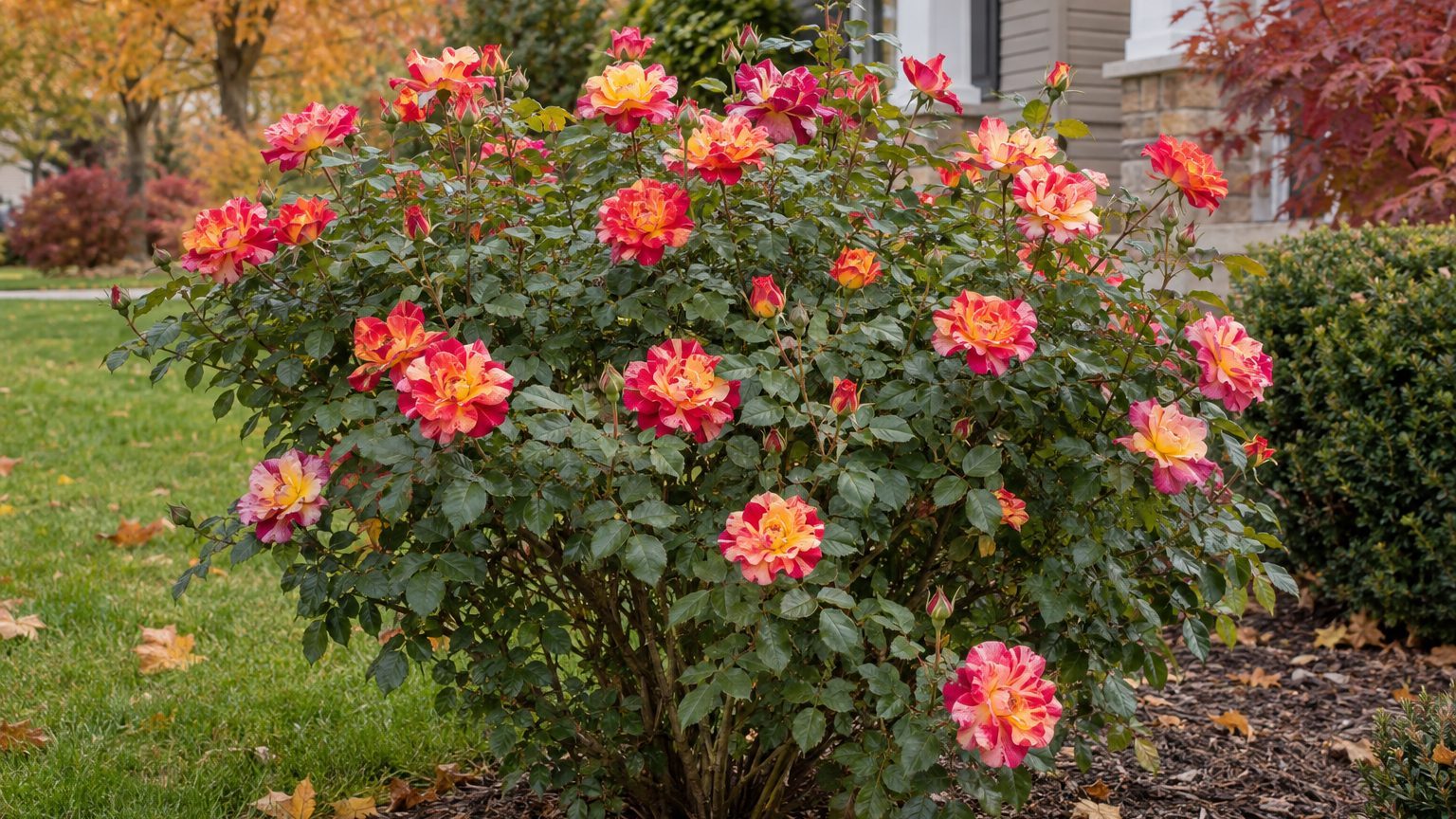
A climbing rose that opens in red, pink, yellow and orange on the same cane will stop you at the fence in spring. Joseph’s Coat is that rose, a vigorous climber that wants a trellis, a wall or a post and full sun.
What Is the Joseph’s Coat Rose?
Joseph’s Coat is a vigorous hybrid climbing rose in the rose family, bred by David L. Armstrong and introduced in 1964. It climbs rather than mounds, so it needs something to lean on and tie to.
Its blooms are semi-double, about 4 inches across, and shift through red, pink, yellow and orange, with a slight fragrance. They open from cardinal red buds and come in large clusters, so one cane can carry several shades at once.
Plan the space before planting. The plant reaches 8-12 feet tall and only 3-4 feet wide, which suits a narrow wall or a single post better than a wide arbor.
From the almanac
Roses in your state
The dates on this page depend on where you live. Your state's page carries its frost dates, its USDA zones and the year laid out month by month.
Northeast
Southeast
- Alabama
- Arkansas
- Delaware
- Florida
- Georgia
- Kentucky
- Louisiana
- Maryland
- Mississippi
- North Carolina
- South Carolina
- Tennessee
- Virginia
- West Virginia
Midwest
Southwest
West
Pacific Northwest
Canada
Where Does the Joseph’s Coat Rose Grow Best?
Joseph’s Coat is listed for USDA zones 5a, 5b, 6a, 6b, 7a, 7b, 8a, 8b, 9a, 9b, 10a. The zone tells you whether the canes survive winter, and your local humidity shapes how healthy the leaves stay.
- Upper Midwest and Northeast: In Minnesota, Wisconsin and Maine, compare your local USDA zone with the cultivar’s listed range before planting. Plant it against a sunny wall where the canes get some shelter.
- Mid-Atlantic and Southeast: In North Carolina, Virginia and Georgia, compare your local USDA zone with the cultivar’s listed range. Warm, damp summers here favor the fungal problems this rose is prone to, so airflow matters.
- Gulf Coast and Florida: Along the Gulf Coast the rose reaches the upper end of its zone range. Humid air keeps leaf diseases active, so give it open, sunny exposure.
- Pacific Coast and Southwest: In Oregon, California and Arizona, compare your local USDA zone with the cultivar’s listed range.
The state selector just below this section takes you to the page for your own state.
How to Care for the Joseph’s Coat Rose Through the Year
Waking Up

Joseph’s Coat prefers moist, well-drained loamy soil and tolerates poorer soil in full sun. When growth restarts, enrich the planting bed if the soil is thin and check that water drains away rather than pooling at the roots.
Pruning
Go light. During the first 2-3 seasons, remove only dead or damaged canes and let the plant build its framework. Tie the long canes along the support.
Bloom
Flowers begin in spring and rebloom in flushes throughout the season. Deadheading helps speed up that return, so snip spent clusters back to a healthy leaf instead of letting hips form.
Summer
Summer is when leaf diseases show up, because this rose is susceptible to blackspot, mildew and rust. Water at the base in the morning, keep the foliage dry, and thin crowded growth so air moves through the canes.
Autumn
Clean up fallen leaves around the base, since they can carry disease spores into the next season. Remove any dead or damaged canes you spot while tidying, and keep tying new growth to the support.
Winter
In the colder part of its listed range, check local winter-protection guidance. Leave the framework tied securely to its support so winter wind does not whip it, and wait for spring growth to show you what is dead.
Joseph’s Coat Rose Diseases and Weak Points
Disease is the main drawback of this rose. Blackspot, mildew and rust can all trouble it, especially where leaves stay wet and air barely moves.
Prevention is mostly about placement and habit. Full sun dries the foliage quickly, and a trellis set a little off the wall keeps air moving behind the canes.
| Threat | How Joseph’s Coat handles it |
|---|---|
| Blackspot | Susceptible |
| Mildew | Susceptible |
| Rust | Susceptible |
Pull off and bin affected leaves rather than composting them.
Is the Joseph’s Coat Rose Right for Your Yard?
It suits a gardener with a sunny wall, fence or post and a narrow strip of ground. It is a poor fit for a shady spot or for anyone who wants a rose with no disease routine.
- Choose it if you want a tall, slim climber with several colors in one bloom and are willing to deadhead and watch the leaves through the growing season.
- Skip it if your site stays damp and shaded, or if you want a low shrub that needs no support.
- Open your state page, using the selector above, to see when to prune and plant in your own climate before you buy.
Common Questions
Can Joseph’s Coat Rose Grow in Poor Soil?
Yes, it tolerates poorer soils as long as it gets full sun. It does best in moist, well-drained loam, so improve the bed if you can.
Does Joseph’s Coat Rose Have a Scent?
The blooms carry a slight fragrance.
How Wide Does a Joseph’s Coat Rose Get?
Plan for 3-4 feet of width, with height reaching 8-12 feet. The slim spread makes it workable beside a doorway or along a short fence run.