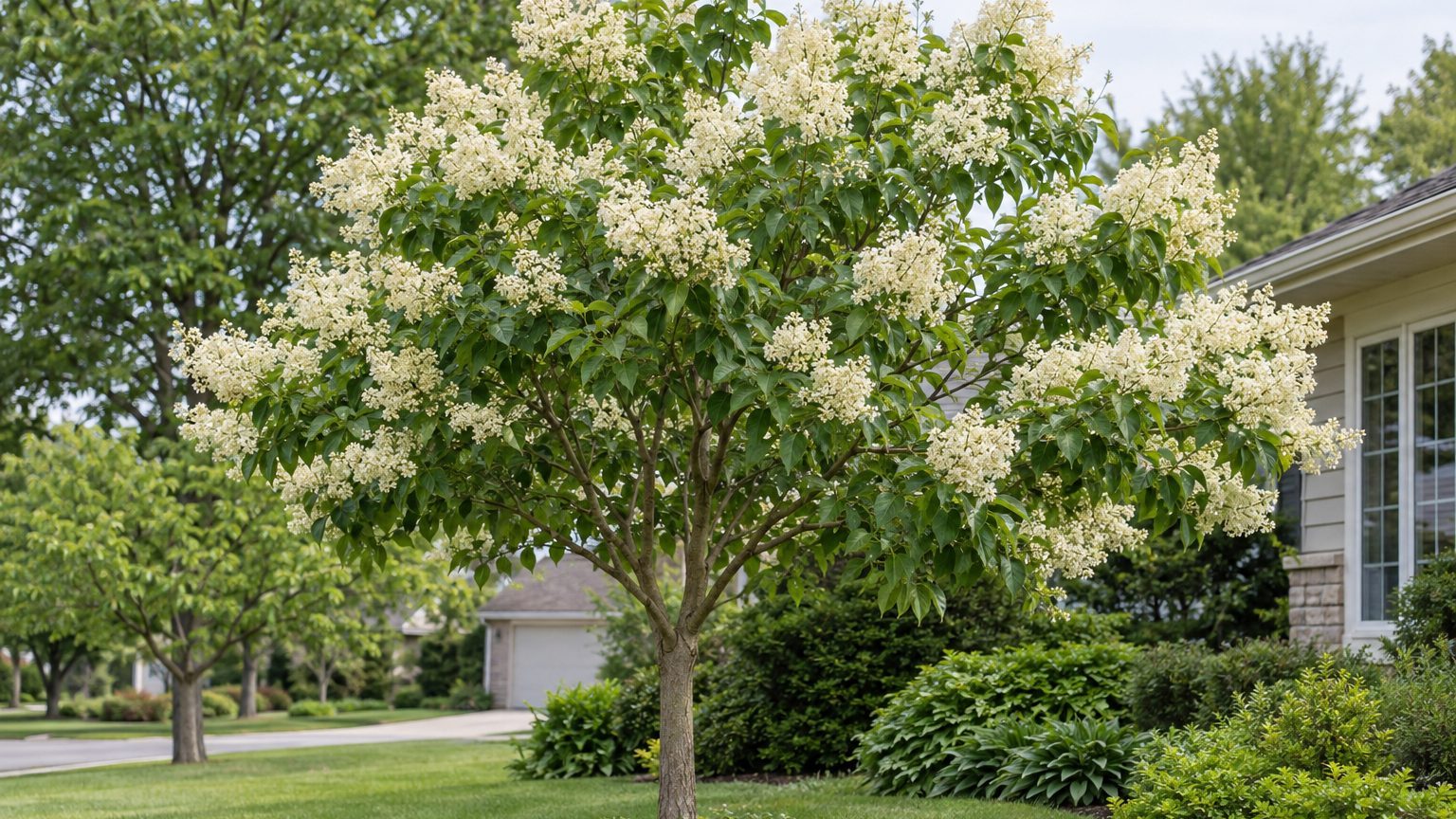
Long after the common lilacs have dropped their blooms, a small tree covered in creamy plumes opens in early summer. That is the Japanese tree lilac, Syringa reticulata, a very large shrub or small tree. It asks for sun, drainage and very little pruning.
What Is the Japanese Tree Lilac?
Japanese tree lilac is a deciduous tree in the olive family, native to Japan. It drops its leaves each fall and regrows them in spring. In a yard it reaches up to 30 feet tall, and it can spread to 20 feet wide, so it needs more room than the name “lilac” suggests.
The flowers come in large clusters of creamy white, sometimes shading toward gray, from May to June. The scent is the surprise. Its fragrance is more suggestive of privet than of a spring-blooming lilac.
Up close, the trunk carries small, visible slits called lenticels. They work as pores that let the tree exchange oxygen and carbon dioxide.
From the almanac
Lilacs in your state
The dates on this page depend on where you live. Your state's page carries its frost dates, its USDA zones and the year laid out month by month.
Northeast
Southeast
- Alabama
- Arkansas
- Delaware
- Florida
- Georgia
- Kentucky
- Louisiana
- Maryland
- Mississippi
- North Carolina
- South Carolina
- Tennessee
- Virginia
- West Virginia
Midwest
Southwest
West
Pacific Northwest
Canada
Where Does the Japanese Tree Lilac Grow Best?
Japanese tree lilac does best where it gets full sun, good drainage and steady moisture, and it handles city conditions, including poor, clay or alkaline soil.
- Upper Midwest (Minnesota, Wisconsin, Michigan): Full sun with good drainage brings the most showy and prolific flowers.
- Northeast (New York, Pennsylvania, Massachusetts): Partial shade can invite powdery mildew.
- Gulf Coast (Louisiana, Mississippi, Texas): Regular irrigation during dry spells helps the tree resist pests.
The state selector just below this section takes you to the page for your own state, where the local timing and conditions are laid out.
How to Care for the Japanese Tree Lilac Through the Year
Bloom

Flowering runs from May to June, and it is at its showiest on trees in full sun with good drainage. Hummingbirds and butterflies visit the flowers.
Pruning After Bloom
Little pruning is required, which is a relief compared with shrub lilacs.
If you grow the plant as a multi-stem shrub, plan on rejuvenation pruning every few years once it becomes overgrown.
Summer
Established trees have moderate drought tolerance, and regular irrigation during dry spells helps the tree resist pests.
Fall
The tree drops its leaves each fall. The tree is mildly invasive and has the potential to spread.
Winter
Bare branches make the trunk’s visible lenticels easy to see.
Japanese Tree Lilac Diseases and Weak Points
This lilac is resistant to pests and diseases, and it is perhaps the most pest-resistant lilac, though that does not make it pest-free.
| Threat | How Japanese Tree handles it |
|---|---|
| Pests and diseases in general | Resistant, though not pest-free |
| Powdery mildew | Can infect trees in partial shade and cause some leaf loss |
| Dry spells | Moderate drought tolerance, and regular irrigation helps keep it resistant |
| Poor, clay or alkaline soil | Tolerates it, as well as urban conditions |
Trees in partial shade can develop powdery mildew and lose some leaves.
Is the Japanese Tree Lilac Right for Your Yard?
It suits a sunny yard with room for a tree that can reach 30 feet. It is a poor match for a small, shady corner or a spot where a scented, spring-blooming lilac is what you want.
- Choose it if you want a low-pruning flowering tree for clay or alkaline soil, planted in a sunny spot with space on all sides.
- Skip it if your lot is tight, shady or under power lines, where a 20-foot spread will become a problem.
- Plan the planting with your own state’s page, which gives the local timing for getting a young tree in the ground.
Common Questions
Do You Need Two Japanese Tree Lilacs to Get Flowers?
No. Each flower has both male and female parts, so a single tree can pollinate itself with the help of pollinators. A second tree is not required for blooms.
Will It Attract Hummingbirds and Butterflies?
Yes. The strong perfume of the flowers draws both, and as they feed on nectar they carry pollen from flower to flower.
How Long Does a Japanese Tree Lilac Live?
It lives about 50 years.