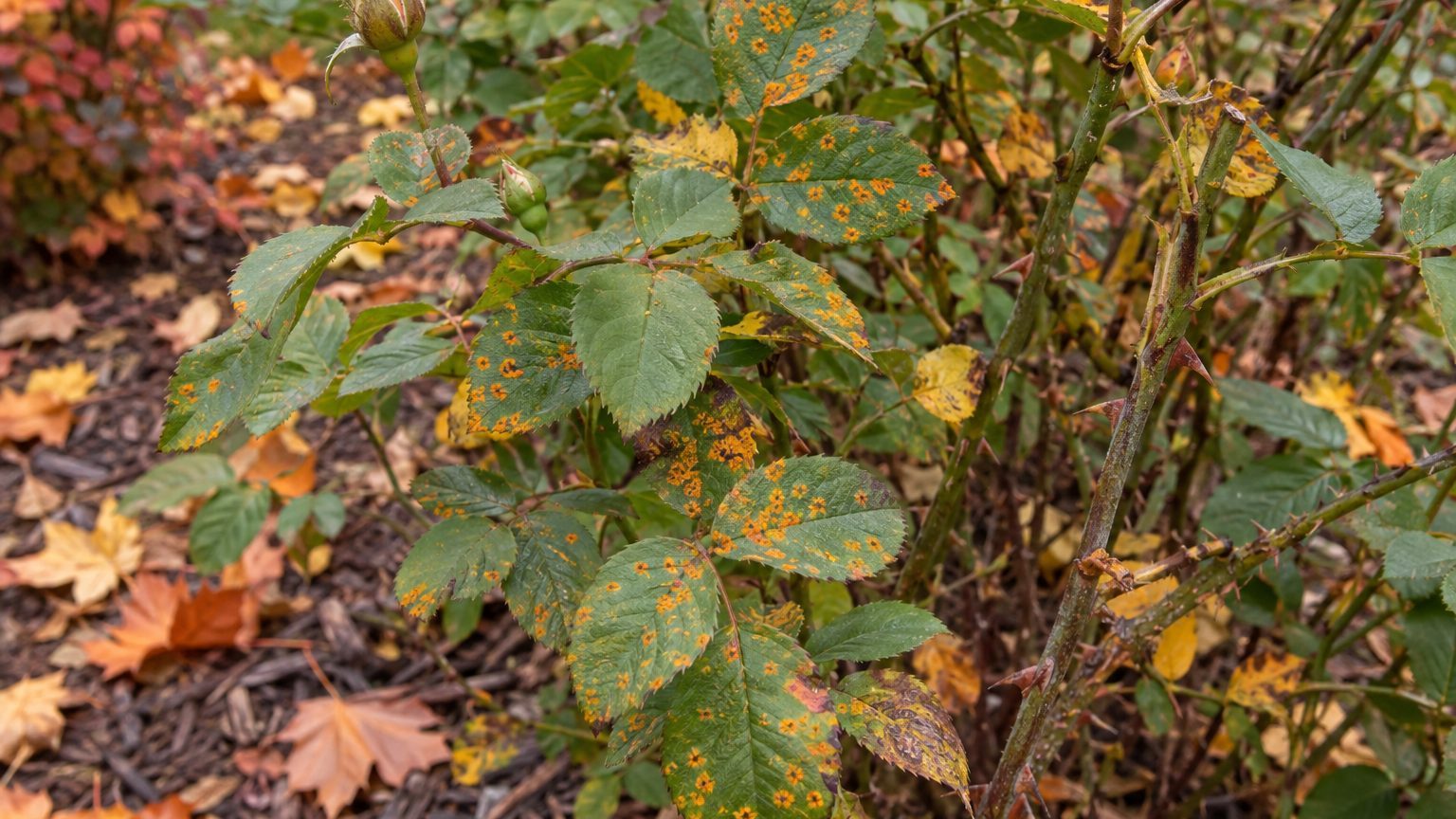
Brush a rusty rose leaf and your fingers can come away dusted with orange. That powder is the spore mass of rose rust, a fungal disease that shows up on the lower leaves first and climbs the plant. Knowing what it looks like, what feeds it and when to clean up lets you keep it at a level the plant tolerates.
Rose Rust: What You See

Turn leaves over, because the telling signs sit on the underside, while the top of the leaf gives only a hint.
- Small orange pustules full of powdery spores cover the undersides of leaves, usually starting on the lower ones and moving upward.
- Yellow to reddish brown spots appear on the upper leaf surfaces, directly over the pustules below.
- Pustules may also break out on the stems, as described for Maryland roses.
- A severe case leaves orange dust on the leaves and on the ground beneath the plant.
- In Maryland, the orange pustules darken late in summer as overwintering spores form, while in Pennsylvania black spores appear on the leaves in autumn.
- Badly infected leaves on highly susceptible cultivars turn yellow or brown and drop.
Only roots and petals escape, so every other part of the bush can carry the fungus.
From the almanac
Roses in your state
The dates on this page depend on where you live. Your state's page carries its frost dates, its USDA zones and the year laid out month by month.
Northeast
Southeast
- Alabama
- Arkansas
- Delaware
- Florida
- Georgia
- Kentucky
- Louisiana
- Maryland
- Mississippi
- North Carolina
- South Carolina
- Tennessee
- Virginia
- West Virginia
Midwest
Southwest
West
Pacific Northwest
Canada
Rose Rust or Something Else?
Spotted, dropping leaves have more than one cause, and some of them call for a very different response. A diagnosis should combine the spot pattern with another clue, such as where the color sits on the leaf or how the stems grow.
Rose rosette disease is the one to rule out, because it reddens the plant in a way that can pass for rust at a glance.
| Looks like | How to tell them apart |
|---|---|
| Rose rosette disease: deep red color on the undersides of young leaves, then small, distorted, bright red leaves | Stems grow vigorously in pink to magenta, leaf stalks shorten and the stem takes on a rosette look. No orange powder appears. Plants generally survive two to five years after the first symptoms. |
| Chrysanthemum rust: discolored spots on leaves that may drop early | The spots are on chrysanthemum foliage, and the neighboring rose shows no orange pustules on its leaf undersides. |
If new growth is red, crowded and rosetted instead of dusty orange underneath, treat it as a different disease. Before you decide what to do with the plant, have the problem identified.
What Causes Rose Rust, and Where It Is Worst
Rose rust comes from fungi in the genus Phragmidium, mainly Phragmidium mucronatum and Phragmidium tuberculatum, and these fungi infect roses only. The fungus runs through four spore stages. It arrives on infected roses you buy or on spores carried by the wind, and it can infect every type of rose, including Knockout cultivars.
Water is what lets an infection take hold, and cool, moist weather favors the fungus. It occurs throughout the United States, but the weather sets how bad it gets. Hot, dry summers limit it, yet it surfaces when conditions turn cool and wet.
The problem is chronic in cool coastal areas and can reach inland in wet years. Dark, thick-walled teliospores form in fall and wait out winter on fallen leaves. In California, some rusts also winter over on leaves that never drop from the plant.
How to Treat Rose Rust
Treatment centers on cleanup and careful watering.
- Check the undersides of the lower leaves first, so that you find the pustules before they climb the plant.
- Prune back severely affected canes, so that the heaviest source of spores leaves the bush.
- Stop overhead watering and wet only the soil, because water is needed for the fungus to infect new leaves.
- Pick up fallen leaves and dispose of them away from the bed, since the overwintering spores rest on them.
- A rose can tolerate a light infection without significant loss, but keep watching for heavier damage.
Fungicides are a separate decision. Which products are registered for roses differs by state, so your state extension service is the place to ask before you buy anything.
How to Prevent Rose Rust Coming Back
Rust returns on a seasonal cycle, so the prevention that works follows that cycle.
- When you bring home new roses, inspect them closely, since infected plants are one way the disease arrives.
- When rust is a problem, water at the base and keep the leaves dry, because wet foliage helps the fungus infect.
- When pustules darken, prune out the most affected canes before the overwintering spores settle in.
- Rake up fallen leaves, because dormant spores survive on them.
- In California, collect leaves still hanging on the plants and those on the ground during winter.
- When replacing a rose in a coastal location where rust is chronic, look for rust-resistant cultivars if they are available.
Removing fallen and lingering leaves clears away spores that can start another infection.
Where This Comes From
These notes draw on university extension and government plant disease publications written for states including California, Maryland, Pennsylvania, South Carolina and South Dakota. Timing and product rules differ by state, so confirm the details with your own state’s extension service.
Common Questions
Can Rose Rust Spread to Other Plants?
No. The fungi are specific to roses, so the disease moves from rose to rose, carried by wind. Chrysanthemums have their own rust, which looks similar but is a different disease.
Will Rose Rust Kill a Rose Bush?
Low levels of damage usually cost a plant little. Heavy infections cause leaves to yellow and fall, which weakens the bush.
Does Rose Rust Affect the Roots or Blooms?
It attacks every part of the plant except the roots and the petals. Leaves and stems carry most of the damage.