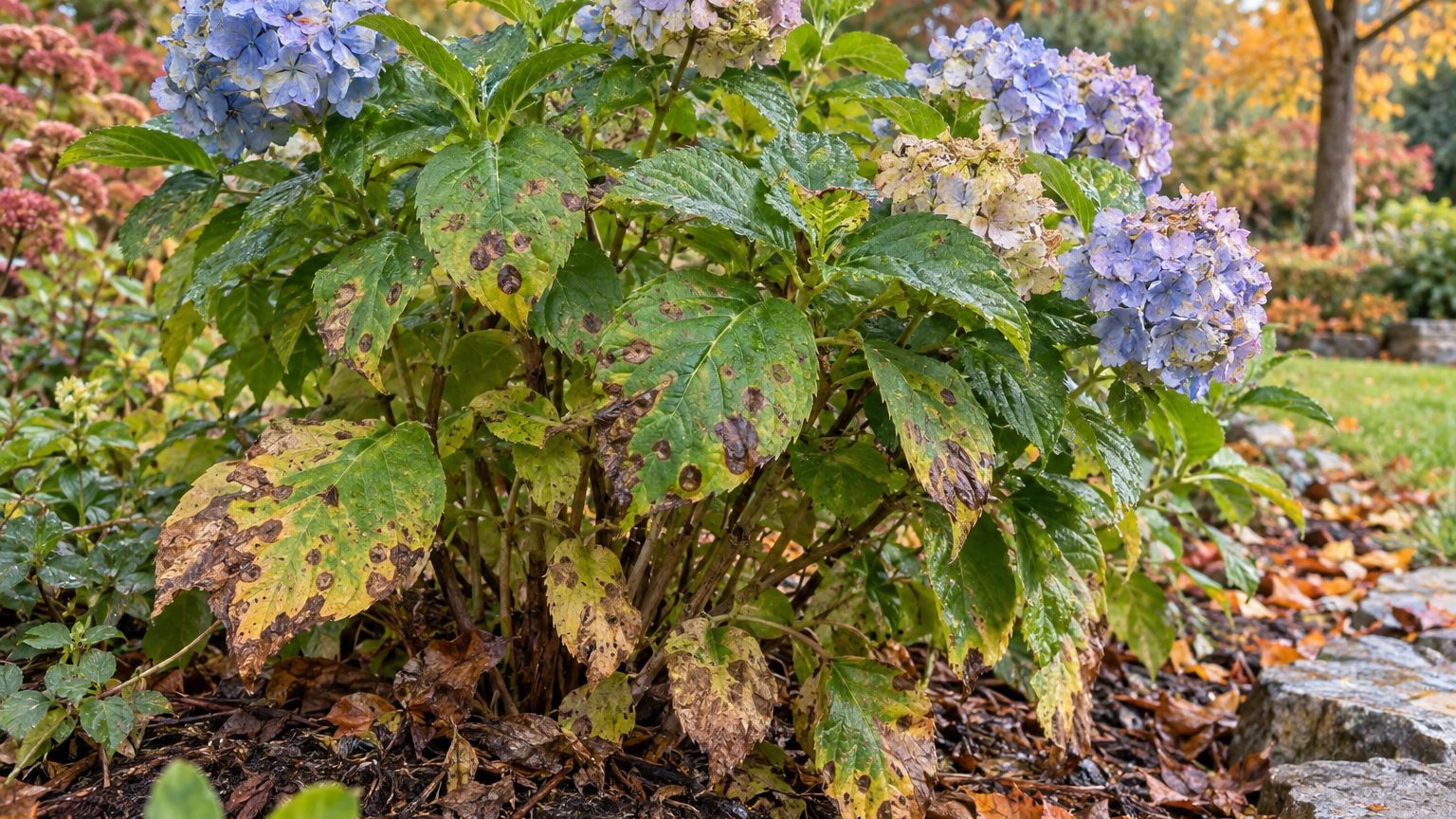
Anthracnose on a hydrangea is a fungal leaf disease. It shows up as tan to brown spots that spread in warm, wet weather, and it usually marks the plant rather than kills it. The fix is mostly housekeeping: dry leaves, cleaned-up debris, and no hard pruning on the wrong type. Here is what to look for, inside our Hydrangea Diseases guide.
Anthracnose: What You See

The NC State Extension Gardener Plant Toolbox lists leaf spot among hydrangea diseases and gives anthracnose no entry of its own, so these signs follow the general leaf-spot pattern. Look for:
- Tan, brown or gray-brown spots on the leaves, often ringed darker.
- Spots that run together into large dead blotches.
- Browning that starts on lower, shaded leaves and climbs.
- Dead patches along leaf edges after a long wet spell.
- Worst from late spring through summer, whenever leaves stay wet for days.
Spots that sit sunk into the leaf and don’t wipe off are the fungus at work. Old spots never turn green again, so judge progress by the new leaves.
From the almanac
Hydrangeas in your state
The dates on this page depend on where you live. Your state's page carries its frost dates, its USDA zones and the year laid out month by month.
Northeast
Southeast
- Alabama
- Arkansas
- Delaware
- Florida
- Georgia
- Kentucky
- Louisiana
- Maryland
- Mississippi
- North Carolina
- South Carolina
- Tennessee
- Virginia
- West Virginia
Midwest
Southwest
West
Pacific Northwest
Canada
Anthracnose or Something Else?
Several hydrangea problems brown a leaf. Color alone won’t sort them, so look at texture and pattern instead.
The NC State Extension Gardener Plant Toolbox says bigleaf needs protection from afternoon sun. That is the first cause to rule out when the browning sits on one side of the shrub only.
| Problem | Looks like | The sign that tells them apart |
|---|---|---|
| Powdery mildew | A white to gray dusty film on leaf surfaces | The film wipes off with a thumb, while anthracnose spots are set into the leaf and stay put |
| Sun scorch | Crisp, papery brown edges or patches | Damage sits only on the side facing afternoon sun, and shaded leaves on the same stem stay clean |
Bacterial wilt is also named by that source, and it shows as whole shoots going limp, not spotted leaves. Mildew has its own sheet: Powdery Mildew on Hydrangeas: Signs, Treatment and Prevention. Whole-plant decline is a different story, covered in Armillaria Root Rot on Hydrangeas: Signs, Treatment and Prevention.
What Causes Anthracnose, and Where It Is Worst
A fungus causes it. It overwinters in fallen leaves and plant debris, then splashes onto new growth whenever foliage stays wet.
The NC State Extension Gardener Plant Toolbox puts panicle at 3a to 8b and bigleaf at 6a to 11b. It offers no map of disease pressure, so the regions below follow leaf wetness, not a published ranking.
- Great Lakes and the North (Michigan, Minnesota, Wisconsin): panicle and smooth types dominate, and humid summer stretches with heavy dew keep leaves wet.
- The South (Georgia, Texas, the Carolinas): bigleaf grows here, and long warm, humid seasons give the fungus more weeks to spread.
- Pacific Northwest (Washington, Oregon): wet springs and mild temperatures keep foliage damp for long periods.
- Dry interior West (Colorado, Utah, Nevada): lower risk, unless overhead sprinklers keep wetting the leaves.
Your state’s page has the local calendar for pruning, mulching and cleanup, matched to your zone and hydrangea type.
How to Treat Anthracnose
Start this week, in this order. Most of it costs nothing and does more than any bottle.
- Remove spotted leaves: pick them off on a dry day and bag them, never drop them at the base of the plant.
- Rake the ground clean: fallen leaves carry the fungus, so clear everything from the soil under the shrub.
- Water at the soil line: use a hose or drip line in the morning, and keep sprinklers off the foliage.
- Hold the pruners: the NC State Extension Gardener Plant Toolbox says bigleaf flowers on last year’s wood, so a spring cut to chase spots removes the buds. Panicle blooms on current growth and tolerates hard cutting in late winter.
- Give it room: pull back groundcover and neighboring plants that crowd the stems and hold moisture in.
- Ask your state extension office: it alone knows which fungicides, if any, are registered where you live, and labels differ by state.
Hold off on anything in a bottle until the first five are done. Clean new leaves are the sign it worked.
How to Prevent Anthracnose Coming Back
Prevention follows the calendar, and each step keeps leaves dry or removes the fungus’s winter shelter.
- Late winter: the NC State Extension Gardener Plant Toolbox says panicle blooms on the current season’s growth, so cut it back hard now, but leave bigleaf alone.
- Early spring: refresh the mulch, since bigleaf and panicle are both shallow-rooted and benefit from it, and it also blocks soil splash.
- Through the growing season: water at the base in the morning so leaves dry before evening.
- Midsummer: pick off the first spotted leaves the day you see them.
- Autumn leaf drop: rake and bag every fallen leaf under the shrub.
- Winter tidy: leave hollow stems standing at 12 to 24 inches, because native bees nest in them.
That last step costs nothing in disease control, since the leaf litter is what matters.
Where this comes from
Bloom wood, hardiness, mulch and bee-stem advice come from the NC State Extension Gardener Plant Toolbox entry for Hydrangea. That entry does not describe anthracnose itself, so the disease details here reflect general leaf-spot practice.
Before you spray or prune, check with your state’s cooperative extension service. Registered products and timing vary by state, zone and hydrangea type.
Common questions
Will anthracnose kill my hydrangea?
On an established shrub it mostly disfigures leaves. Repeated bad seasons can weaken a plant, so sanitation matters. Sudden wilting of whole shoots points to a different problem.
Can I compost the spotted leaves?
Bagging them is safer. Home piles often stay too cool to kill the fungus, and the leaves come back to the bed with the compost. Check your local yard-waste rules.
Does my hydrangea type change what I do?
Yes, for pruning. Bigleaf sets buds on last year’s wood, so spring cutting costs flowers. Panicle blooms on new growth and can be cut back hard in late winter. Cleanup and watering are the same for both.