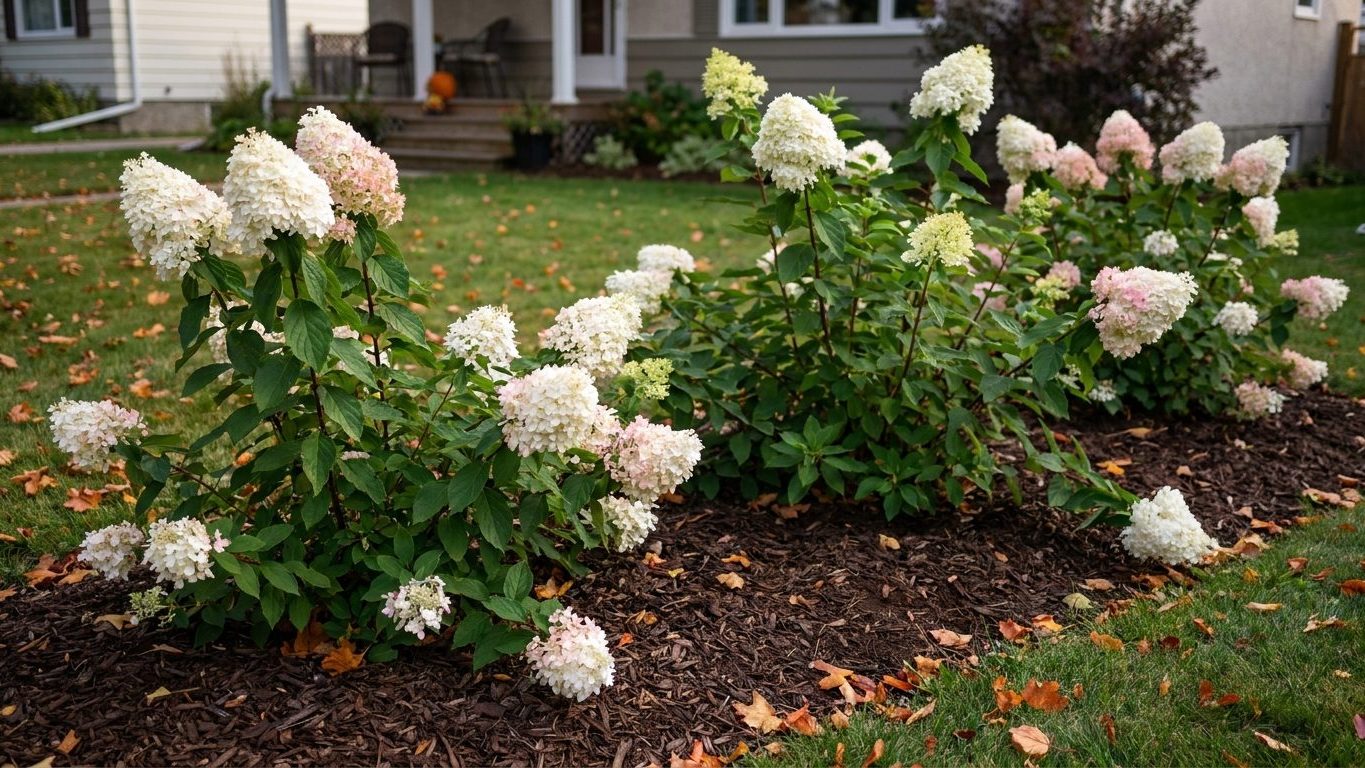
Hydrangeas can grow in Saskatchewan, but only the cold-hardy, new-wood bloomers make it through a winter this severe. Saskatoon’s growing season runs from an average last frost on May 18 to an average first frost on September 18, inside a Canadian zone 3a rating, and that four-month gap decides which varieties bloom and which ones just survive.
Hydrangeas Care Calendar for Saskatchewan

In Saskatoon, the last spring frost falls on average May 18 and the first fall frost on average September 18, according to Environment and Climate Change Canada’s climate normals for the Saskatoon SRC station, leaving roughly four months for a hydrangea to leaf out, bloom, and shut down before the ground locks up again.
- Dormancy: from the first hard freeze through early April is the one stretch to move or divide a plant with its roots undisturbed.
- Planting: wait two to three weeks past the May 18 average, into early June, before setting a new hydrangea into open ground.
- Mulching: lay four inches of shredded bark or leaves right after planting to buffer shallow roots against prairie swings.
- Pruning: cut back new-wood types in early spring, well before the May 18 average, while stems are still bare.
- Feeding: apply a balanced fertilizer once in late May or early June, as new leaves unfold.
- Watering: soak the root zone weekly through July and August, the driest stretch of the short season.
- Winter prep: mound mulch over the crown by early September, ahead of the September 18 average, to protect next year’s buds.
Every one of these windows narrows or shifts depending on how close a yard sits to Saskatoon’s climate station, so treat May 18 and September 18 as a midpoint, never a guarantee.
Saskatchewan — the year and the numbers
- State
- Saskatchewan
- Hardiness zones
- 3a
- Last spring frost
- May 18
- First fall frost
- September 18
- Annual rain
- 14 in
- Lawn zone
- cool-season
- Source
- Environment and Climate Change Canada — Canadian Climate Normals 1981-2010, station SASKATOON SRC · Saskatoon
Best Hydrangeas for Saskatchewan
Saskatchewan’s hydrangea math starts with zone 3a, the Canadian hardiness rating Natural Resources Canada assigns Saskatoon under its 1991-2020 normals, a figure built from seven climate variables rather than the single-variable USDA scale used south of the border.
The types that bloom on new wood shrug off a winter that kills the top growth, because they simply regrow and flower the same year. The types that set their buds on last year’s wood lose the whole show if that wood freezes.
| Kind | Flowers on | Verdict in zone 3a | Sun |
|---|---|---|---|
| Panicle | New wood | Reliably hardy | Full sun to part shade |
| Smooth (Annabelle type) | New wood | Reliably hardy | Full sun to part shade |
| Bigleaf | Old wood, mostly | Dies back to the ground most winters | Part shade |
| Oakleaf | Old wood | Rarely survives without heavy winter cover | Part shade |
| Climbing | Old and new wood | Borderline, needs a sheltered wall | Part sun |
Lacecap and mountain hydrangea carry the same old-wood risk as bigleaf here, so the other kinds are on their own pages.
When to Plant, Prune and Feed Hydrangeas in Saskatchewan
Three windows decide whether a Saskatchewan hydrangea earns its keep, when it goes into the ground, when it gets cut back, and when the crown gets tucked in for winter. Each one counts from Saskatoon’s average frost dates, the May 18 and September 18 figures Environment and Climate Change Canada publishes for the region.
The four-month gap between those two dates compresses everything, so feeding has to happen early and watering has to taper off in time for new growth to harden before the cold returns.
| Task | Window here | Counted from |
|---|---|---|
| Planting | Early to mid June | Two to three weeks after the May 18 average |
| Pruning new-wood types | Late March to mid April | Well before the May 18 average |
| Feeding | Late May to early June | Right at or just after the May 18 average |
| Winter mulching | Early to mid September | Just ahead of the September 18 average |
Growers running bigleaf or oakleaf here would normally prune right after bloom, but with that wood dying back most winters, the call rarely comes up.
Hydrangeas Problems in Saskatchewan and What Causes Them
No flowers on an otherwise healthy shrub
Bigleaf and oakleaf hydrangeas set next year’s buds on the current season’s wood, and in a zone 3a winter those buds usually don’t survive, even when the crown itself lives on. Choose a new-wood bloomer instead, the kind covered on the which-ones-hold-up-here page.
New growth blackened after a late frost
Because May 18 is only an average, roughly half of Saskatchewan springs bring a colder night after that date, and tender new leaves blacken overnight. Hold off pulling winter mulch until the soil itself has warmed, not just when the calendar turns.
Leaf edges scorched by midsummer
Prairie wind pulls moisture out of shallow hydrangea roots faster than a short summer can replace it, especially once the frost-free stretch turns hot in July. A four-inch mulch ring and a weekly deep soak keep the scorch off leaf margins.
Saskatchewan North to South: How the Dates Shift
Saskatoon’s May 18 and September 18 dates sit near the middle of a province that stretches for hundreds of miles, and the frost calendar shifts hard in both directions from that midpoint.
- The northern forest fringe (Prince Albert, La Ronge, Meadow Lake): frost lingers later in spring and returns earlier in fall, so the safe planting window opens later and closes sooner than around Saskatoon.
- The southern grain belt (Regina, Moose Jaw, Weyburn): winters run a touch milder and the frost-free stretch runs a bit longer, giving new-wood bloomers a better shot at a full flush.
- The river valleys (the South Saskatchewan, the Qu’Appelle): cold air pools at night on low ground, so a hydrangea planted at the valley bottom often meets frost before one planted on the rim above it.
None of these shifts come with their own published frost-date average, so treat Saskatoon’s May 18 and September 18 as the province’s best available midpoint and adjust by feel for elevation and shelter.
Saskatchewan Extension Offices and County Contacts
Saskatoon’s zone 3a rating and its May 18 to September 18 frost window are a province-wide starting point, not a guarantee for any one yard, so a local check is worth the five minutes it takes.
- Saskatchewan’s agriculture business page: the province’s agribusiness and horticulture contacts for growers across Saskatchewan.
- Your local municipal office or garden club: the closest read on frost pockets and wind exposure for your own street.
- This month’s task: check the mulch depth over any hydrangea crown before the ground locks up for winter.
Common questions
Can hydrangeas survive winter in Saskatchewan without extra protection?
New-wood bloomers like panicle and smooth hydrangea can, since a killed top simply regrows from the roots. Bigleaf and oakleaf types typically die back to the ground in zone 3a and rarely bloom without heavy cover.
What hydrangea type blooms best in Saskatchewan gardens?
Panicle and smooth hydrangeas hold up best here because they flower on the current season’s growth, so a hard winter costs them height, not blooms.
When is it safe to plant hydrangeas outdoors in Saskatchewan?
Aim for early to mid June, two to three weeks past Saskatoon’s May 18 average last frost, once the soil has had time to warm.