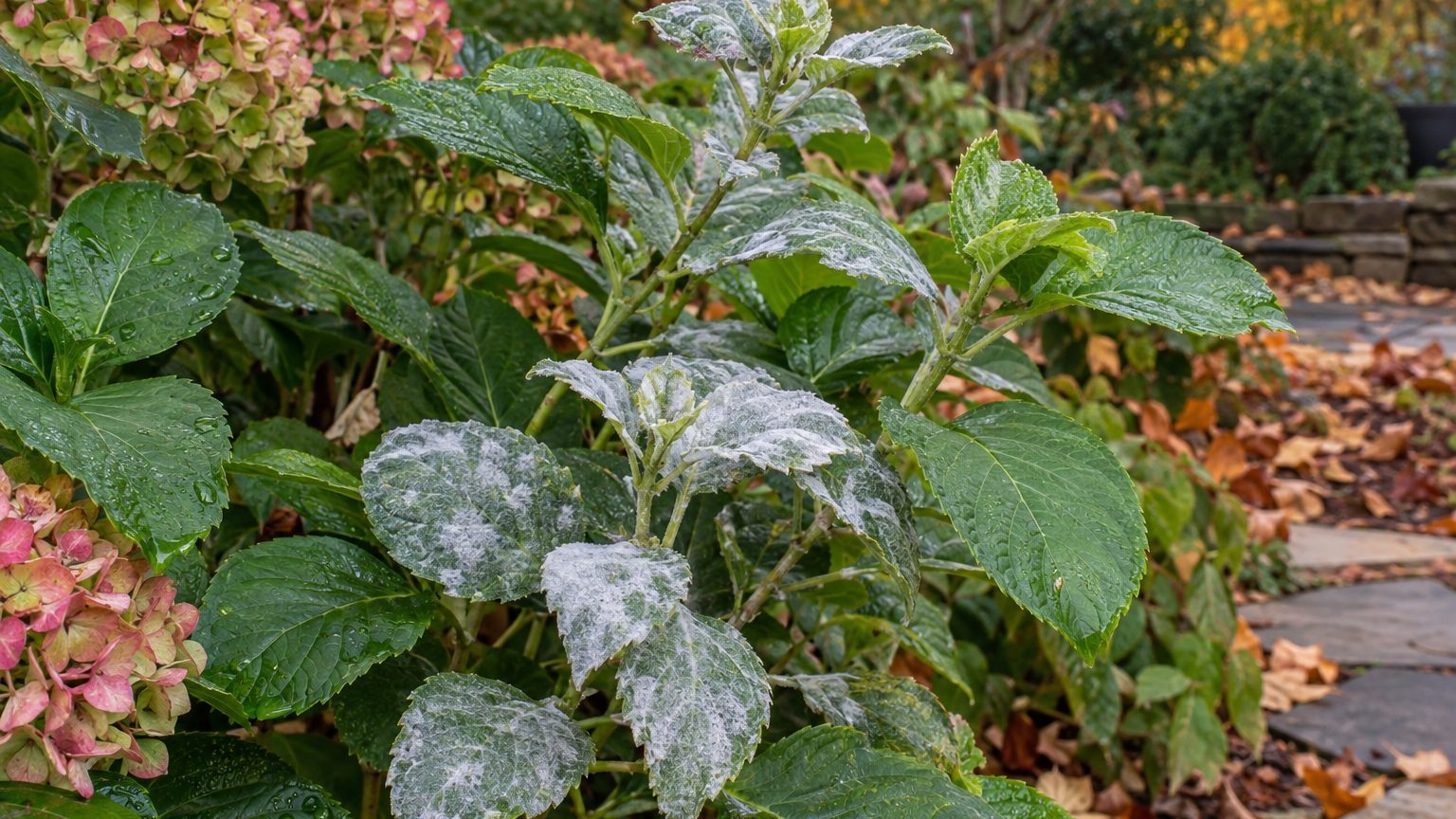
Powdery mildew on hydrangea shows as a white, flour-like film on the leaves, and it is usually a cosmetic problem long before it is a serious one.
Pick off the worst leaves, open up the airflow, and ask your state extension service what is registered locally before buying a spray. Which cuts are safe depends on your hydrangea type.
Powdery Mildew: What You See

The NC State Extension Gardener Plant Toolbox lists powdery mildew among the diseases of the genus, and in the yard it announces itself by sight first.
- A white to gray, flour-like film on the top of leaves, often starting on shaded or inner growth.
- Patches that spread and merge into a coating that smears off under a damp thumb.
- Young leaves that curl, twist or stay small where the coating is heavy.
- A dusty look on flower buds and sepals when the infection is bad.
- Yellowing or browning leaves under the coating, most often from midsummer into fall.
The same coating turns up on bigleaf, panicle and the other types, so the leaf names the disease and only the type tells you how far you can cut.
From the almanac
Hydrangeas in your state
The dates on this page depend on where you live. Your state's page carries its frost dates, its USDA zones and the year laid out month by month.
Northeast
Southeast
- Alabama
- Arkansas
- Delaware
- Florida
- Georgia
- Kentucky
- Louisiana
- Maryland
- Mississippi
- North Carolina
- South Carolina
- Tennessee
- Virginia
- West Virginia
Midwest
Southwest
West
Pacific Northwest
Canada
Powdery Mildew or Something Else?
The NC State Extension Gardener Plant Toolbox names leaf spot, bacterial wilt and powdery mildew for the genus, and adds rust and bud blight on panicle. Three of those can pass for a dusty leaf at a glance.
One test sorts most of them: rub the spot with a damp thumb. A coating that smears off, with green tissue beneath, points to mildew. Anything that stays put is damage inside the leaf, which is a different disease.
| Look-alike | Looks like | The sign that tells them apart |
|---|---|---|
| Rust (named on panicle) | Dusty specks on the leaf | The powder is orange, not white, and it usually sits on the underside of the leaf. |
| Leaf spot | Blotched, discolored leaves | The spots have a defined edge and nothing wipes off. |
| Bacterial wilt | Limp, drooping shoots | The leaves droop with no coating on them, even when the soil is moist. |
Each of the first and last has its own sheet: Hydrangea Rust on Hydrangeas: Signs, Treatment and Prevention and Bacterial Wilt on Hydrangeas: Signs, Treatment and Prevention. Bud blight is covered separately.
What Causes Powdery Mildew, and Where It Is Worst
Powdery mildew is a fungus that settles where air stays still and stems crowd. The NC State Extension Gardener Plant Toolbox, which puts panicle at 3a to 8b and bigleaf at 6a to 11b, lists it for the genus but maps nothing, so I read regions by type.
- Great Lakes and the North (Michigan, Minnesota, Wisconsin): panicle and smooth do the work here, so crowded stems on those two are the ones to watch.
- Northeast and Mid-Atlantic (New York, Pennsylvania, Virginia): the mix widens to bigleaf, oakleaf and mountain, so check each type’s wood before you cut anything.
- The South (Georgia, Texas, the Carolinas): bigleaf reaches up to zone 11b, and its dappled-to-deep-shade spots are the still corners where a fungus settles.
- Plains and Mountain West (Colorado, Nebraska, Kansas): panicle, the only hydrangea that takes full sun well, suits open sites where air moves.
Your state’s page carries the zone, the type and the calendar for your yard, and the other sheets sit under Hydrangea Diseases.
How to Treat Powdery Mildew
Start with the type you own, because the NC State Extension Gardener Plant Toolbox splits hydrangeas by which wood carries the flowers, and that sets how much you can cut.
- Wipe one leaf: a chalky smear that lifts off under a damp thumb, with green tissue beneath, separates mildew from spotting.
- Bag the worst leaves: pick off heavily coated leaves and put them in the trash, not the compost pile, so the spores leave the yard.
- Thin by type: on panicle and smooth, which flower on new wood, take out a few crowded inner stems, but on bigleaf, oakleaf, mountain and climbing, remove leaves only.
- Water the soil, not the leaves: do it early in the day so the foliage is dry well before night.
- Call your county extension office: ask which fungicide, if any, is registered in your state, since that list changes by state and I won’t guess it.
- Recheck weekly: look at new growth and leaf undersides, and note whether the coating is spreading.
Bag the leaves, spare the stems. Cutting an old-wood hydrangea back hard to chase mildew can cost next year’s flowers, since bigleaf buds form the previous summer. A damaged leaf is the cheaper loss.
How to Prevent Powdery Mildew Coming Back
The calendar does most of the prevention, and it starts with roots, since the NC State Extension Gardener Plant Toolbox lists macrophylla and paniculata as shallow-rooted and says both benefit from mulch.
- Late winter: on panicle, which flowers on the current season’s growth, thin a few crowded stems to open the center to air.
- Spring planting: leave room for mature size, 3 to 6 feet tall and wide for bigleaf and 8 to 25 feet for panicle, and mulch over the shallow roots.
- Summer watering: water at the base early in the day, and check inner stems and leaf undersides about once a week.
- Late summer: leave bigleaf and other old-wood types uncut, because next year’s buds are forming now.
- Autumn: rake up and bag fallen leaves from any plant that had mildew.
- Winter: if you cut dead hollow stems, leave stubs 12 to 24 inches tall, where native bees nest.
Your state page sets the exact dates, and the type decides which of these steps apply to you.
Where this comes from
Hardiness ranges, wood types and the disease list come from the NC State Extension Gardener Plant Toolbox entry for Hydrangea. The symptom descriptions are general field guidance, not figures from that entry.
Treatment rules vary by state, so confirm what is registered and recommended with your state’s cooperative extension service before you spray anything. A county office can often help you confirm your hydrangea type from a photo of the leaf and bloom.
Common questions
Can powdery mildew kill a hydrangea?
It mostly disfigures leaves. A thick coating that spreads year after year is worth a call to your county extension office, which can rate the risk in your area.
Does my hydrangea type change how I treat it?
Yes. Panicle and smooth flower on new wood and tolerate thinning, while bigleaf, oakleaf, mountain and climbing carry buds on old wood, so heavy cutting can remove flowers.
Will it come back next year?
It can, whenever still air and crowded stems return. Late-winter thinning on panicle and a fall cleanup of fallen leaves are the two habits that work against it.