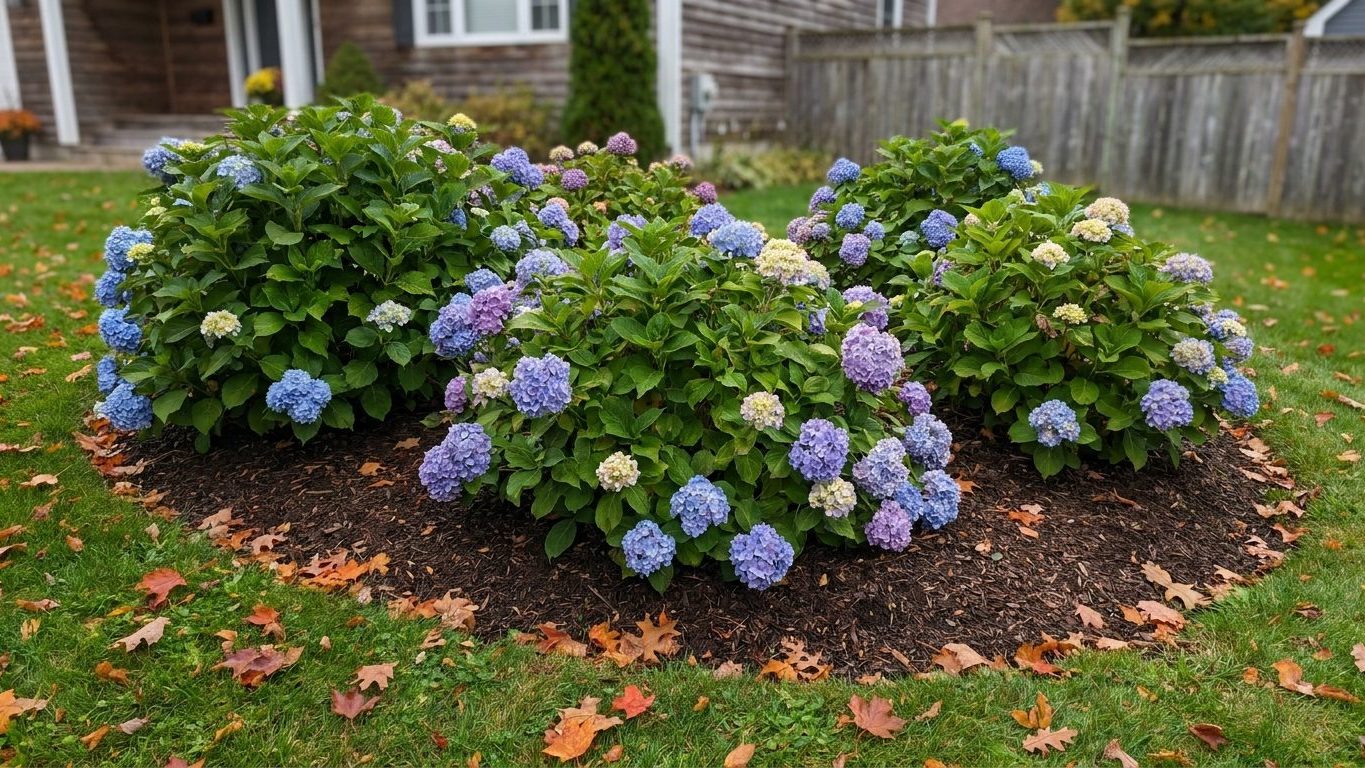
Hydrangeas grow well across Nova Scotia as long as the variety matches a Canadian zone 6b winter and a growing season that runs from an average last frost near May 7 to an average first frost near October 18. Panicle and smooth types bloom reliably here. Bigleaf and oakleaf types, which set buds on last year’s wood, face real odds of winter bud kill.
Hydrangeas Care Calendar for Nova Scotia

Environment and Climate Change Canada’s Canadian Climate Normals put Halifax’s average last spring frost at May 7 and average first fall frost at October 18, inside Canadian hardiness zone 6b, and that mean date is a midpoint, not a guarantee: half of all years bring frost later.
- Dormancy: the safe window to move a plant sits in the weeks before May 7, while roots stay dormant and undisturbed.
- Planting: put new hydrangeas in the ground two to three weeks after May 7, once the soil has warmed enough to work.
- Feeding: a first feed lands four to six weeks after May 7, timed to new leaf growth rather than the calendar page.
- Deep watering: through the height of summer, roughly ten to twelve weeks after May 7, when the plant is drinking hardest.
- Deadheading: spent blooms come off through late summer, anywhere from twelve to sixteen weeks after May 7.
- Mulching for winter: pile mulch two to three weeks before October 18, ahead of the first hard freeze.
- Wrapping tender types: burlap or a cage goes up in the week bracketing October 18, once leaves have dropped.
None of these windows is a promise. A late May frost or an early October one can shift every step by two weeks in either direction, so the plant’s own buds are the better clock.
Nova Scotia — the year and the numbers
- State
- Nova Scotia
- Hardiness zones
- 6b
- Last spring frost
- May 7
- First fall frost
- October 18
- Annual rain
- 55 in
- Lawn zone
- cool-season
- Source
- Environment and Climate Change Canada — Canadian Climate Normals 1981-2010, station HALIFAX STANFIELD INT'L A · Halifax
Best Hydrangeas for Nova Scotia
Natural Resources Canada’s Plant Hardiness Site places Halifax in Canadian zone 6b, a system built on seven climate variables rather than the single one behind USDA maps, so it never converts directly onto that other scale.
That distinction matters here because winter, not summer heat, decides which hydrangea blooms. Types that flower on new wood shrug off a hard freeze. Types that rely on last year’s growth gamble every single year.
| Kind | Flowers on | Fares in zone 6b | Why |
|---|---|---|---|
| Bigleaf (Hydrangea macrophylla) | Old wood | Marginal | Winter often kills the flower buds even when the stems live |
| Panicle (Hydrangea paniculata) | New wood | Reliable | Blooms each year on fresh growth no matter how far it died back |
| Smooth (Hydrangea arborescens) | New wood | Reliable | Dies back hard some winters and rebounds by midsummer regardless |
| Oakleaf (Hydrangea quercifolia) | Old wood, mostly | Marginal to poor | An old-wood bloom habit meets a winter that can strip the buds |
Mountain hydrangea and climbing hydrangea can work in a sheltered courtyard, but the other kinds are on their own pages. For a first shrub in an open Nova Scotia yard, new-wood bloomers save a season of disappointment.
When to Plant, Prune and Feed Hydrangeas in Nova Scotia
Environment and Climate Change Canada’s Canadian Climate Normals put Halifax’s average last frost at May 7, and everything below counts forward or back from that one mean date.
The window is wider than it looks. Since frost falls later than average in half of all years, treat these ranges as a starting point checked against your own ground.
| Task | Window here | Counted from |
|---|---|---|
| Planting | Two to three weeks after May 7 | Average last spring frost |
| Pruning new-wood types | Roughly ten to twelve weeks before May 7, in late winter, before growth starts | Average last spring frost, counted backward |
| Feeding | Four to six weeks after May 7 | Average last spring frost |
| Last safe pruning cut | Six to eight weeks before October 18 | Average first fall frost, counted backward |
The month-by-month calendar page breaks all twelve months down in full. These three windows are the ones that actually move the needle.
Hydrangeas Problems in Nova Scotia and What Causes Them
No blooms after a mild-looking winter
Bigleaf types set next year’s flowers on old wood, and a Canadian zone 6b winter can kill those buds even when the stems survive. Skip old-wood bloomers or wrap them in fall, and lean on the new-wood kinds listed above.
New growth blackened in spring
The May 7 last-frost date is a mean, not a promise, so in roughly half of all years frost arrives after new leaves have already pushed out and burns them black. Hold off feeding until growth looks settled, and expect a second flush.
Stems dying back to the snowline every year
A short season between May 7 and October 18 leaves little time for new wood to harden off before the first frost, so soft growth is the first casualty of winter. Choose kinds that flower on new wood, since dieback barely costs them a season.
Nova Scotia North to South: How the Dates Shift
Halifax’s frost dates are one station’s average, and the rest of the province leans earlier or later depending on the coast, the hills, and the distance from open water.
- The Annapolis Valley (Kings, Annapolis counties): the mildest pocket in the province, sheltered by hills on both sides, tends to leaf out a little ahead of the Halifax mean.
- The Atlantic coast (Halifax, the South Shore, the Eastern Shore): ocean fog keeps spring cool and delays leaf-out, but it also buffers the hardest cold, easing bud kill on old-wood types.
- Cape Breton and the interior highlands (Inverness, Victoria counties): elevation and distance from the coast push spring frost later and fall frost earlier, shortening the whole season.
None of that changes the province-wide averages, only where your yard sits inside them.
Nova Scotia Extension Offices and County Contacts
The Canadian zone 6b figure and the May 7 to October 18 frost window come from Halifax, and your yard may run earlier or later. Nova Scotia’s Department of Agriculture keeps county-level contacts for gardeners who want a local check before planting.
- The Nova Scotia calendar page: all twelve months laid out, not just the three windows covered here.
- Which ones hold up here: a closer look at bigleaf, panicle, smooth, and oakleaf side by side.
- What goes wrong here: the pests and diseases tied to Maritime humidity and salt air.
Whatever the source, the first move stays the same: check the ground before the calendar.
Common questions
Can hydrangeas survive winter in Nova Scotia?
Yes. New-wood types like panicle and smooth handle a Canadian zone 6b winter reliably, dying back and regrowing each spring, while old-wood bigleaf types are hit or miss from one year to the next.
When is the best time to plant hydrangeas in Nova Scotia?
Two to three weeks after the average May 7 last frost at Halifax, once the soil has warmed, gives roots the longest run before the average October 18 first frost.
Do hydrangeas need winter protection in Nova Scotia?
Old-wood bloomers benefit from mulch and a burlap wrap before the ground freezes solid. New-wood types generally skip that step, since they flower regardless of how far they die back.