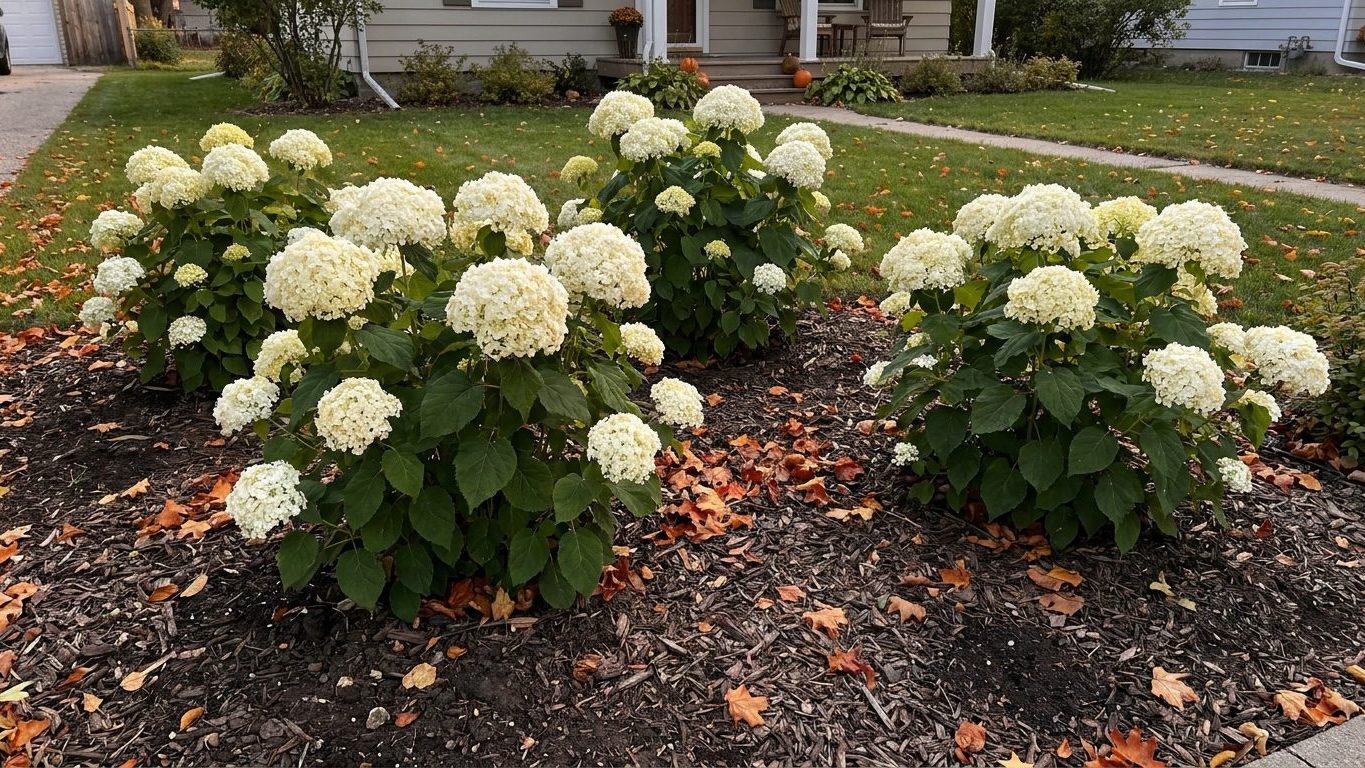
Panicle and smooth hydrangeas are the two kinds that reliably survive winter in North Dakota, where the USDA rates hardiness at zone 3a to 4b. Plant either one two to three weeks after Fargo’s last spring frost, typically May 4 to 15, and skip bigleaf and oakleaf types, which rarely make it through an open winter here.
Hydrangeas Care Calendar for North Dakota

Fargo’s growing season is short and boxed in by real cold on both ends, and that box is what a hydrangea calendar here has to work around.
- Dormancy: from late fall through winter, roots sit still and pruning waits, since NOAA NCEI U.S. Climate Normals 1991-2020 puts Fargo’s last spring frost between May 4 and May 15.
- Planting: hold off until two to three weeks after that window closes, landing roughly in late May into early June.
- Root establishment: the six to eight weeks right after planting matter most, since a shrub moved into North Dakota soil needs that stretch before summer heat sets in.
- Bud set and bloom: through midsummer, whichever kinds tolerate this zone push their buds and open, on a compressed timeline compared to gardens further south.
- Pruning: the right timing depends on the kind, and getting it wrong can wipe out a whole season of flowers, which the planting and pruning section below sorts out.
- Fall prep: four to six weeks before the first fall frost, which lands between September 25 and October 5, feeding stops and mulch goes down.
- Winter protection: once the ground freezes, a deep mulch layer over the crown is often what decides whether a shrub returns, given a statewide hardiness range of 3a to 4b.
Every window here shifts with your own county, so treat Fargo’s dates as the starting point rather than the final word.
North Dakota — the year and the numbers
- State
- North Dakota
- USDA zones
- 3a-4b
- Last spring frost
- May 4 to May 15
- First fall frost
- September 25 to October 5
- Annual rain
- 24 in
- Lawn zone
- cool-season
- Source
- NOAA NCEI U.S. Climate Normals 1991-2020, 32F freeze probabilities · Fargo
Best Hydrangeas for North Dakota
The USDA Plant Hardiness Zone Map 2023 places North Dakota at 3a to 4b, and that range does most of the deciding here. Anything rated no hardier than zone 5 struggles to make it through winter outdoors in this state.
Two kinds handle this cold without extra fuss, and both flower on new wood, which matters when winter routinely kills stems back to the ground anyway.
| Kind | Verdict here | Why |
|---|---|---|
| Panicle | Reliable | Cold-hardy well into this range, blooms on new wood so dieback doesn’t cost flowers |
| Smooth | Reliable | Native-range cold tolerance, also flowers fresh from the ground each year |
| Bigleaf | Not reliable | Sets buds on old wood that rarely survives a North Dakota winter |
| Climbing | Marginal | Needs years of established growth that winter dieback keeps resetting to zero |
Oakleaf hydrangea runs into the same old wood problem as bigleaf, and it gets its own fuller writeup on the page covering which kinds hold up in this state.
When to Plant, Prune and Feed Hydrangeas in North Dakota
Three dates carry most of the weight in a North Dakota hydrangea year, and all three count backward or forward from the same two frost windows.
Missing any one of them costs a season, whether that means a shrub planted too soon or a pruning cut made at the wrong point in its cycle.
| Task | Window here | Counted from |
|---|---|---|
| Planting | Late May into early June | Two to three weeks after the last spring frost of May 4 to 15 |
| Pruning, panicle and smooth | Late winter into early spring, before new growth | While still dormant, ahead of the May 4 to 15 frost window |
| Feeding | Stops by late summer | Six to eight weeks before the first fall frost of September 25 to October 5 |
Because bigleaf and oakleaf blooms rely on old wood that rarely survives here, their pruning calendar is mostly academic for a North Dakota yard.
Hydrangeas Problems in North Dakota and What Causes Them
No flowers despite a healthy shrub
Old wood buds carried through a North Dakota winter usually die at zone 3a to 4b cold, so a bigleaf or oakleaf shrub can green up fine and still skip flowers entirely. Switching to a panicle or smooth type, covered above, sidesteps the problem for good.
New growth blackened in late spring
Tender leaves that push out before Fargo’s last frost window of May 4 to 15 get nipped and turn black almost overnight. Holding off on uncovering or feeding until that window closes protects the new growth underneath.
Stems that never harden off before winter
Growth pushed too late in the season, often from feeding past the cutoff, stays soft going into the first fall frost of September 25 to October 5 and dies back further than it should. Stopping fertilizer six to eight weeks ahead of that date gives stems time to toughen up.
North Dakota North to South: How the Dates Shift
- The Red River Valley (Fargo, Grand Forks): the flattest, lowest ground in the state, and typically the first spot to see a killing frost lift in spring.
- The northern tier (Bottineau, Rugby, near the Canadian border): expect both frost dates to arrive later in spring and earlier in fall than Fargo’s own.
- Western North Dakota (Dickinson, Williston, into the Badlands): higher elevation and drier air compress the growing season further, with more open exposure for a shrub planted without windbreak.
- The southeast corner (Wahpeton, near the South Dakota and Minnesota lines): closest to Fargo’s own dates, since it shares similar elevation and latitude.
None of that changes the state’s overall hardiness range, which the USDA Plant Hardiness Zone Map 2023 sets at 3a to 4b, but it does mean checking your own county’s frost record before trusting Fargo’s dates outright.
North Dakota Extension Offices and County Contacts
North Dakota’s statewide hardiness range of 3a to 4b, from the USDA Plant Hardiness Zone Map 2023, is a useful starting point, but your county agent knows what last winter actually did to shrubs nearby.
- Your state page: the frost dates and pruning window gathered for North Dakota in one place.
- Which ones hold up here: the fuller rundown of hydrangea types worth planting in this zone.
- NDSU Extension: reach your county office for a local read on winter damage before you plant or prune.
Common questions
Can hydrangeas survive winter outdoors in North Dakota without protection?
Panicle and smooth types generally can, given the state’s 3a to 4b hardiness range, though a mulch layer over the crown improves the odds. Bigleaf and oakleaf types typically need pot culture or heavy winter protection to make it through.
When is it safe to plant a new hydrangea in North Dakota?
Wait two to three weeks after Fargo’s last spring frost of May 4 to 15, which usually lands in late May into early June, before setting a new shrub in the ground.
Why didn’t my hydrangea bloom this year even though it looks healthy?
If it’s a bigleaf or oakleaf type, the old wood buds most likely died over winter in this cold, leaving healthy leaves but no flowers. A new wood bloomer like panicle or smooth avoids that outcome entirely.