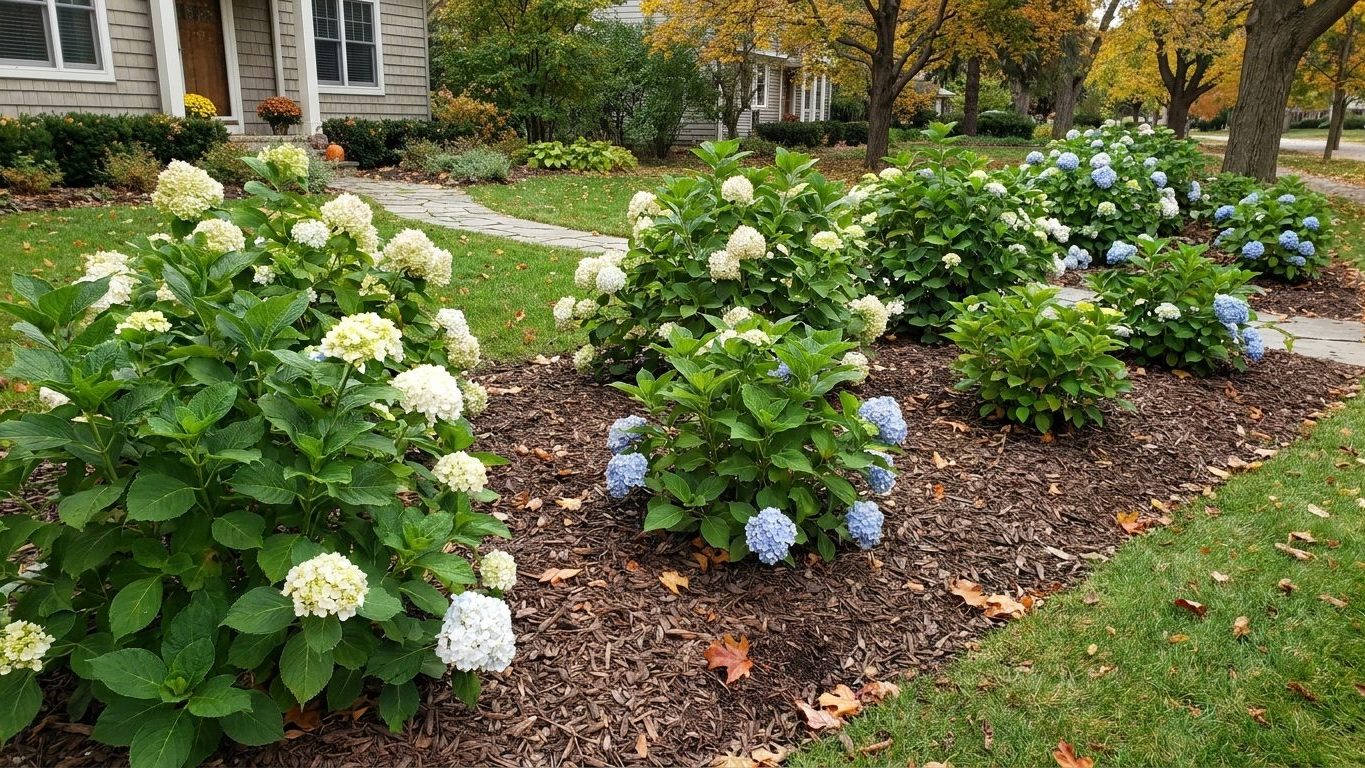
Wisconsin homeowners can grow hydrangeas across the whole state, but the safe kind depends on which side of the frost you’re planting. Panicle and smooth hydrangeas flower on new wood and shrug off the state’s harsh winters, while bigleaf and mountain types set next year’s buds on old wood that a Wisconsin winter regularly kills. The right pick, and the right planting date, both trace back to two frost dates and one hardiness range.
Hydrangeas Care Calendar for Wisconsin

NOAA NCEI 1991-2020 Climate Normals put Milwaukee’s last spring freeze at April 16 to April 29 and the first fall freeze at October 17 to October 29, and that gap, inside a state that spans USDA zone 3b to 6a, decides which hydrangeas even make it through a Wisconsin winter.
- Dormancy: the one safe window to dig up or move a shrub, roots undisturbed, runs from leaf drop through late winter while the plant is fully asleep.
- Planting: set new hydrangeas in the ground two to three weeks after the last spring freeze, once the soil has actually warmed underneath.
- Feeding: give one balanced feeding as new growth starts and stop there, so soft new wood has the whole season to harden off.
- Pruning new-wood kinds: cut panicle and smooth hydrangeas back hard while they’re still dormant, ahead of the last spring freeze.
- Pruning old-wood kinds: trim bigleaf and mountain hydrangeas right after the flowers fade, never in fall and never in spring.
- Winter cover: mound mulch or cage the crown as soon as the first fall freeze passes, before hard freezes settle in for good.
Every one of those jobs can shift by a week or two depending on exactly where you garden inside the state, but the frost dates above are the anchor for all of them.
Wisconsin — the year and the numbers
- State
- Wisconsin
- USDA zones
- 3b-6a
- Last spring frost
- April 16 to April 29
- First fall frost
- October 17 to October 29
- Annual rain
- 35 in
- Lawn zone
- cool-season
- Source
- NOAA NCEI 1991-2020 Climate Normals, 32F freeze probabilities · Milwaukee
Best Hydrangeas for Wisconsin
The safest choices here build flower buds on the current season’s growth, since a bud that forms in June can’t be undone by a January cold snap. That single trait separates a shrub that blooms every year from one that sulks.
Old-wood bloomers are the gamble. Their buds form the summer before and sit exposed all winter, and a state spanning USDA zone 3b to 6a claims a lot of them before spring ever shows up.
| Kind | Flowers on | Verdict here | Why |
|---|---|---|---|
| Panicle (Limelight, Tardiva) | New wood | Reliable statewide | Blooms even after winterkill, from the far north to the state line |
| Smooth (Annabelle, Incrediball) | New wood | Reliable statewide | Same new-wood habit, handles the coldest counties without a fuss |
| Oakleaf | Old wood, mostly | Better in the south | Buds often die where winters run hardest |
| Bigleaf | Old wood | Needs shelter or a pot | Old-wood buds rarely survive an open Wisconsin winter |
| Mountain | Old and new wood | Marginal | Some rebloom on new wood, but stems still winterkill in hard years |
Climbing hydrangea and a handful of reblooming bigleaf cultivars are on their own pages, since one table row can’t do them justice. The variety-by-variety page for this state sorts named cultivars county by county, which goes further than this overview needs to.
When to Plant, Prune and Feed Hydrangeas in Wisconsin
NOAA NCEI 1991-2020 Climate Normals anchor every date below, counted from Milwaukee’s last spring freeze of April 16 to April 29 and its first fall freeze of October 17 to October 29. Three windows matter more than the rest of the calendar combined.
Planting waits for the soil to warm, pruning waits for dormancy or for the last bloom to drop, and feeding stops early enough that new growth has time to toughen before fall arrives.
| Task | Window here | Counted from |
|---|---|---|
| Planting | Two to three weeks after the freeze risk drops | Last spring freeze, April 16 to April 29 |
| Pruning, new-wood kinds | While still dormant, before buds swell | Ahead of the last spring freeze |
| Pruning, old-wood kinds | Right after flowers fade, by midsummer | At least ten weeks before the first fall freeze |
| Feeding | One application as growth starts, none after midsummer | Six to eight weeks before first fall freeze, October 17 to October 29 |
Bigleaf and mountain hydrangeas follow the same feeding clock but a stricter pruning one, since cutting them at the wrong point removes next year’s flowers outright. The month-by-month calendar page for this state walks through the rest of the season in order.
Hydrangeas Problems in Wisconsin and What Causes Them
No flowers on an otherwise healthy shrub
This is almost always lost old-wood buds, not disease. A gardener who prunes a bigleaf or mountain hydrangea in fall, or who leaves buds exposed through a hard freeze inside the state’s zone 3b to 6a range, cuts off next year’s bloom before it starts.
Buds burned by a late spring freeze
Wisconsin’s last spring freeze lands anywhere from April 16 to April 29, late enough to catch buds that broke early after a warm stretch. Leaving winter mulch in place until that window passes protects the soft new growth underneath from a surprise cold night.
Leaves scorched by midsummer sun
Full afternoon sun paired with a dry stretch scorches leaf edges, especially on bigleaf types planted for morning shade alone. A part-shade spot and a deep, regular watering schedule fix most of this without any pruning or spraying involved.
Wisconsin North to South: How the Dates Shift
The ten-day spread in both frost dates hides real differences depending on where inside the state you garden, and the lake matters more than latitude alone.
- The Lake Michigan shoreline (Milwaukee, Sheboygan, Green Bay): the lake holds its warmth into fall, so the first freeze here lands closer to the late end of the state’s October 17 to October 29 window.
- Inland southern Wisconsin (Madison, Janesville, Beloit): without the lake’s buffer, this stretch typically freezes earlier, often by early October, even as spring arrives sooner here too.
- The north (Rhinelander, Ashland, Superior): the shortest growing season in the state, closer to zone 3b, with the earliest freeze of anywhere in Wisconsin.
The county extension contacts below narrow any of this further than a statewide range ever can on its own.
Wisconsin Extension Offices and County Contacts
The USDA NIFA Land-Grant University Extension directory lists the University of Wisconsin-Madison Division of Extension as the state’s contact point, and a county office there fills in what a statewide zone 3b to 6a range can’t.
- Your county extension office: part of University of Wisconsin-Madison Division of Extension, for soil tests and frost-date specifics where you actually live.
- Which ones hold up here: the variety-by-variety page for Wisconsin, with named cultivars sorted by climate.
- The month-by-month calendar: every task for the year, laid out in order from dormancy to bloom.
With the first fall freeze only weeks away, this is the month to stop feeding and start mounding mulch, not to wait on a phone call.
Common questions
Can I plant hydrangeas in Wisconsin in fall?
Fall planting works if the shrub goes in the ground well ahead of the first fall freeze, which runs October 17 to October 29 across the state, giving roots time to settle before the ground locks up for winter.
Do hydrangeas need winter protection in Wisconsin?
Bigleaf and mountain hydrangeas usually need mounded mulch or a cage over the crown, since their old-wood buds sit exposed through a winter that spans USDA zone 3b to 6a. Panicle and smooth types rarely need more than a normal mulch layer.
Why did my hydrangea survive but not bloom?
The shrub itself is hardy enough for the state’s coldest zones, but the flower buds it set the previous summer likely froze over winter or were pruned off by mistake in fall, a common mix-up with old-wood bloomers here.