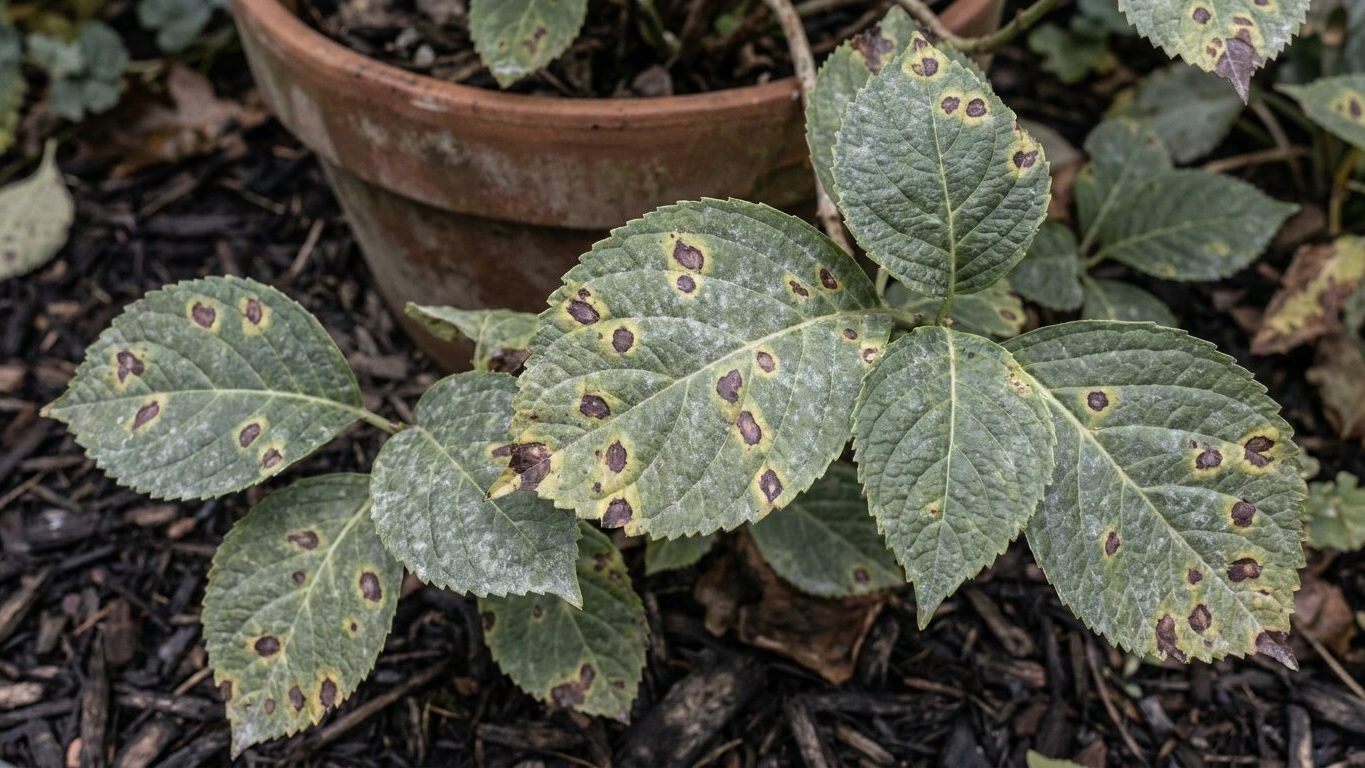
Leaf spot, powdery mildew, bacterial wilt, and a crown that turns soft and rots at the soil line: these are the problems that show up on hydrangeas across the country. None of them ends a shrub outright, but each one costs a season of bloom if it’s ignored. What decides the outcome is the type of hydrangea in your yard and the humidity around it, not a single spray.
Hydrangea Diseases: The Short Answer
NC State Extension Gardener Plant Toolbox places the hydrangea genus across USDA zones 3a through 9b, and that spread is exactly why disease pressure shifts so much from yard to yard. Humidity and airflow matter more than the calendar.
The source names three diseases for the whole genus: leaf spot, bacterial wilt, and powdery mildew. Panicle hydrangeas pick up two more, rust and bud blight, because their flower buds sit exposed on new wood all summer.
Type decides more than zone does. A bigleaf hydrangea holds its flower buds through winter on old wood, which puts frost damage and fungal spotting on the same plant at the same time.
The state selector below this section leads straight to your state’s page, where the local pressure and the pruning window are laid out.
From the almanac
Hydrangeas in your state
The dates on this page depend on where you live. Your state's page carries its frost dates, its USDA zones and the year laid out month by month.
Northeast
Southeast
- Alabama
- Arkansas
- Delaware
- Florida
- Georgia
- Kentucky
- Louisiana
- Maryland
- Mississippi
- North Carolina
- South Carolina
- Tennessee
- Virginia
- West Virginia
Midwest
Southwest
West
Pacific Northwest
Canada
Hydrangea Diseases, Step by Step

Work through the plant in this order, from the leaves down to the roots, before reaching for any spray.
- Check the leaf pattern first: NC State Extension Gardener Plant Toolbox names leaf spot as one of three diseases that reach across the genus, showing as brown or purple rings scattered on older leaves rather than new growth.
- Look for a white or gray coating: powdery mildew sits on top of the leaf like flour dust and thickens in still, humid air, especially on shrubs pressed against a fence or wall.
- Test for wilt that water doesn’t fix: bacterial wilt drops the whole shoot even when the soil underneath is damp, the tell that separates it from ordinary drought stress.
- Press the base of the stem: a crown that feels soft or dark under the mulch points to rot from soil that never drains, since the source lists good drainage as a requirement even where occasional wet soil is tolerated.
- Rule out pests before blaming disease: aphids, scales, mites, and nematodes turn up on the same plant, but the source calls them rarely a problem next to the fungal and bacterial issues above.
- Match the fix to your type: a bigleaf hydrangea and a panicle hydrangea don’t share a treatment calendar, so the next section sorts out which pressure applies to which shrub.
None of these six checks needs a lab. A hand lens for the mildew, a thumbnail press on the crown, and a look at where the wilt starts tell you most of what a diagnostic clinic would.
Hydrangea Diseases by Hydrangea Type
Disease pressure and pruning risk trace back to one fact: does the shrub bloom on last year’s wood or this year’s growth? NC State Extension Gardener Plant Toolbox puts bigleaf at 6a to 11b, flowering only on wood set the previous summer, so a late frost erases the whole show.
Panicle hydrangea flowers on the current season’s growth instead, and it can take a hard cut back in late winter without losing a single bloom. It’s also the only type in the group that handles full sun well.
| Kind | Flowers on | USDA zones | Sun |
|---|---|---|---|
| Bigleaf | Last year’s wood | 6a–11b | Part shade, protect from afternoon sun |
| Panicle | Current season’s growth | 3a–8b | Full sun |
Smooth, oakleaf, mountain, and climbing hydrangeas all set their buds on old wood too, but each carries its own quirks, from oakleaf’s wine-red fall color to climbing hydrangea’s slow start. Those four are on their own pages, where zone and timing specifics are laid out type by type.
Hydrangea Diseases: Mistakes That Cost a Season
Watering the leaves at dusk
Wet foliage overnight is what lets leaf spot and powdery mildew take hold, since both need standing moisture on the leaf surface to establish. Aim water at the soil instead, and check your type’s page for how much a mature shrub actually needs.
Pruning an old-wood type in spring
Bigleaf, oakleaf, mountain, and climbing hydrangeas set their flower buds the summer before, so a spring cut removes the very wood that was about to bloom. Save the shears for right after flowering, and let your state page settle the exact window for your zone.
Feeding for growth instead of color
A high-phosphorus fertilizer locks up the aluminum a bigleaf or mountain hydrangea needs to turn blue, so a plant fed for bigger blooms can drift pink even in acid soil. Coffee grounds and citrus peel move the pH too little to matter, whatever the yard talk says.
Hydrangea Diseases in Your State
The genus spans USDA zones 3a through 9b, too wide a range for one national answer on disease timing or pruning risk. Your zone and your hydrangea’s type decide the rest.
- Your state page: the frost dates and the pruning window that apply where you live.
- Which types hold up here: whether a bigleaf or a panicle hydrangea is the better bet for your winters and summers alike.
- Your local extension office: the fastest way to confirm a diagnosis before treating the wrong problem.
Common Questions
Is leaf spot the same as powdery mildew?
No. Leaf spot shows as brown or purple rings on the leaf surface, while powdery mildew looks like a dusting of flour sitting on top of the leaf. Both thrive in still, humid air, but they’re separate problems with separate causes.
Can a hydrangea with bacterial wilt be saved?
The shoot that wilts despite damp soil is already lost, and the source lists bacterial wilt alongside leaf spot and powdery mildew as one of the genus’s named diseases. Removing the affected stems and improving airflow around the rest of the plant is the practical response.
Does soggy soil always mean rot?
Not always, but it’s the first thing to check. The source lists good drainage as a requirement even where occasional wet soil is tolerated, so a crown that stays wet for days rather than hours is the pattern worth watching.