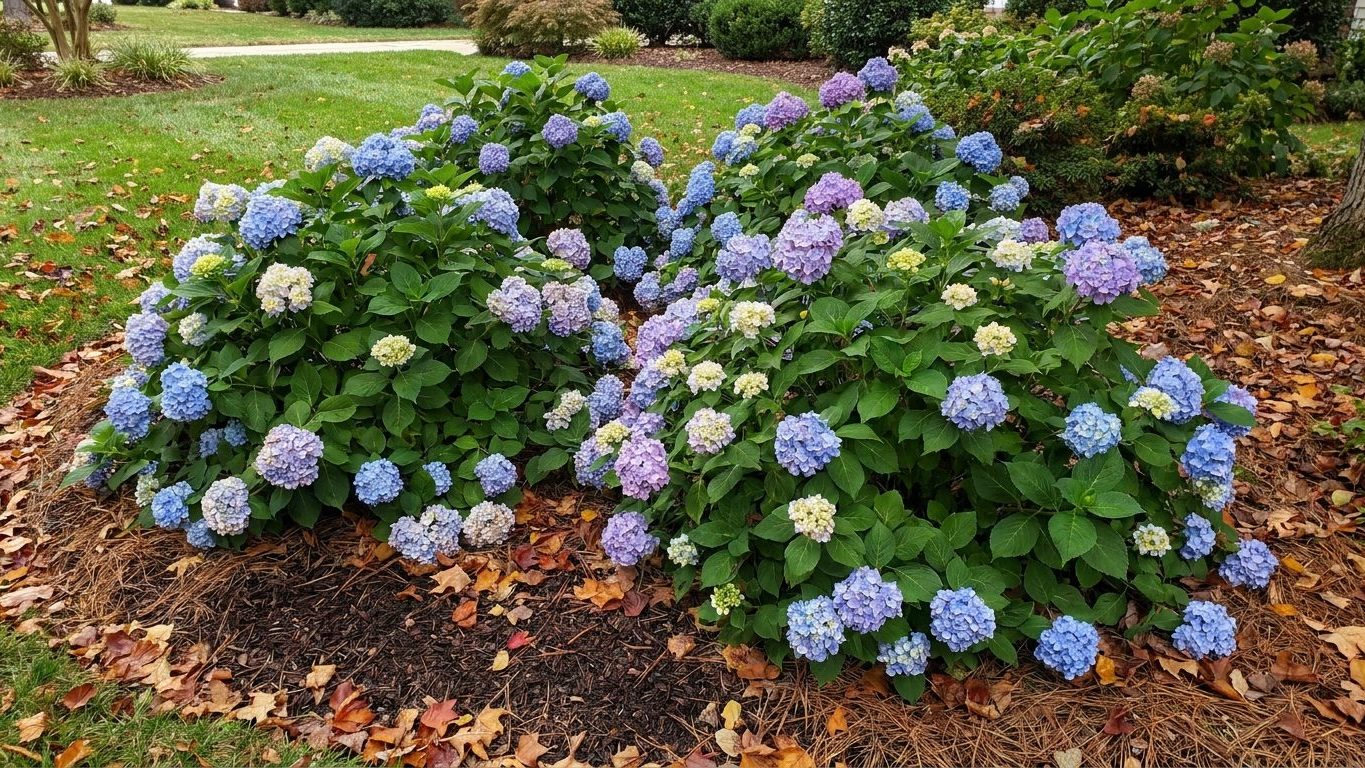
Hydrangeas in Virginia bloom well from the mild coast to the cold Blue Ridge, but the shrub that thrives in Virginia Beach can struggle two hundred miles west. The state’s frost windows and its zone 5a to 8b range decide what to plant, when to prune, and which kind actually flowers here. The sections below walk through the year, the varieties, and the trouble spots.
Hydrangeas Care Calendar for Virginia

In Virginia Beach, NOAA NCEI 1991-2020 Climate Normals for station USW00013769 place the last spring frost between March 20 and April 3, and the first fall frost between November 10 and November 24, across a state that runs USDA zones 5a to 8b. That decides one thing for a hydrangea: trust the freeze, not the calendar.
- Dormancy: the stretch from the first fall frost window into the last spring frost window is the one safe time to dig up and move a shrub with its roots undisturbed.
- Planting: wait two to three weeks past the last spring frost window before setting a new hydrangea in the ground, so a late cold snap can’t hit tender roots.
- Mulching: lay two to three inches of mulch right after planting to hold moisture through the humid weeks that follow.
- Bud watch: a freeze that lands inside the last spring frost window can still nip swelling buds on old-wood types, so cover the shrub on any cold night in that stretch.
- Bloom check: old-wood bigleaf types typically show color six to eight weeks after the last spring frost window closes.
- Feed cutoff: stop nitrogen feeding roughly six weeks ahead of the first fall frost window, so new growth has time to harden off.
- Winter mulch: pile mulch heavier once the first fall frost window opens, from November 10 to November 24, to protect the base through winter.
Every one of those windows runs later in spring and earlier in fall west of Virginia Beach, so a homeowner in the Blue Ridge should read each range as later, not earlier.
Virginia — the year and the numbers
- State
- Virginia
- USDA zones
- 5a-8b
- Last spring frost
- March 20 to April 3
- First fall frost
- November 10 to November 24
- Annual rain
- 47 in
- Lawn zone
- transition-season
- Source
- NOAA NCEI 1991-2020 Climate Normals, 32F freeze probabilities · Virginia Beach
Best Hydrangeas for Virginia
The USDA Plant Hardiness Zone Map places Virginia between 5a in the far southwest highlands and 8b along the coast, which means one shrub’s easy pick is another’s gamble. A hydrangea that flowers on old wood carries its buds through whatever winter that end of the state throws at it, or it doesn’t.
Heat and humidity matter as much as cold here. Coastal summers run wet and sticky, favoring kinds bred for part shade and airflow, while the drier mountain air treats the same shrub differently.
| Kind | Verdict here | Why |
|---|---|---|
| Bigleaf | Reliable near the coast, risky in the mountains | Flowers on old wood, and a late freeze inside the spring window can erase the buds |
| Panicle | Solid statewide, including the cold end | Flowers on new wood, so a hard winter doesn’t erase the season’s blooms |
| Smooth | Solid statewide | Native to eastern uplands, tolerates the state’s coldest zone, blooms on new wood |
| Oakleaf | Strong pick, especially inland | Native to the Southeast, handles Virginia summer humidity well |
Climbing hydrangea and mountain hydrangea also do fine in sheltered Virginia yards, but the other kinds are on their own pages.
When to Plant, Prune and Feed Hydrangeas in Virginia
Three dates decide most of the hydrangea year in Virginia, and all three count from the frost windows NOAA NCEI Climate Normals set for Virginia Beach, not from a fixed month.
Which one applies to a given shrub depends on whether it flowers on old wood or new, since that changes when it’s safe to cut.
| Task | Window here | Counted from |
|---|---|---|
| Plant | Two to three weeks after the window closes | Last spring frost, March 20 to April 3 |
| Prune old-wood types | Right after bloom fades, before the window opens | First fall frost, November 10 to November 24 |
| Prune new-wood types, feed | While dormant, before the window opens | Last spring frost, March 20 to April 3 |
Get the wood type wrong and a well-timed cut still costs a season of flowers, which is worth checking before any blade touches the shrub.
Hydrangeas Problems in Virginia and What Causes Them
No flowers on an otherwise healthy shrub
A spring freeze inside the March 20 to April 3 window likely killed the swelling buds on an old-wood bigleaf or oakleaf. Plant a new-wood panicle or smooth type instead, or cover buds on cold nights near that window.
Leaves scorched on the sunny side
Coastal heat and humidity near the 8a to 8b end of the state push a bigleaf past its part-shade preference. Move it to afternoon shade, or swap in an oakleaf, which tolerates more sun.
Dieback to the ground after a hard winter
A shrub planted at the 5a to 6a mountain end lost its top growth over a cold winter. Choose panicle or smooth, since both push new wood and bloom regardless.
Virginia North to South: How the Dates Shift
Frost dates and bloom windows don’t move the same way across Virginia, and elevation matters more than distance.
- Coastal Tidewater (Virginia Beach, Norfolk, the Eastern Shore): the mildest end of the state, the earliest last spring frost and the latest first fall frost, most forgiving for bigleaf.
- The Piedmont (Richmond, Charlottesville, Lynchburg): a step colder and later to warm in spring, earlier to cool in fall than the coast.
- Blue Ridge and Southwest (Roanoke, the highlands toward Bristol): the coldest end, the latest spring and the earliest fall, favors panicle and smooth over bigleaf.
The state page above uses the coastal reference station, so shift every date later in spring and earlier in fall the farther inland and uphill a yard sits.
Virginia Extension Offices and County Contacts
Virginia Cooperative Extension, reachable at ext.vt.edu, is the state’s land-grant service, and a county office there knows local soil and frost better than any statewide number.
- Virginia Cooperative Extension: ext.vt.edu lists county offices for soil tests and a local frost read.
- The month-by-month calendar: the sibling page here breaks the year into all twelve months, not just the three windows above.
- Which ones hold up here: the sibling page ranks kinds and named varieties against Virginia’s zones in more depth.
Whatever the calendar says this week, the gesture that matters is checking the forecast before you prune or plant.
Common questions
When should I prune hydrangeas in Virginia?
It depends on the kind. Old-wood bigleaf and oakleaf get cut right after bloom fades and before the first fall frost window. New-wood panicle and smooth get cut while dormant, before the last spring frost window opens.
What hydrangea variety is best for Virginia’s climate?
Panicle and smooth hydrangeas handle the state’s full 5a to 8b spread, since both bloom on new wood and shrug off a hard winter. Bigleaf works well near the coast but risks losing its buds in the mountains.
Can hydrangeas survive Virginia winters without protection?
Panicle and smooth types generally do. Bigleaf and oakleaf, both old-wood bloomers, benefit from a heavier mulch layer once the first fall frost window opens, especially west of the coastal plain.