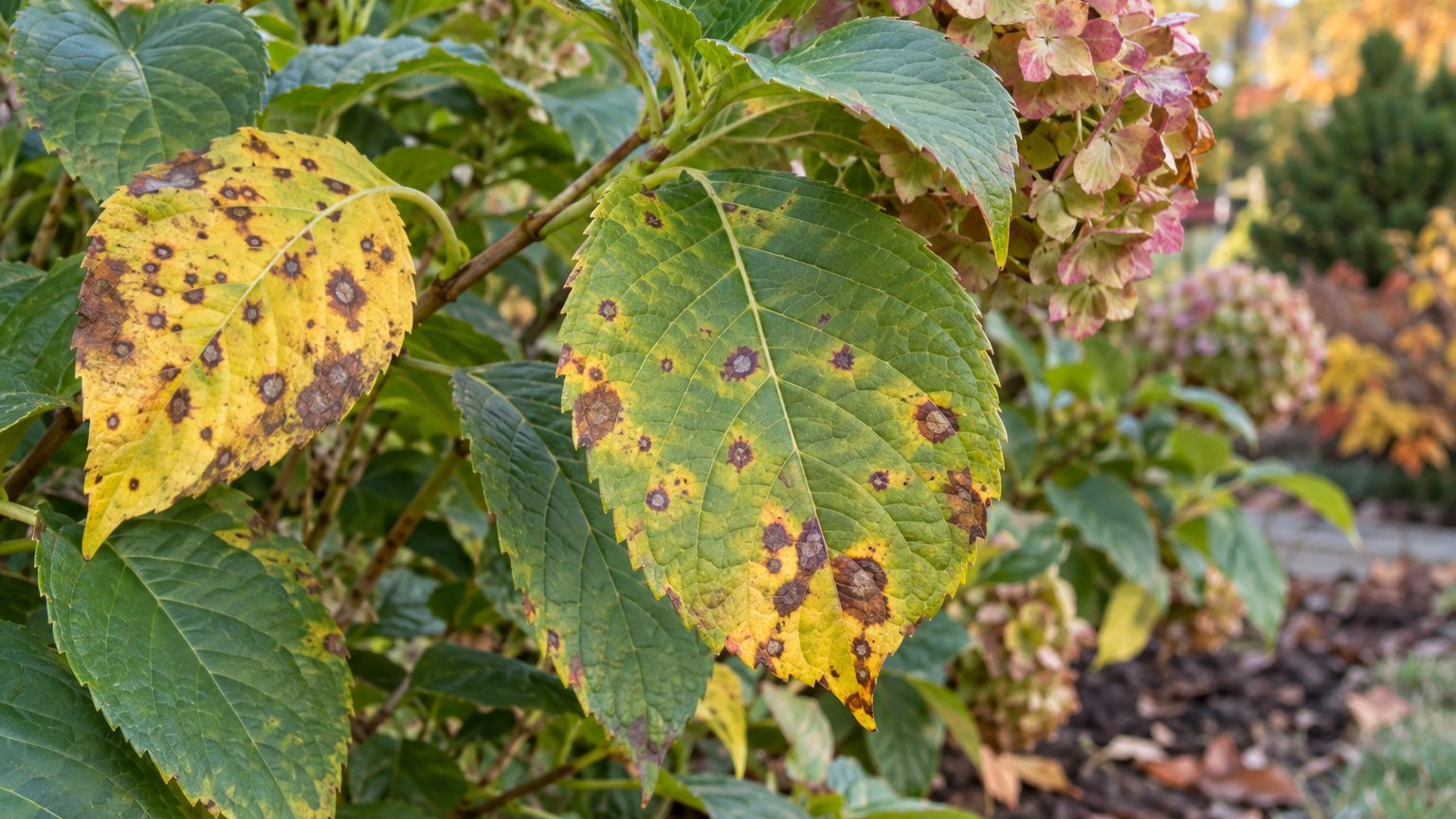
Cercospora leaf spot is a fungal disease that dots hydrangea leaves with small purple-brown spots, usually from midsummer on. It rarely kills the shrub, but it spoils the foliage and returns each year if fallen leaves stay under the plant. The fix is cleanup and dry leaves, not a spray bought on impulse.
Cercospora Leaf Spot: What You See

NC State Extension Gardener Plant Toolbox lists leaf spot among the diseases of the genus, and on the shrub it shows up in a few clear ways:
- Small round spots, purple to brown, that pale to tan or gray in the center as they age
- A yellow halo around many spots
- Lower and inner leaves hit first, where the air stays stillest
- Neighboring spots merging into blotches, then leaves yellowing and dropping early
- Worst from midsummer into fall, after warm, wet weather
Bigleaf shows it most, since its broad, soft leaves hold water, but any type can carry it.
From the almanac
Hydrangeas in your state
The dates on this page depend on where you live. Your state's page carries its frost dates, its USDA zones and the year laid out month by month.
Northeast
Southeast
- Alabama
- Arkansas
- Delaware
- Florida
- Georgia
- Kentucky
- Louisiana
- Maryland
- Mississippi
- North Carolina
- South Carolina
- Tennessee
- Virginia
- West Virginia
Midwest
Southwest
West
Pacific Northwest
Canada
Cercospora Leaf Spot or Something Else?
NC State Extension Gardener Plant Toolbox lists powdery mildew next to leaf spot, and adds rust and bud blight on panicle. Several problems make a hydrangea leaf look sick, so judge by the sign that differs, not by the general look.
Pull a few affected leaves and compare them against the table. One feature settles most cases: whether the marks stay on the leaf blade with sharp edges.
| Looks like | The sign that tells them apart |
|---|---|
| Powdery mildew | A white, dusty film that wipes off with a thumb, with no defined spots underneath |
| Anthracnose | Spots that also mark the flower petals, not only the leaves (see Anthracnose on Hydrangeas: Signs, Treatment and Prevention) |
| Botrytis blight | Gray, fuzzy mold on flowers and leaves in cool, damp weather (see Botrytis Blight on Hydrangeas: Signs, Treatment and Prevention) |
The other kinds are on their own pages, gathered under Hydrangea Diseases.
What Causes Cercospora Leaf Spot, and Where It Is Worst
The fungus survives on fallen leaves and splashes onto new growth when foliage stays wet. NC State Extension Gardener Plant Toolbox puts panicle at USDA 3a to 8b and bigleaf at 6a to 11b, so what you grow and how long leaves stay damp vary a lot by region.
- Great Lakes and the North (Michigan, Minnesota, Wisconsin): panicle and smooth are the usual choices, and cool, damp summer mornings keep their leaves wet for hours.
- The Northeast (New York, Pennsylvania, Massachusetts): humid stretches and summer thunderstorms splash spores from soil and old leaves onto the lower foliage.
- The South (Georgia, Texas, the Carolinas): bigleaf is at home here, and the long warm, humid season gives the fungus more weeks to spread.
- The dry West (Arizona, Nevada, Utah): low humidity dries leaves fast, so trouble usually follows overhead sprinklers.
The source does not map this disease by state, so treat these as patterns to watch for. Your state’s page in this series gives the timing that fits your zone and type.
How to Treat Cercospora Leaf Spot
Work through these steps this week, in this order, and go easy on the plant.
- Pick off the worst leaves: take the heavily spotted ones, mostly low and inside, and bag them. Leave healthy top leaves so the shrub keeps feeding itself.
- Rake every fallen leaf: the fungus lives on them, so clear the ground under the shrub and put the leaves in the trash.
- Water at the soil, in the morning: aim the hose at the base and stop overhead sprinkling, so foliage dries before evening.
- Add a layer of mulch: NC State Extension Gardener Plant Toolbox notes that shallow-rooted bigleaf and panicle both benefit from it, and it also blocks soil splash onto low leaves.
- Do not prune hard now: bigleaf flowers on last year’s wood, so a big cut costs next year’s blooms. Panicle flowers on current growth and tolerates a hard cut in late winter.
- Ask your state extension service: it alone knows which fungicide is registered in your state, so I name none here.
Spots already on a leaf will not heal. The goal is protecting next year’s growth, and a mild case often needs only steps one through four.
How to Prevent Cercospora Leaf Spot Coming Back
NC State Extension Gardener Plant Toolbox says to cut dead hollow stems back to 12-24 inches and leave them standing for native bees, so the cleanup that matters for leaf spot is the leaves.
- Late winter: cut panicle back hard if you like, and leave bigleaf uncut, since its buds formed last summer.
- At planting: space by mature size, 3-6 feet tall and wide for bigleaf, so air moves between plants.
- Leaf-out: refresh the mulch to hold soil splash down.
- Summer: water at the base in the morning and check lower leaves every week.
- Leaf drop: rake up spotted leaves as they fall and bag them.
Done every year, this breaks the cycle the fungus needs to start again.
Where this comes from
The plant details come from the NC State Extension Gardener Plant Toolbox entry for hydrangea. It names leaf spot as a disease of the genus but gives few specifics.
Symptom descriptions and cleanup steps are general horticultural practice. Check with your state’s cooperative extension service for what is registered and timed for your area.
Common questions
Will cercospora leaf spot kill my hydrangea?
Rarely. It mostly disfigures and weakens the leaves, and a shrub that loses many leaves early has less energy stored. Cleanup and dry foliage usually keep it in check.
Do I need a fungicide?
Not always. Start with removing leaves, watering at the base and mulching. If you want a product, ask your state extension service what is registered for hydrangea in your state.
Does the type of hydrangea matter?
It changes the cleanup timing. Bigleaf must not be cut hard in spring or summer, while panicle takes a hard cut in late winter. The disease itself can appear on any type.