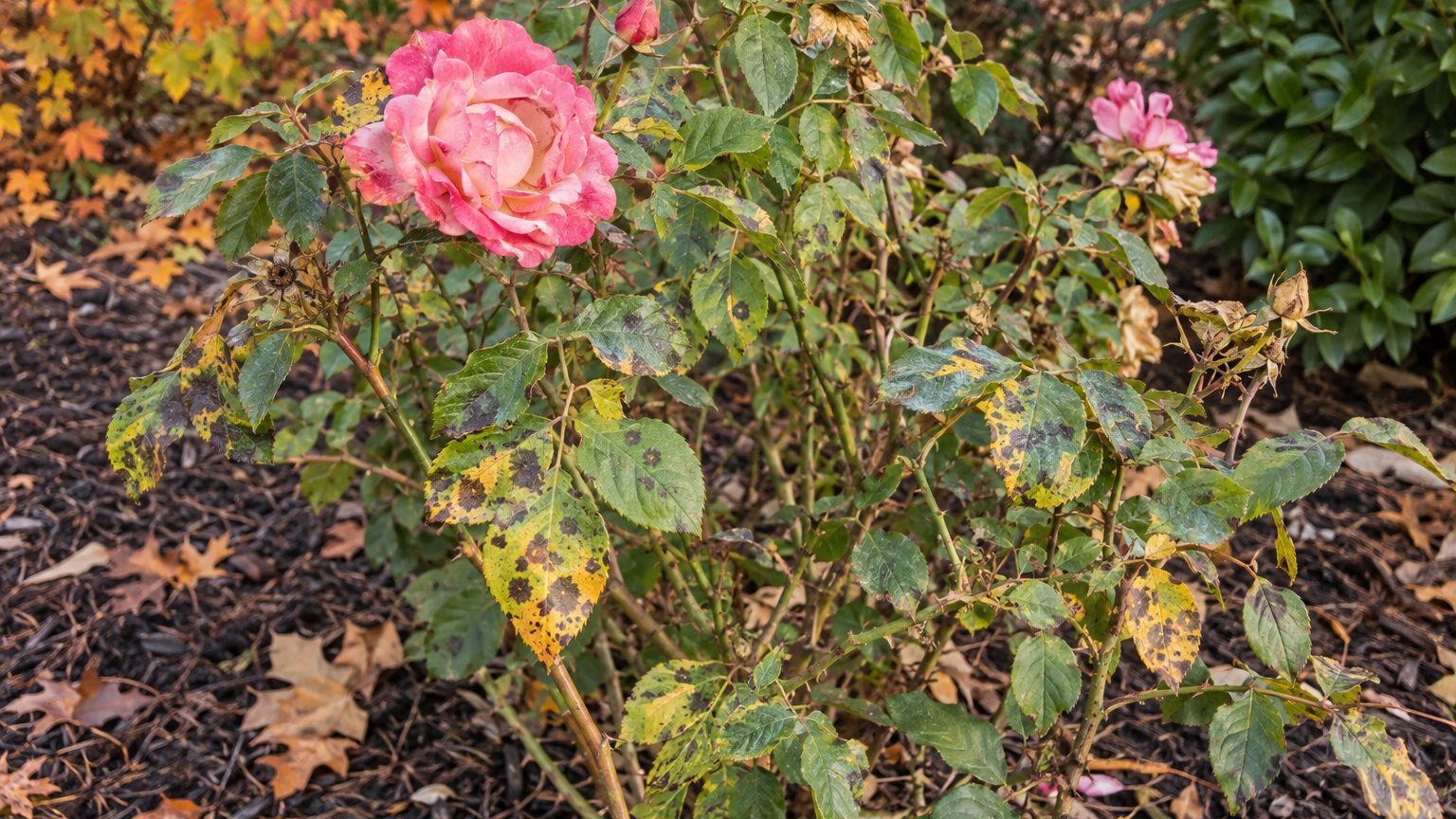
Rose canes that suddenly shoot out in a crowded, red, thorny tangle make any gardener stop and stare. That growth is the usual sign of rose rosette disease, a virus with no cure that spreads from rose to rose on tiny mites. Catching it early helps protect the roses growing nearby.
Rose Rosette Disease: What You See

The symptoms vary a good deal from one rose to the next, so look for a combination of changes on new growth.
- Clusters of thin, crowded shoots form a dense witches’ broom, a tight tuft that looks nothing like normal branching.
- New growth turns red, and on a diseased plant that color stays as the leaf matures, while on a healthy rose it usually fades.
- Stems grow thicker and more succulent than the rest of the plant, often with a reddened tip.
- Thorns multiply wildly on the affected canes, and leaves come out distorted and misshapen.
- On wild multiflora roses, leaves show a reddish-purple vein pattern and the shoots look bright red.
In South Carolina, check new growth in spring when it starts to push, because a rose may show only some signs early in the disease.
From the almanac
Roses in your state
The dates on this page depend on where you live. Your state's page carries its frost dates, its USDA zones and the year laid out month by month.
Northeast
Southeast
- Alabama
- Arkansas
- Delaware
- Florida
- Georgia
- Kentucky
- Louisiana
- Maryland
- Mississippi
- North Carolina
- South Carolina
- Tennessee
- Virginia
- West Virginia
Midwest
Southwest
West
Pacific Northwest
Canada
Rose Rosette Disease or Something Else?
Several other problems redden or twist rose growth. Pairing what you see with where it appears on the plant, or with diagnostic testing, helps you avoid removing a healthy rose or overlooking an infected one.
| Looks like | How to tell them apart |
|---|---|
| Herbicide damage | Testing for the virus or checking for mites can help separate the two. |
| Nutrient deficiency | Off-color leaves show up across the whole plant, while rosette signs sit on selected canes. |
| Normal red new growth | Healthy young leaves are reddish at first, then the color fades as the leaf matures, while on diseased plants it stays. |
If the pattern still leaves you unsure, your state’s extension service can arrange a test for the virus.
What Causes Rose Rosette Disease, and Where It Is Worst
The cause is the rose rosette virus, an Emaravirus. It travels on a microscopic eriophyid mite, the rose leaf curl mite, which feeds on the sap of tender stems and leaf stalks. Once the virus is in, it moves through the whole plant, roots included. Symptoms usually begin soon after the mite feeds.
The mites drift on the wind and can hitch a ride on clothing and equipment, and possibly on insects. Wild multiflora rose is highly susceptible and can be a source of the virus, so a neglected patch near your yard raises the risk.
Rose rosette disease affects both wild and ornamental roses. The virus can also pass through grafting, though it does not spread through sap on a pruner.
How to Treat Rose Rosette Disease
Because the disease cannot be treated and infected plants often die within one to two years, the work is removal, done carefully.
- Confirm the signs on new growth, so that you are not digging out a rose that only has herbicide drift or a nutrient problem.
- Remove the whole plant promptly, so that the mites on it do not move on to neighboring roses.
- Dig out all the roots, because the virus may persist in roots left in the soil even though it does not survive well in the soil itself.
- Bag the plant and roots before carrying them across the yard, since mites travel on the wind and on clothing.
- Clean your tools and change your clothes afterward, as a precaution, even though the disease does not appear to spread mechanically.
- Look over nearby roses and any wild multiflora roses close by, so that a source of the virus does not remain.
Your state’s extension service can tell you which mite controls are approved where you live, and whether to replant in the same bed.
How to Prevent Rose Rosette Disease Coming Back
Prevention follows the season, because the mites feed on tender new growth and symptoms show there first.
- In South Carolina, inspect every rose closely in spring as new growth appears, because early signs are easiest to see on fresh shoots.
- Keep checking new canes, and remove any plant that shows the red, crowded, thorny growth as soon as you are sure.
- After each removal, disinfect pruning tools and wash your clothes before working near other roses.
- Whenever you plant, keep new roses away from wild multiflora roses, and cut out those wild plants if they grow near your property.
Humans can also carry the virus through grafting and pruning, so be selective about where cuttings come from.
Where This Comes From
Check with your state’s extension service for local recommendations.
Common Questions
Can a Rose with Rose Rosette Disease Recover?
No. The disease eventually kills the infected plant, and the virus spreads through the roots and shoots, so cutting off the affected cane does not clear it.
Can You Spread Rose Rosette Disease with Pruners?
The virus is not sap-transmitted, but mites can travel on equipment, so clean tools after working on infected roses.
Does the Virus Stay in the Soil After You Remove a Rose?
The virus does not survive well in soil, but it can persist in roots left behind, so dig out every piece you can find.