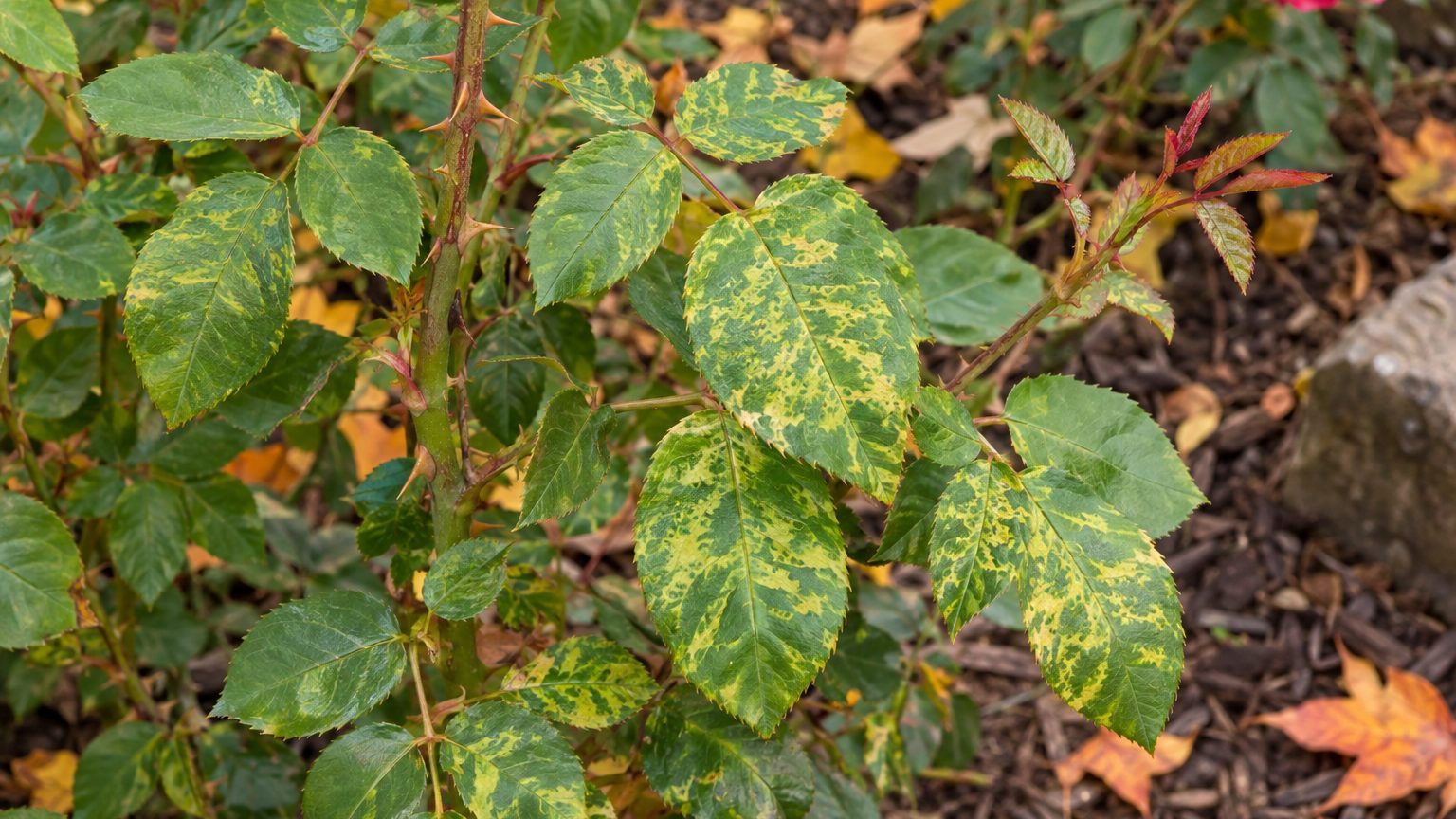
Yellow squiggles, rings, or a faint net pattern on rose leaves often point to a virus, not a pest or a feeding problem. Rose mosaic is systemic, so it sits in the whole plant and cannot be trimmed away. What you can do is confirm it, protect the rose from added stress, and keep it from spreading to new plants.
Rose Mosaic: What You See

Look at the leaves first, because that is where the pattern shows, and it can cover the whole plant or just a part of it.
- Irregular yellow or white lines, bands, ring spots, or blotches run across the leaf surface, and some are brownish.
- Yellow wavy lines and mottles can appear on some varieties at some point in the growing season.
- Some leaves show an oak-leaf pattern, a yellow net, or yellow banding along the veins.
- In Washington and South Carolina, symptoms are usually seen in spring and may fade later, while in Kansas they start in late spring and stay through the growing season.
- Plants may be somewhat stunted, with fewer or poorer flowers.
How strongly any of this shows depends on the variety and the time of year, so a rose that looked clean last summer can still be carrying the virus.
From the almanac
Roses in your state
The dates on this page depend on where you live. Your state's page carries its frost dates, its USDA zones and the year laid out month by month.
Northeast
Southeast
- Alabama
- Arkansas
- Delaware
- Florida
- Georgia
- Kentucky
- Louisiana
- Maryland
- Mississippi
- North Carolina
- South Carolina
- Tennessee
- Virginia
- West Virginia
Midwest
Southwest
West
Pacific Northwest
Canada
Rose Mosaic or Something Else?
Leaf patterns alone can mislead, since several problems put yellow on a rose. Pair what the leaf looks like with where it shows up on the plant and what the canes are doing.
| Looks like | How to tell them apart |
|---|---|
| Rose rosette disease, with odd leaves and distorted growth | Rosette brings leaf trouble together with twisted, distorted canes, while mosaic is mostly yellow patterns on flat leaves and canes bend badly only in severe cases |
| Similar patterns from related viruses such as apple mosaic or arabis mosaic | The same lines and rings can appear on the leaves, so appearance alone cannot separate them from the usual rose mosaic viruses |
Yellowing from plain nutrient shortage or herbicide drift can also be mistaken for mosaic. Because other problems can yellow a rose, confirm the cause before taking action.
What Causes Rose Mosaic, and Where It Is Worst
A virus causes it, and more than one kind can do the job, including apple mosaic virus and Prunus necrotic ringspot virus. Rose mosaic virus itself has been linked with the Prunus necrotic ringspot virus. Related viruses in mixed infections can produce the same leaf patterns.
Roses are propagated by budding, grafting, and rooting cuttings, and that is how the virus travels from plant to plant. Insects and pruning tools do not spread it, though arabis mosaic virus can be carried by nematodes in the soil.
No region escapes it. The disease turns up wherever roses are grown, and it is fairly common in Kansas rose gardens. Its spread depends on infected propagation material, not on insects or pruning tools.
How to Treat Rose Mosaic
No treatment clears the virus from a rose, so the work is about confirming the problem and managing the plant you have.
- Confirm the diagnosis with your state extension service, so that you do not remove a rose that has a different, fixable problem.
- Leave the pruning shears out of it as a cure, because the virus is present throughout the plant and cutting off spotted leaves or stems will not remove it.
- Keep the rose watered through dry spells, so that a weakened plant is not pushed further by drought.
- Skip taking cuttings, buds, or grafts from it, so that the virus does not pass to new roses.
- Decide whether to keep or replace it, based on how weak it has become and how much the leaf patterns bother you.
A lightly affected rose may remain in the bed, but it can still carry the virus. If it is badly stunted or declining, replacing it with a healthy plant is the cleaner choice, and your extension office can say how to dispose of it locally.
How to Prevent Rose Mosaic Coming Back
Prevention happens before the rose goes into the ground, plus a few seasonal habits that keep infected plants from spreading the problem.
- Before you buy a rose, ask the nursery where its stock comes from, since plants can carry the virus without showing it.
- When new leaves open in spring, look over every rose for yellow lines and rings, because that is when symptoms are most evident in places like South Carolina and Washington.
- In late spring, check again, since in Kansas the pattern starts showing then and can stay.
- Whenever you plan to root cuttings or graft, do not take material from a rose suspected of infection.
- Keep infected roses watered during dry weather, because they are more vulnerable to drought and cold injury.
Mark any suspect plant with a tag so you remember not to use it for propagation.
Where This Comes From
This sheet draws on university extension and government plant disease pages from Nebraska, Maryland, South Carolina, Kansas, Washington, and California. Rules and timing differ by state, so check with your state’s extension service before you act on a diagnosis.
Common Questions
Can a Rose Have Rose Mosaic Without Showing It?
Yes. Some infected plants stay symptomless, and roses infected during propagation may not show anything until after they are planted and start growing in the landscape.
Will Rose Mosaic Kill the Plant?
Effects range from no visible harm to distorted canes and, finally, plant death. An infected plant may be weakened, with less vigor and poorer flowers.
Does Rose Mosaic Make Roses More Likely to Suffer Winter Damage?
It can. Infected plants may be more sensitive to winter injury and to stresses such as drought, which is why a rose with mosaic deserves steady care through the year.