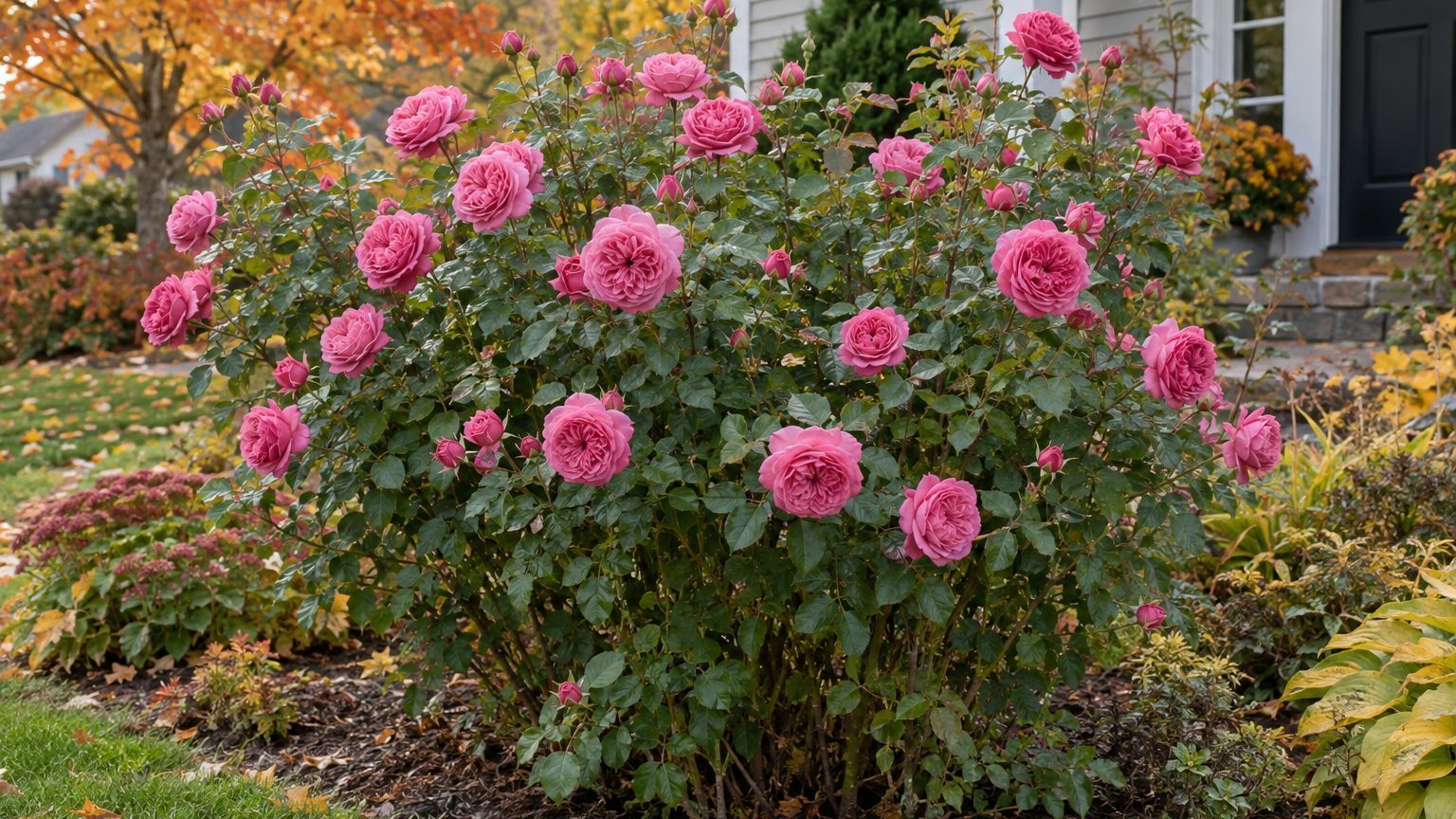
A rose that throws long, arching canes loaded with pink flowers by late spring is usually Gertrude Jekyll, and it keeps going until frost. The Gertrude Jekyll rose is a tall, fragrant shrub that can be trained as a climber, and it behaves differently in a humid Southeast yard than in a dry one.
What Is the Gertrude Jekyll Rose?
Gertrude Jekyll is a hybrid shrub rose in the rose family (Rosaceae), bred by David Austin in 1986. It forms a bushy, vigorous plant with arching canes that reaches 6-10 feet tall and only 3-4 feet wide, so it is tall and narrow rather than mounded.
The bright pink flowers have a reddish center and a strong old-world fragrance. Each bloom is a flat rosette 4-5 inches wide with 50-80 petals, and the flowers open in small clusters.
It grows tallest in warm climates, which matters when you pick a spot. A rose that stays near the low end of its height in one yard can reach the top of the range in another.
From the almanac
Roses in your state
The dates on this page depend on where you live. Your state's page carries its frost dates, its USDA zones and the year laid out month by month.
Northeast
Southeast
- Alabama
- Arkansas
- Delaware
- Florida
- Georgia
- Kentucky
- Louisiana
- Maryland
- Mississippi
- North Carolina
- South Carolina
- Tennessee
- Virginia
- West Virginia
Midwest
Southwest
West
Pacific Northwest
Canada
Where Does the Gertrude Jekyll Rose Grow Best?
Warmth pushes this rose toward its full height, and humidity decides how much you will fight leaf diseases. These factors shape the differences from region to region.
- Gulf Coast: In warm climates, the canes reach their greatest height. Humid air also invites black spot, rust and powdery mildew, so give the plant room for airflow.
- Southeast Piedmont: In warm climates, the rose can be trained as a climber. Humid summers make disease watching part of the routine.
- Upper Midwest: In colder climates, expect a shorter plant than in warm climates, since height follows the climate. Choose a sunny, well-drained spot.
- Pacific Northwest: In humid conditions, fungal problems show up first.
The state selector just below this section leads to the page for your state, with the months that apply where you garden.
How to Care for the Gertrude Jekyll Rose Through the Year
Waking Up

Growth starts when the canes begin to swell and leaf buds show color. Planting is best in full sun, in amended, well-drained, moist soil, so spring is a good moment to work compost into the bed before the plant leafs out.
Pruning

This rose repeat blooms, so prune as the buds swell in spring. Remove dead and damaged canes first, then thin crowded stems so air moves through the center.
If you grow it as a climber, keep healthy long canes and tie them to the support as they lengthen.
Bloom
The first flowers open in late spring in small clusters rather than as solitary blooms. Snip spent clusters back to a healthy leaf to keep the plant producing.
Summer
Keep the soil evenly moist, since the plant likes moist ground. Water at the base in the morning so the leaves dry quickly, which matters most in humid conditions where black spot and mildew take hold.
A tall plant also catches wind, so check ties on climbing canes after storms.
Autumn
Flowers keep coming until frost, so do not stop deadheading early. Rake up fallen leaves around the base, especially any with spots, so disease does not carry over to next year.
Winter
Leave the heavy pruning for spring. In colder climates, tie long canes together loosely so snow and wind do not whip them, and check your local extension office for local timing.
Gertrude Jekyll Rose Diseases and Weak Points
The main weak points are fungal diseases of the leaves. They show up most where the air is humid and the foliage stays wet, which is why spacing and morning watering carry so much weight.
Catching problems early is easier on a rose this tall if you look at the lower canes, where air circulation may be limited.
| Threat | How Gertrude Jekyll handles it |
|---|---|
| Black spot | Watch for it, especially in humid conditions |
| Rust | Watch for it, especially in humid conditions |
| Powdery mildew | Watch for it, especially in humid conditions |
Pull off affected leaves as soon as you see them. Open the center of the shrub at spring pruning so breezes can dry the foliage.
Is the Gertrude Jekyll Rose Right for Your Yard?
It suits yards with a sunny spot and vertical room, because the plant is much taller than it is wide. It works as a specimen, in a border, as a hedge or on a trellis.
- Choose it if you want strong fragrance near a path, a patio or a window, where you will brush past the blooms.
- Skip it if your only spot is shady or constantly damp, since full sun and good drainage are what keep it healthy.
- Plan on regular deadheading, and a look at the leaves whenever the weather turns humid.
Common Questions
Can You Grow a Gertrude Jekyll Rose in a Pot?
Yes. A pot placed near the patio puts the fragrance within reach. Use a large container, since the plant likes moist but well-drained soil.
Can You Train a Gertrude Jekyll Rose on a Trellis?
Yes. The long, arching canes can be trained to a vertical surface, and the plant tends to climb higher in warm climates. Tie canes loosely as they grow.
Can You Use Gertrude Jekyll as a Hedge?
It can be grown as a hedge as well as a specimen or border plant. Space the plants so air still moves between them, because crowding raises the risk of black spot, rust and mildew.