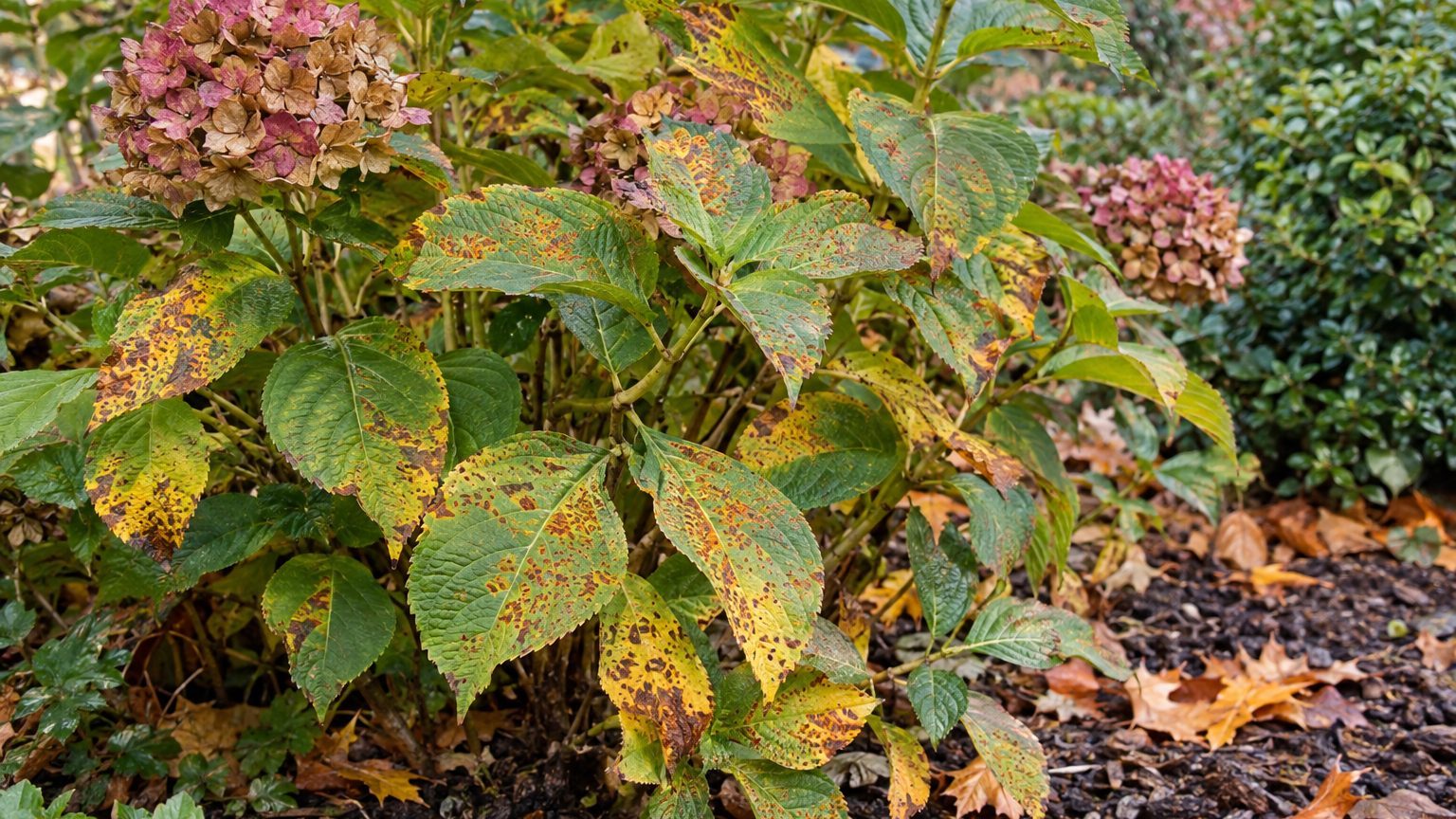
Hydrangea rust is a fungal leaf disease. It shows up as yellow spots on top of the leaf and orange, powdery pustules underneath. It is mostly cosmetic, but a heavy attack can strip leaves early. The right response depends on your hydrangea type, because rust is tied most closely to panicle hydrangeas.
Hydrangea Rust: What You See

NC State Extension Gardener Plant Toolbox lists rust among the diseases of panicle hydrangea (H. paniculata), so read the leaves on both faces before you decide anything.
- Yellow patches on the upper leaf surface, often small and angular.
- Orange to rusty-brown pustules on the underside, sitting right behind each patch.
- A fine orange powder that wipes onto a fingertip or a white tissue.
- Leaves that curl, brown and drop early when the attack is heavy.
- Symptoms that start on the lower, shaded, crowded leaves and climb from there.
The underside of the leaf is where the diagnosis is made, so flip a few leaves before you touch the pruners.
From the almanac
Hydrangeas in your state
The dates on this page depend on where you live. Your state's page carries its frost dates, its USDA zones and the year laid out month by month.
Northeast
Southeast
- Alabama
- Arkansas
- Delaware
- Florida
- Georgia
- Kentucky
- Louisiana
- Maryland
- Mississippi
- North Carolina
- South Carolina
- Tennessee
- Virginia
- West Virginia
Midwest
Southwest
West
Pacific Northwest
Canada
Hydrangea Rust or Something Else?
NC State Extension Gardener Plant Toolbox names three common leaf and stem problems on hydrangeas: leaf spot, bacterial wilt and powdery mildew. Two of them are easy to mistake for rust on a quick glance.
One test settles most cases. Rub the affected area and look at what comes off, then check which side of the leaf carries the damage.
| Looks like | The sign that tells them apart |
|---|---|
| Leaf spot: brown or tan blotches | Spots with a defined edge and nothing powdery on the underside. Nothing rubs off. |
| Powdery mildew: dusty patches | The powder is white to gray, not orange, and it sits on the upper leaf surface as often as underneath. |
Rust is the one with orange dust under the leaf. Bacterial wilt and the other problems have their own pages, gathered on the Hydrangea Diseases hub.
What Causes Hydrangea Rust, and Where It Is Worst
NC State Extension Gardener Plant Toolbox lists rust on panicle hydrangea, a type hardy in USDA zones 3a to 8b. Rust is caused by a fungus whose spores spread on wind and splashing water, and it thrives where leaves stay wet.
The source does not map rust state by state, so this list follows the plants and the weather, not an invented outbreak map.
- Great Lakes and the North (Michigan, Minnesota, Wisconsin): panicle is the hydrangea that survives the coldest winters here, so it is the type most likely to carry rust.
- The South (Georgia, Texas, the Carolinas): long humid summers keep foliage damp, and both bigleaf and panicle are grown side by side.
- Pacific Northwest (Oregon, Washington): mild, damp springs and falls give spores plenty of wet-leaf time.
- Interior West and Plains (Colorado, Nebraska, Kansas): dry air helps, but sprinklers that wet the foliage can recreate the problem.
Your state page on this site gives the calendar and the varieties that suit your zone.
How to Treat Hydrangea Rust
NC State Extension Gardener Plant Toolbox rates hydrangea maintenance as low, so treatment is mostly clean-up and airflow. Work through it in this order this week.
- Confirm the type: check whether you grow panicle, bigleaf or another kind, because rust is the disease the source ties to panicle.
- Pick off spotted leaves: remove only the affected foliage and leave the stems, since bigleaf sets its flower buds on last year’s wood.
- Bag, don’t compost: put the leaves in the trash, along with any that have already fallen under the shrub.
- Water at the base: aim at the soil in the morning, so the leaves dry quickly. Both bigleaf and panicle are shallow-rooted and benefit from mulch.
- Open the canopy: thin crowded stems lightly so air moves through the center of the shrub.
- Ask your extension office: your state’s service alone knows which fungicides are registered locally, if you need one at all.
Skip anything that promises a cure in a day. Rust is slow, and steady sanitation does more than any single spray.
How to Prevent Hydrangea Rust Coming Back
NC State Extension Gardener Plant Toolbox gives bigleaf a mature size of 3 to 6 feet tall and wide, and panicle 8 to 25 feet, so spacing decisions start at planting. Then the year does the work.
- Late winter: cut panicle hydrangeas back hard, since they bloom on the current season’s growth, and leave bigleaf alone.
- Spring: lay mulch over the shallow roots to keep soil from splashing spores onto low leaves.
- Summer: water at ground level in the morning and never with an overhead sprinkler in the evening.
- Early fall: rake and bag fallen leaves before they can carry spores through winter.
- After frost: cut dead hollow stems to 12 to 24 inches and leave them standing, which suits native bees that nest in them.
- Any time: give new plants room for their mature width, so air can move between shrubs.
Deer browse hydrangeas, so a fence or a cage also keeps torn, stressed foliage out of the picture.
Where this comes from
The plant facts here come from the NC State Extension Gardener Plant Toolbox entry for hydrangea. It gives hardiness, blooming habit, size and the diseases named above.
Treatment products and timing vary by state. Check with your state’s extension service before you buy anything or schedule a cut.
Common questions
Does rust affect every hydrangea type?
The source lists rust specifically on panicle hydrangea. For the genus as a whole it names leaf spot, bacterial wilt and powdery mildew, so check the leaf underside before you name the problem.
Should I cut the whole shrub back to get rid of it?
Not without knowing your type. Panicle flowers on the current season’s growth, but bigleaf flowers on last year’s wood, so a hard cut can remove next summer’s blooms.
Which product should I buy?
None until your state extension office weighs in. Registered products differ from state to state, and sanitation and airflow come first anyway.