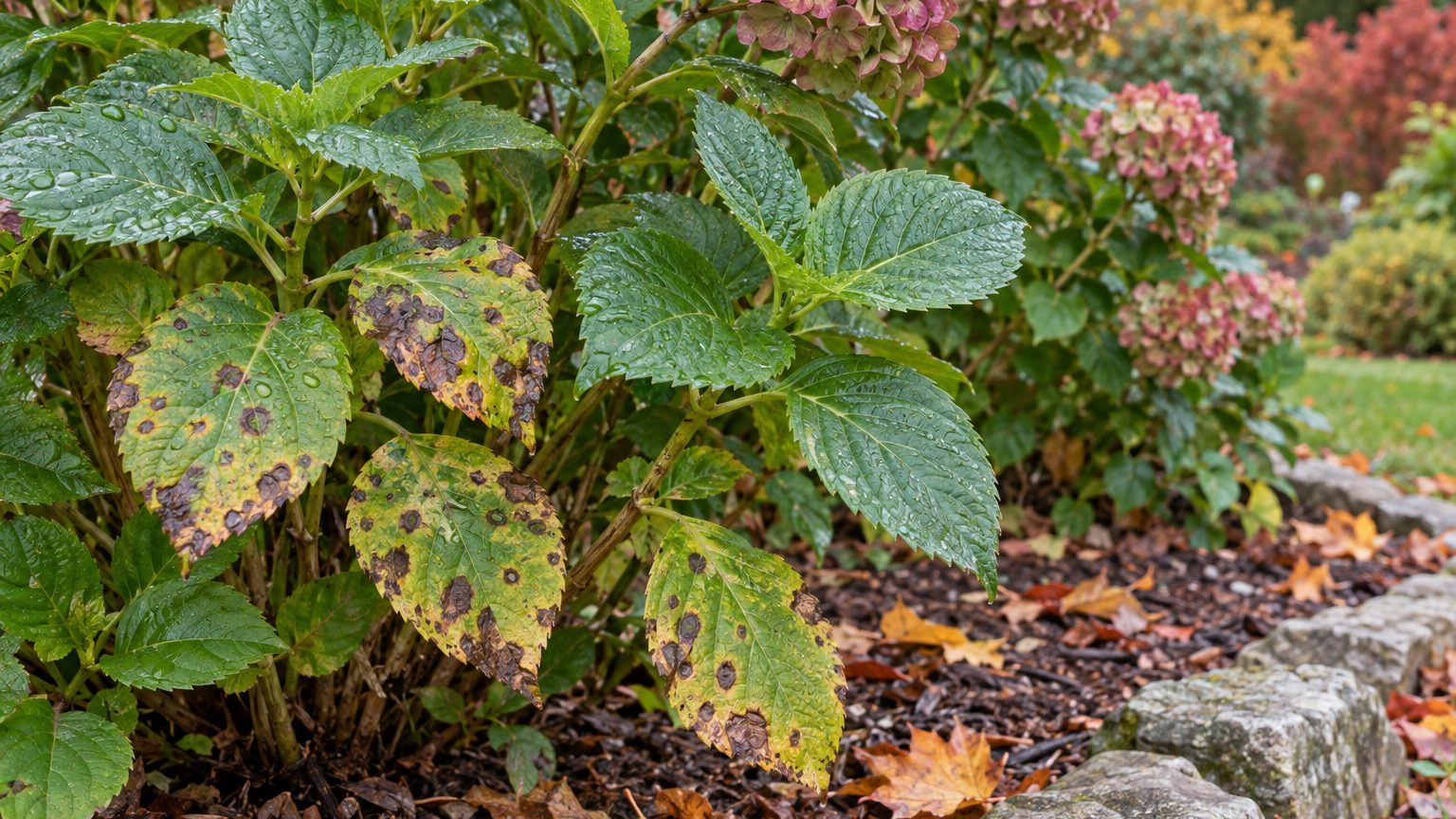
Leaf spot on hydrangeas is a leaf disease that thrives on wet foliage. Most cases get the same handling: pick off the spotted leaves, keep the rest dry, and clean up in fall.
The timing changes with the type you grow, since bigleaf, panicle and smooth hydrangeas differ in hardiness and pruning. Your zone and type settle the rest.
Leaf Spot: What You See

The NC State Extension Gardener Plant Toolbox lists leaf spot among the diseases of hydrangea, and on the leaf it follows a fairly steady pattern.
- Round to irregular spots, tan, brown or purplish-brown, often with a darker rim or a yellow halo.
- The lowest and innermost leaves are hit first, then the spotting climbs.
- Spots appear in summer and carry into early fall, usually after rainy or humid spells.
- Neighboring spots merge into blotches, and badly marked leaves yellow and drop early.
- The leaf itself stays firm and does not droop.
One common form has its own sheet: Cercospora Leaf Spot on Hydrangeas: Signs, Treatment and Prevention.
From the almanac
Hydrangeas in your state
The dates on this page depend on where you live. Your state's page carries its frost dates, its USDA zones and the year laid out month by month.
Northeast
Southeast
- Alabama
- Arkansas
- Delaware
- Florida
- Georgia
- Kentucky
- Louisiana
- Maryland
- Mississippi
- North Carolina
- South Carolina
- Tennessee
- Virginia
- West Virginia
Midwest
Southwest
West
Pacific Northwest
Canada
Leaf Spot or Something Else?
Spotted leaves get blamed on one disease when several look alike from a few steps away. Up close, one test sorts most cases: touch the leaf, then turn it over.
The NC State Extension Gardener Plant Toolbox names leaf spot, bacterial wilt and powdery mildew for hydrangeas, and adds rust and bud blight for panicle. Three of those get mistaken for leaf spot most often.
| Look-alike | Looks like | The sign that tells them apart |
|---|---|---|
| Powdery mildew | A pale, dusty film over the leaf | It wipes off with a thumb. Leaf spot marks sit in the leaf tissue and stay put. |
| Rust (listed for panicle) | Orange to rust-colored freckles | Turn the leaf over. Powdery orange pustules underneath separate it from plain spotting. |
| Bacterial wilt | Browning, hanging leaves | Whole shoots droop even when the soil is moist. Leaves with leaf spot stay firm. |
Bud blight, listed for panicle, goes after the flower buds rather than the leaf blades. For the full lineup, see Hydrangea Diseases, and for the wilting case, Bacterial Wilt on Hydrangeas: Signs, Treatment and Prevention.
What Causes Leaf Spot, and Where It Is Worst
Leaf spot follows wet foliage, and the NC State Extension Gardener Plant Toolbox lists it for the whole genus with no regional map, while putting panicle at USDA 3a to 8b and bigleaf at 6a to 11b. What you grow tells you what your climate asks of it.
- Great Lakes and the North (Michigan, Minnesota, Wisconsin): panicle and smooth, the hardiest types, dominate, and spotting follows cool, rainy stretches and crowded planting.
- The South (Georgia, Texas, the Carolinas): bigleaf is common here, and warm, humid nights leave leaves damp for hours.
- The Pacific Northwest (Washington, Oregon): a long wet spring keeps bigleaf foliage wet from the day it opens.
- The dry interior West (Colorado, Utah, New Mexico): dry air helps, but overhead sprinklers wet leaves as surely as rain does.
The exact zone, type and calendar for your yard sit on your state page.
How to Treat Leaf Spot
Start this week, and start with the leaves. Nothing here needs a product.
- Pick off spotted leaves: the NC State Extension Gardener Plant Toolbox says bigleaf buds form the previous summer, so take leaves only and leave the stems alone.
- Bag the leaves and bin them: a compost pile that never gets hot keeps the problem in circulation.
- Water at the base in the morning: dry foliage by evening is the single change that matters most.
- Switch off overhead sprinklers: a drip line or a hose at the soil does the job without wetting the canopy.
- Mulch over the roots: both bigleaf and panicle are shallow-rooted and benefit from mulch, which also stops soil splashing onto low leaves.
- Ask your state extension service about fungicide: only they know what is registered where you live.
If new leaves keep spotting after the foliage has dried out, photograph a few leaves and send them to your county extension office. A wilting shoot is a different question, so check the table above first.
How to Prevent Leaf Spot Coming Back
The NC State Extension Gardener Plant Toolbox gives bigleaf 3 to 6 feet tall and wide, and that mature size is where prevention begins, since a crowded shrub never dries out.
- Planting: leave room for the full width so air moves between shrubs.
- Late winter: cut panicle back hard, since it flowers on the current season’s growth, and leave bigleaf uncut because it flowers on last year’s wood.
- Spring, as leaves open: refresh the mulch over the shallow roots.
- Growing season: water at the base in the morning and check the lowest leaves after every rainy spell.
- Leaf drop: rake fallen leaves and bin them.
- After leaf drop: cut dead hollow stems to 12 to 24 inches and leave them standing, since native bees nest in them.
Dates for each step depend on your zone and type, so use your state page.
Where this comes from
Type names, zone ranges, mature sizes and the disease list come from the NC State Extension Gardener Plant Toolbox entry for Hydrangea. That entry lists leaf spot without ranking severity or giving a regional map.
Symptom descriptions here are general and vary by type and region. Confirm anything local, especially products, with your state’s extension service.
Common questions
Will leaf spot kill my hydrangea?
The source rates hydrangea maintenance as low and lists leaf spot without calling it fatal. I would treat spotting as a leaf problem first, and get help if the shrub itself starts wilting.
Should I cut off the spotted stems?
Take leaves, not stems, on bigleaf, because its buds form the previous summer and a spring cut removes flowers. Panicle flowers on the current season’s growth and takes a hard cut in late winter.
Do I need a fungicide?
Not as a first step. Drier leaves, cleaner ground and better spacing come first, and your state extension service can tell you which products are registered where you live.