The practical answer is to confirm it, remove the plant and protect its neighbors. Your zone and the type of hydrangea you grow decide what goes back in that spot.
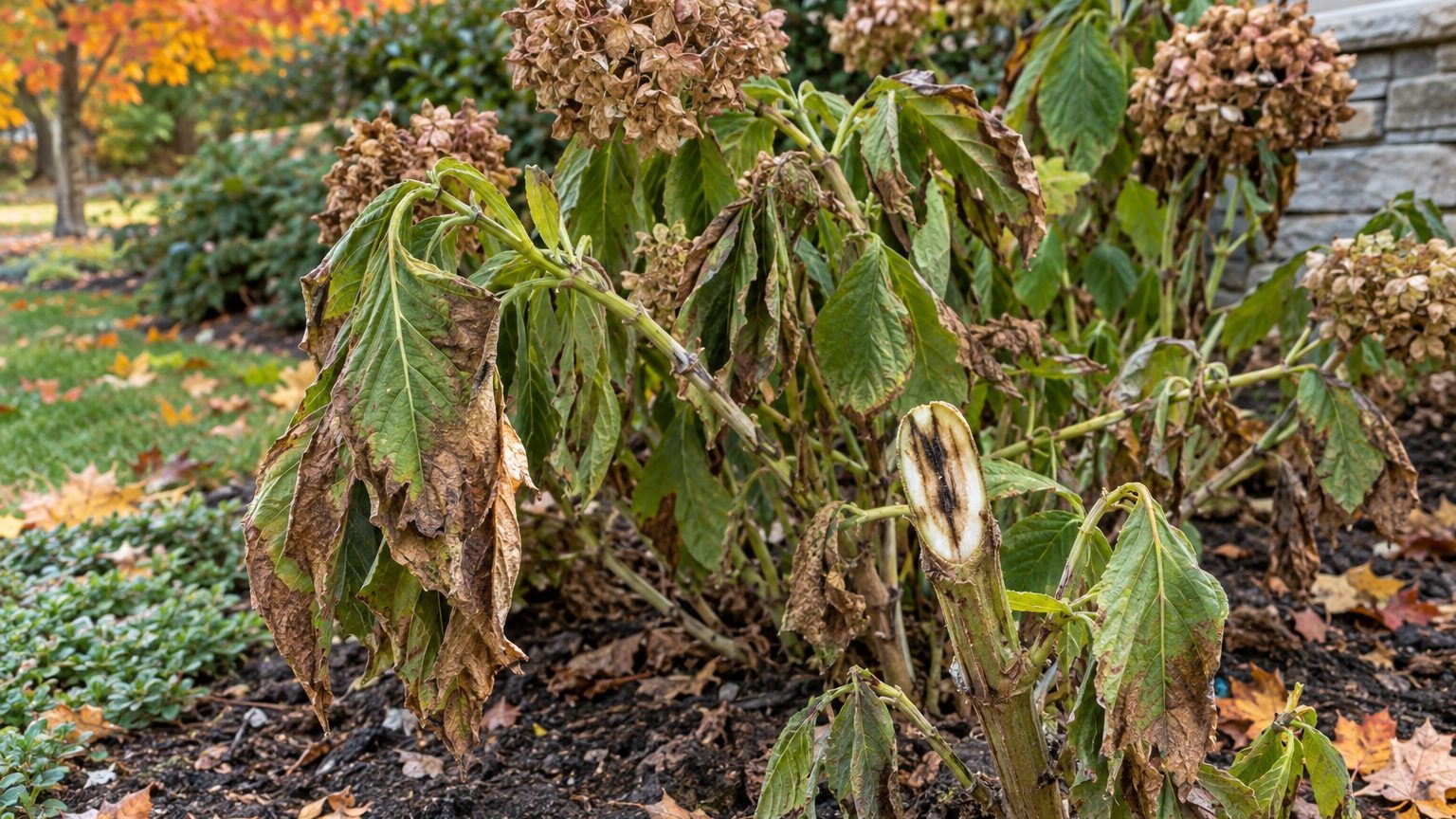
Bacterial Wilt: What You See

The NC State Extension Gardener Plant Toolbox names bacterial wilt among hydrangea diseases, and what you notice first is a shrub that cannot keep its leaves supplied with water.
- Leaves droop and hang limp, often on a few shoots before the whole shrub follows.
- The wilting stays put after a deep watering, where plain thirst is gone by morning.
- Leaves turn brown and dry at the edges, then across the blade, and cling to the stem.
- Flower heads sag and dry out well before their season is over.
- A cut stem shows dark or brown streaking inside the wood where it should look pale.
Bigleaf and panicle hydrangeas are both shallow-rooted, so a dry spell can imitate every sign above. That is why the test is whether the leaves stay limp after a deep watering, not how they look at 3 p.m.
From the almanac
Hydrangeas in your state
The dates on this page depend on where you live. Your state's page carries its frost dates, its USDA zones and the year laid out month by month.
Northeast
Southeast
- Alabama
- Arkansas
- Delaware
- Florida
- Georgia
- Kentucky
- Louisiana
- Maryland
- Mississippi
- North Carolina
- South Carolina
- Tennessee
- Virginia
- West Virginia
Midwest
Southwest
West
Pacific Northwest
Canada
Bacterial Wilt or Something Else?
Three problems get mistaken for this one more often than the real thing. The NC State Extension Gardener Plant Toolbox lists leaf spot and powdery mildew right next to bacterial wilt, and thirst needs no source at all.
Each has one sign that settles the question. You can check all three in a single slow walk around the shrub, with a finger for the soil and a look at the underside of a few leaves.
| Looks like | The sign that tells them apart |
|---|---|
| Leaf spot | Spots with a defined edge sit on leaves that are otherwise firm and upright. |
| Powdery mildew | A white, dusty coating wipes off on a fingertip, and the leaves are not limp. |
| Thirst or heat stress | The plant stands back up by the next morning after a deep watering. |
Leaf spot has a full sheet at Leaf Spot on Hydrangeas: Signs, Treatment and Prevention, and flower-head problems are covered in Botrytis Blight on Hydrangeas: Signs, Treatment and Prevention. The other kinds are on their own pages under Hydrangea Diseases.
What Causes Bacterial Wilt, and Where It Is Worst
Bacteria cause it. They move inside the plant’s water-carrying tissue and travel on dirty pruners, in splashing water and on cuttings taken from an infected plant.
The NC State Extension Gardener Plant Toolbox lists the genus at USDA zones 3a through 9b, yet it names bacterial wilt without saying which climate favors it. I won’t draw a map the source does not draw. What changes from region to region is the type of hydrangea at stake.
- Great Lakes and the North (Michigan, Minnesota, Wisconsin): panicle, rated 3a to 8b, and smooth, the hardiest of the genus, are the shrubs most yards carry, so a loss here means replacing one hardy type with another.
- The South (Georgia, Texas, the Carolinas): bigleaf, rated 6a to 11b, is at home here beside panicle and oakleaf, and its shallow roots dry out fast in summer heat, which muddies the diagnosis.
- Northeast and Mid-Atlantic (New York, Pennsylvania, Virginia): bigleaf and panicle share the borders, and each needs its own replacement plan because bigleaf blooms on last year’s wood and panicle on the current season’s growth.
Your state’s page holds the zone verdict and the calendar that this national sheet cannot give.
How to Treat Bacterial Wilt
Work through these steps in order this week, before you decide anything about replacing the plant.
- Run the watering test: soak the root zone deeply in the evening and look again at first light, because a thirsty shrub recovers and one with bacterial wilt does not.
- Cut one wilted stem and look inside: use clean pruners and note any brown or dark streaking in the wood.
- Call your state extension office: it can confirm the diagnosis, and it alone knows what is registered for use in your state.
- Stop taking cuttings or layering from it: propagation by stem cutting or layering carries the problem straight into the new plant.
- Remove the whole plant, roots included: bag it for the trash and keep it out of the compost pile.
- Disinfect your tools and wash your boots: soil and sap on blades are how it reaches the next shrub, so follow your extension office’s advice on how to clean them.
I would hold off replanting in the same hole until extension says it is fine. When you do replant, match the type to your zone, since panicle and bigleaf differ by several zones.
How to Prevent Bacterial Wilt Coming Back
Prevention is mostly housekeeping, and it follows the shrub’s year.
- Late winter: clean your pruners before cutting panicle or smooth hydrangeas, which bloom on the current season’s growth and take hard cutting back.
- Planting time: buy healthy stock and reject any plant with dark streaks in the stems or limp leaves in the pot.
- Spring: spread mulch over the shallow roots, and keep it pulled back from the stems.
- Summer: water at the base in the morning so leaves stay dry, and never work among wet shrubs with pruners.
- Autumn: rake up fallen leaves, and if you leave hollow stems standing for native bees, the NC State Extension Gardener Plant Toolbox says to cut them back to 12 to 24 inches.
- Whenever you propagate: take cuttings or layers only from shrubs that have never wilted.
Clean tools do more than any product I can think of, and they cost nothing.
Where this comes from
The disease names, zone ranges and habits here come from the NC State Extension Gardener Plant Toolbox entry for Hydrangea. That source names bacterial wilt but gives no regional map for it.
Take a wilted stem or a photo to your state’s extension office before you dig anything up. They can confirm the diagnosis and tell you what applies in your zone.
Common questions
Can a hydrangea recover from bacterial wilt?
I would not count on it. A shrub that stays limp after a deep watering should be treated as infected until extension says otherwise, and the safe move is to remove it before it spreads.
Can I compost the infected plant?
I would not. Bag the plant, roots included, and put it in the trash so nothing carries the problem to healthy beds.
Which hydrangea should I plant instead?
That depends on your zone and how you want it to bloom. Panicle is rated 3a to 8b and bigleaf 6a to 11b, so check your state’s page for the type that fits, and see Hydrangea Diseases for the other problems to watch.