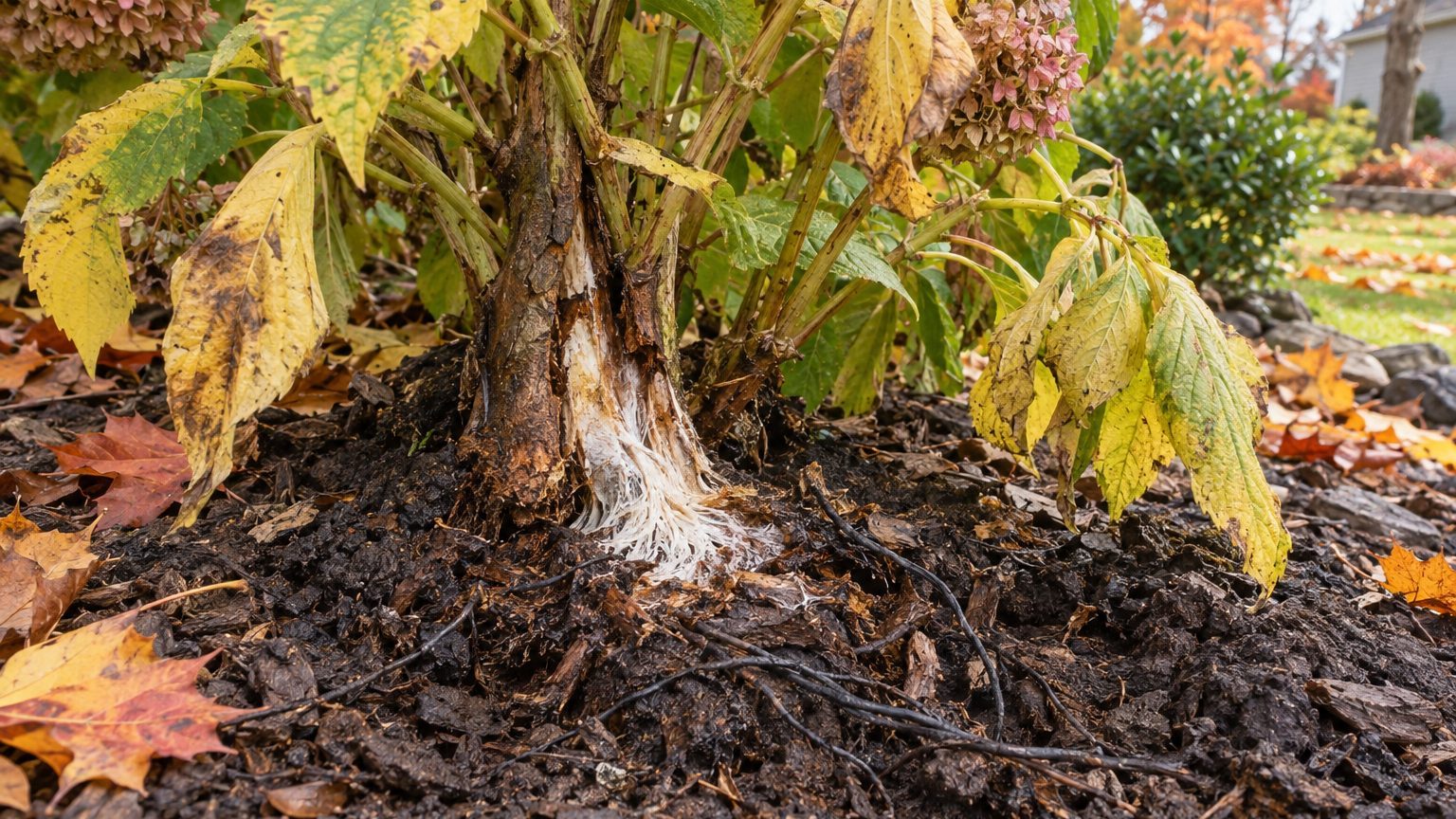
Armillaria root rot is a soil fungus that rots the roots and the bark at the base of a hydrangea, and once it has girdled the crown, no spray brings the shrub back. What you can do is confirm it, remove the plant, and change what goes in that spot.
Armillaria Root Rot: What You See
The disease works underground first, so the above-ground signs look like a thirsty plant that never recovers after watering.
- Leaves yellow, droop or stay small on part of the shrub or all of it, often in summer heat while the soil is moist.
- Stems die back branch by branch, and flowering thins out or stops.
- Under the bark at the base, a white to cream fungal sheet spreads in a fan shape.
- Black strands like bootlaces cling to roots or run through the soil near the crown.
- Clusters of honey-colored mushrooms appear at the base in fall, usually after rain.
- Bark on the lowest part of the stems turns soft, cracked or loose.
One sign alone proves little, but the white sheet under the bark is the one that decides.
From the almanac
Hydrangeas in your state
The dates on this page depend on where you live. Your state's page carries its frost dates, its USDA zones and the year laid out month by month.
Northeast
Southeast
- Alabama
- Arkansas
- Delaware
- Florida
- Georgia
- Kentucky
- Louisiana
- Maryland
- Mississippi
- North Carolina
- South Carolina
- Tennessee
- Virginia
- West Virginia
Midwest
Southwest
West
Pacific Northwest
Canada
Armillaria Root Rot or Something Else?
Wilting and dieback have many causes, and most of them are easier to fix. The NC State Extension Gardener Plant Toolbox names bacterial wilt among hydrangea diseases and calls nematodes rarely a problem.
Frost is the third suspect, especially on bigleaf. Its buds form the previous summer on last year’s wood, so a late frost or a spring prune removes the flowers without touching the roots.
| Looks like | The sign that tells them apart |
|---|---|
| Bacterial wilt | A cut stem shows browning inside the wood, but the bark at the base has no white sheet. |
| Nematode injury | Fine roots carry knots or galls, and armillaria leaves none of those. |
| Late frost on bigleaf | Shoots blacken from the tips, the base stays firm and green, and the shrub resprouts. |
Spots and pustules on leaves point elsewhere, and those problems have their own pages: Hydrangea Rust on Hydrangeas: Signs, Treatment and Prevention and Anthracnose on Hydrangeas: Signs, Treatment and Prevention. The full list sits in Hydrangea Diseases.
What Causes Armillaria Root Rot, and Where It Is Worst
The cause is the Armillaria fungus, which lives on dead roots and old stumps, then reaches living roots of stressed plants through the soil. It follows woodland history and wet ground more than a climate map, so the regions below are about which hydrangeas grow there.
- Great Lakes and the North (Michigan, Minnesota, Wisconsin): panicle is rated 3a to 8b by the NC State Extension Gardener Plant Toolbox and smooth is the hardiest, so lots cleared from woods with stumps left behind carry the risk.
- The South (Georgia, Texas, the Carolinas): bigleaf reaches zones 6a to 11b and oakleaf does well too, and warm, wet soil around old hardwood stumps suits the fungus.
- Northeast and Mid-Atlantic (New York, Pennsylvania, Virginia): every type is grown here, so watch beds built where a tree came down.
- The West Coast (Washington, Oregon, California): irrigated shade beds for bigleaf stay damp at the crown for long stretches.
Your state’s page gives the zone, the type and the calendar that fit your yard.
How to Treat Armillaria Root Rot
Treatment here means confirming the problem and removing the source, done this week in this order.
- Scrape the bark at the base: use a thumbnail or a knife at the soil line, and a white sheet under the bark settles the question.
- Call your county extension office: send a photo or a sample, because the state extension service alone knows what is registered where you live.
- Pull mulch off the crown: hydrangeas are shallow-rooted and like mulch, but keep it a hand’s width from the stems so the bark can dry.
- Dig out the dead shrub with as many roots as you can: root pieces left in the ground keep the fungus fed.
- Remove nearby stumps and large roots: an old stump within reach of the bed is the likely source.
- Leave the hole without a hydrangea: ask the extension office which plants tolerate the spot before you replant.
I name no fungicide because I cannot see your state’s registered list. A shrub with a few dead stems and a sound crown may hold on, but watch it through the next fall.
How to Prevent Armillaria Root Rot Coming Back
The NC State Extension Gardener Plant Toolbox lists hydrangea maintenance as low and asks for good drainage, with occasional wet soil acceptable, so prevention follows the calendar.
- Dormancy: the one safe window to move a plant, roots undisturbed, and the time to clear old stumps from the bed.
- Planting: choose a spot with good drainage and set the crown at soil level, never buried.
- Spring: refresh mulch over the shallow roots and keep it off the stems as growth starts.
- Summer: water at the soil line in dry spells, and keep mowers and string trimmers away from the bark at the base.
- Fall: check the base after rain for honey-colored mushrooms and scrape one stem if the shrub looks tired.
- Every year: match the type to your zone, since a stressed plant is the one the fungus picks.
Pruning dates and hardiness differ by type and by state, so use the page for your state before you cut anything.
Where this comes from
The hydrangea types, zones and drainage notes here come from the NC State Extension Gardener Plant Toolbox, Hydrangea entry. That source names leaf spot, bacterial wilt and powdery mildew, plus rust and bud blight on panicle, but does not list armillaria.
The descriptions of the fungus are general, so confirm any diagnosis with your state’s extension service. They can tell you what is present locally and what is allowed in your state.
Common questions
Can a hydrangea recover from armillaria root rot?
Once the white sheet has spread around the crown, recovery is unlikely. A shrub with a sound crown and a few dead stems may hold on, so confirm with your extension office before you dig.
Does it hit every type of hydrangea?
Any type can be hit, so the difference is in the replacement you choose. Bigleaf is rated 6a to 11b and panicle 3a to 8b, so type and zone decide what goes back in.
Do mushrooms at the base mean the shrub is doomed?
Honey-colored mushrooms mean the fungus is active in the wood nearby, and it may be feeding on a stump instead. Scrape the bark at the base and look for the white sheet before you decide.