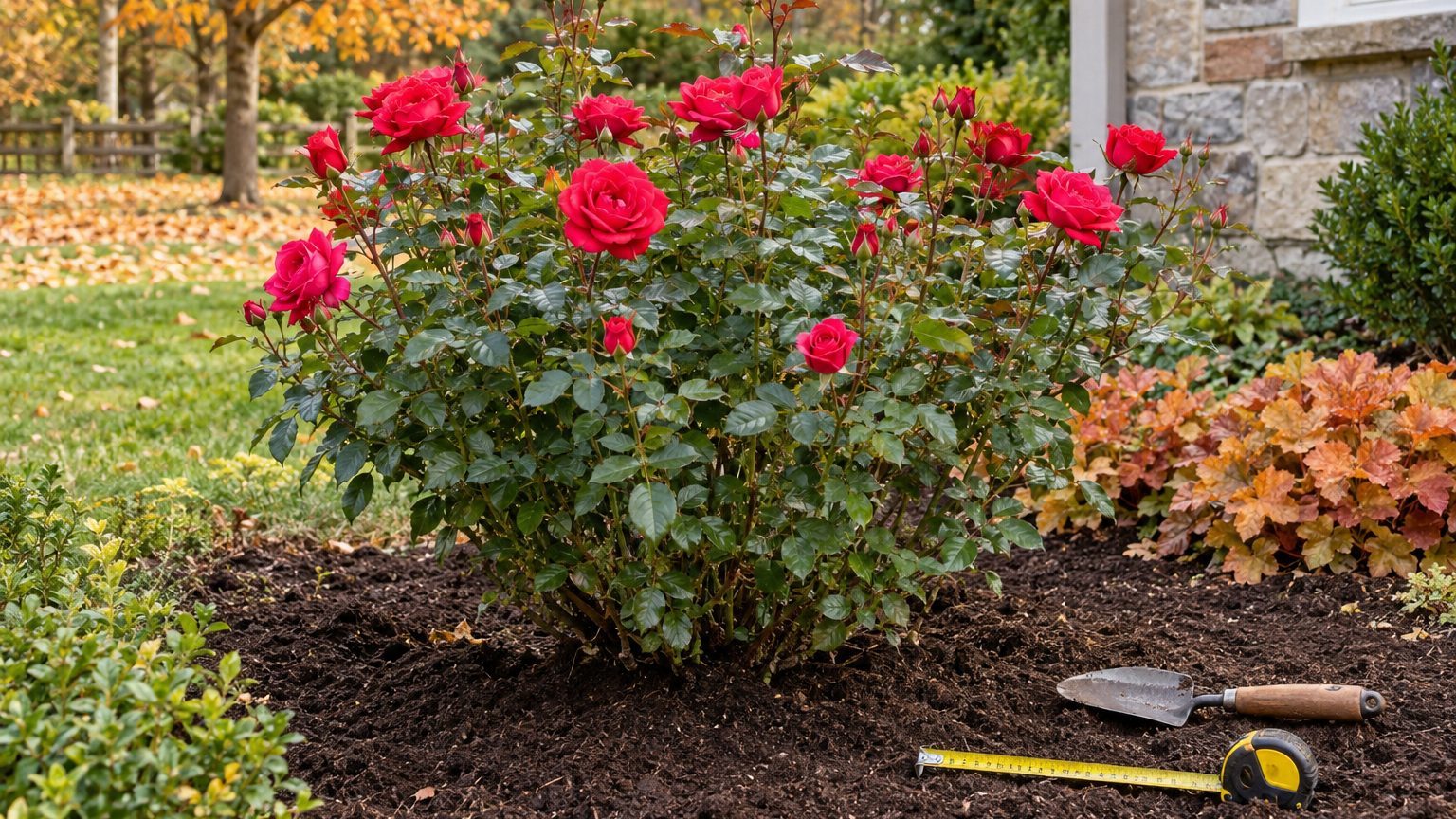
A rose in a shady corner may stay leggy with few buds while the rose by a sunny fence fills out. Where you put a rose shapes how it grows and flowers. Sun, soil and spacing set that spot, and each is simple to get right before planting.
Where Is the Best Place to Plant Roses?
Roses do well in a sunny, open spot where the soil drains freely and air moves through the plant. That rule holds across the country. What shifts it is the rose itself, since a compact miniature, a sprawling shrub and a climber need different amounts of room.
Either way, a bright site keeps the canes healthy. Climate adjusts the details, such as how much afternoon sun a hot summer region can give and how soon the ground thaws.
The state selector just below this section leads to the page for your state, where the local timing sits.
From the almanac
Roses in your state
The dates on this page depend on where you live. Your state's page carries its frost dates, its USDA zones and the year laid out month by month.
Northeast
Southeast
- Alabama
- Arkansas
- Delaware
- Florida
- Georgia
- Kentucky
- Louisiana
- Maryland
- Mississippi
- North Carolina
- South Carolina
- Tennessee
- Virginia
- West Virginia
Midwest
Southwest
West
Pacific Northwest
Canada
How to Prepare a Rose Bed

A good bed is built in a set order, because each step depends on the one before it, and all of it happens before the rose goes in.
- In West Virginia, choose an open spot where the plant gets full sun all day or at least 6 hours of direct sun.
- Fill an 18-inch-deep hole with water and watch it, because in Illinois a hole that empties in 5-6 hours means the drainage is satisfactory.
- Check the soil pH, since roses want it slightly acid to neutral, about 6.5 to 7.0 in Montana, and a little lower, 6.2–6.8, in Oregon.
- Work in compost across the whole bed, so that roots find loose, rich soil in every direction, at least 2 inches in Oregon, mixed in well.
- Mark each planting spot from the center of one plant to the center of the next, so that neighbors do not crowd each other, and in Oregon that distance is at least 33 inches.
- Finish with a mulch layer of 3–4 inches around each bush, a depth Arizona rose growers use to hold moisture in the root zone.
Heavy clay asks for more work. In Kansas, where clay is common, gardeners are told to amend to a depth of 18 to 24 inches with organic matter such as composted leaves, manure or milled peat moss. Washington gardeners use a general rule of about 24 inches between roses, a tighter spacing than the Oregon figure, which is why it helps to match spacing to the rose you are planting.
Sun and Soil Needs by Rose Type
Sun and drainage matter for every rose. What changes from type to type is the room each one needs, and that decides where on the property it fits.
Spacing is also tied to walls and fences. A rose pushed against a wall gets stagnant air, so leave a gap between plant and masonry.
| Rose Type | What changes | Why it matters |
|---|---|---|
| Shrub and old-fashioned roses | In Kentucky, 4 to 6 feet apart | Wide, arching canes need space to fill out |
| Climbers along fences | In Kentucky, 8 to 10 feet apart | Long canes need room to reach along the support |
| Miniature roses | In Florida, most can be spaced about 12 inches apart | Small plants fit close together in a bed or border |
| Modern roses near a wall | In Arizona, 12–18 inches from the wall | Air can circulate around the plant |
| Climbers on a trellis | In Oklahoma, not closer than 18 to 24 inches to a wall | The trellis stands clear of the surface behind it |
For hybrid teas and rugosas, match the spacing to the plant’s mature size. For you, the practical result is a quick sketch before digging: shrubs and climbers claim the most ground, miniatures the least, and anything near a wall needs a gap.
Rose Placement Mistakes to Avoid
Amending Only the Hole

Digging a rich pocket and refilling around it leaves roots stuck in a small pot of good soil, surrounded by native ground that is much tougher. Roots tend to circle inside the improved patch.
In Georgia, soil amendments go into the whole bed, mixed evenly to a depth of 12 inches, not just into the planting hole.
Planting on a Hilltop

A breezy rise looks like good airflow, but in Florida, cultivated roses on hilltops or downwind of known multiflora rose plantings are more likely to be invaded by eriophyid mites.
Choose a spot away from wild multiflora and not on the exposed crest.
Overlooking Salty Soil
Roses do not tolerate salt. In California, the guidance is that the soil’s salt reading should be less than 2.0 dS/m, a level that is hard to judge by eye.
If the yard sits near a road that gets de-icing salt, or the water is salty, have the soil tested before planting, then move the bed or improve the drainage.
Where to Plant Roses in Your State
Planting time depends on your climate and on whether the rose is bare-root or potted. The calendar months differ by state.
- The state page gives the planting months for your state, so check it before buying roses.
- Check the state page before planting and follow its local timing.
Common Questions
How Much Compost Should You Add to a Rose Bed?
In Georgia, the advice is at least 4 inches of organic matter. In Oregon, compost can be tilled 6 to 12 inches deep into the soil before planting.
Can Roses Grow in Partial Shade?
In California, planting sites may have full sun to partial shade, but roses do best with 6 hours or more of direct sun. Partial shade works as a compromise, not as a goal.
How Far Apart Should Roses Be in the Arizona Desert?
Arizona growers are advised to plant roses at least 3 feet apart, in a location with at least 6 hours of sunlight a day.