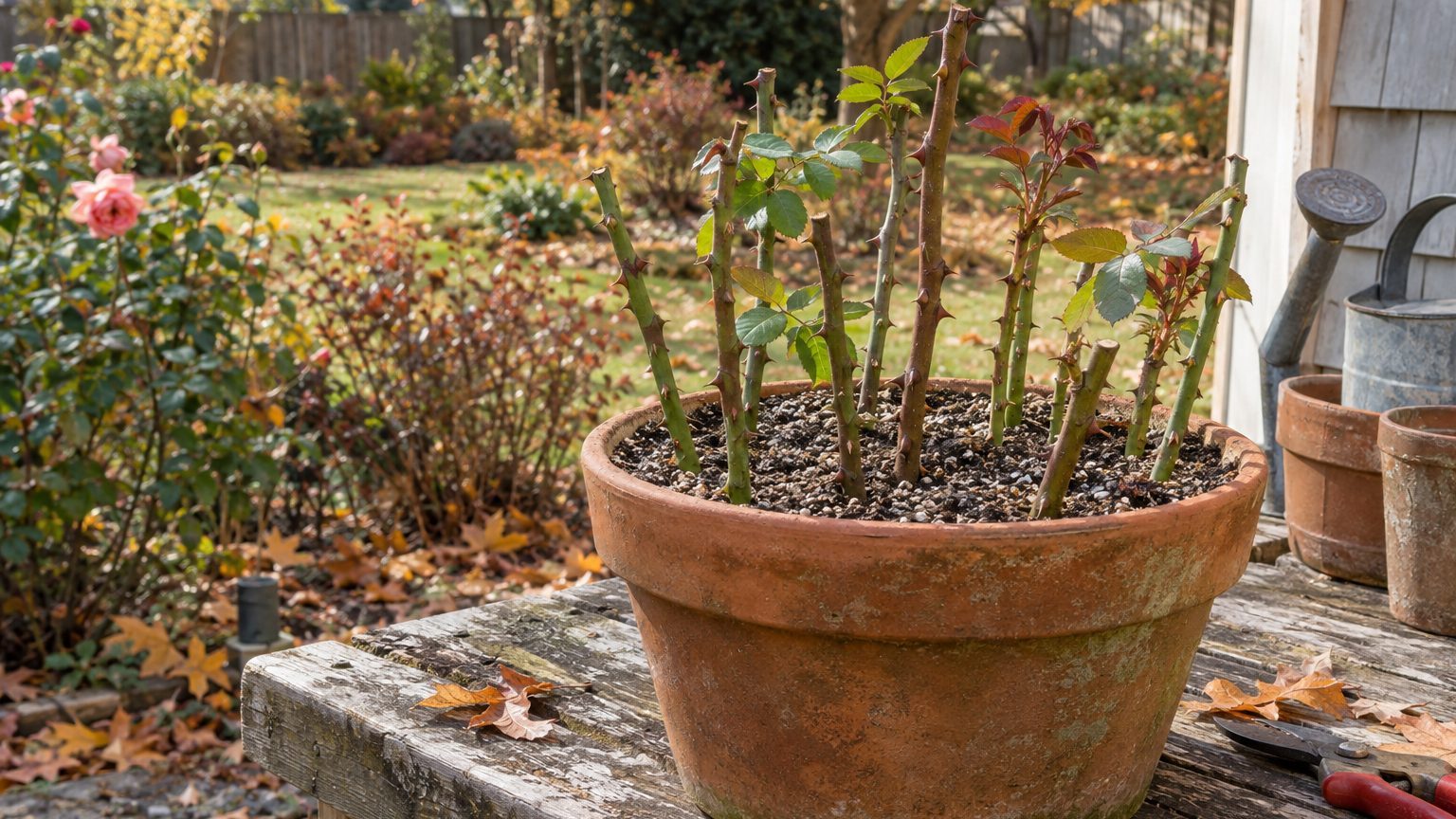
A cane that has just finished blooming holds the makings of a new rose. Propagating roses from cuttings turns spent stems into rooted plants of the same variety, using a clean cut, a loose mix and some shade. Timing and rose type decide how well it works, and each varies from place to place.
How Do You Grow Roses from Cuttings?
Cut a firm, partly mature stem from the rose you want to copy, strip the lower leaves, set it in a loose mix, and keep it shaded and moist until roots form. Roots take approximately four weeks to develop. The young plant is ready for the landscape after roughly six months.
Rose variety and climate shift the details. In Iowa, semi-hardwood cuttings come from mature new growth in July and August. In North Carolina, cuttings can be taken at any time of year, but November through February gives the best success.
Where your garden sits changes the calendar, and the state selector under this section leads to the page for your state.
From the almanac
Roses in your state
The dates on this page depend on where you live. Your state's page carries its frost dates, its USDA zones and the year laid out month by month.
Northeast
Southeast
- Alabama
- Arkansas
- Delaware
- Florida
- Georgia
- Kentucky
- Louisiana
- Maryland
- Mississippi
- North Carolina
- South Carolina
- Tennessee
- Virginia
- West Virginia
Midwest
Southwest
West
Pacific Northwest
Canada
How to Take Rose Cuttings

Semi-hardwood cuttings come from stems that have firmed up but have not turned fully woody, and the work goes in a set order.
- Choose a shoot that has already bloomed and cut the flower back to the first five-leaflet leaf, so that the stem left behind is mature wood rather than soft tip growth. In Kentucky, that remaining stem makes a cutting 4 to 6 inches long.
- Use a sharp knife or pruning shears to avoid crushing the stem, and in North Carolina make the cut at a 45° angle. In North Carolina, a cutting from the growing tip is 6 to 8 inches long, while Washington aims for about 9 inches.
- Strip the leaves, but not the buds, from the part that will be buried, so that no foliage rots in the soil. Washington’s advice is to clear the lower 2/3 of the stem. A California propagation program leaves only the top two leaves.
- Dip the base of the cutting, including the bottom nodal area, in rooting hormone, so that roots have every chance to start where the stem was cut.
- Push the cutting into a loose mix of loam and sand, so that the base sits in a medium that holds moisture without packing down. In Washington, the mix goes down about 9 inches in a pot or a V-shaped trench.
- Set the pot or trench in a shady spot out of direct sun, because strong sun will cook a cutting that has no roots yet to feed it.
Arkansas advice is to cut stems in one foot sections, which leaves room to trim each cutting to length and to keep the buds that matter. Keep the mix moist and the shade steady, and confirm that roots have formed before moving the cutting.
Propagation by Rose Type
Roses do not all root alike. Some varieties strike readily from a summer cutting, while others do better when budded onto a vigorous rootstock, the way growers produce them commercially.
| Rose Type | What changes | Why it matters |
|---|---|---|
| Most varieties | In Iowa, semi-hardwood cuttings from mature new growth in July and August | Wood that has firmed up in summer gives the cutting its footing |
| Hard-to-root varieties | In Hawaii, not every rose roots from cuttings, and many are budded on vigorous rootstock | A failed cutting may reflect the variety, and a budded plant may suit it better |
| Roses in hot climates without dormancy | In Hawaii at sea level, research favors budding on a Rosa fortuniana rootstock | Heat and the lack of dormancy are what these plants must withstand |
Hybrid teas, shrub roses, climbers, old garden roses and rugosas are not sorted by rooting ability here, so judge each by how its own cuttings do. A failed batch may reflect the variety, the timing or the growing conditions, so a fresh attempt in the proper season is reasonable.
Rose Propagation Mistakes to Avoid
Rooting in a Glass of Water

A jar on the windowsill looks tidy, but in Arkansas the advice is not to root roses in water because it does not produce as well. The cost is a weak or failed cutting after weeks of waiting.
Use the loam and sand mix instead, in a pot or trench, and keep it moist.
Putting Cuttings in Full Sun

A cutting has no roots to replace the water its leaves lose. Arkansas gardeners are told that direct sunlight will cook the plants, which wipes out the whole batch.
Park the pot in shade and move it only once the cutting has rooted and shows new growth.
Stripping Buds with the Leaves
Cleaning the buried stem is right, but pulling the buds along with the leaves removes the points where new growth starts. The cutting may sit there with nothing to push out.
Take off the leaves on the lower part of the stem and leave every bud in place, then tuck that part into the mix.
When to Take Rose Cuttings in Your State
The trigger is the wood itself. In Iowa, take semi-hardwood cuttings from mature new growth in mid to late summer. In North Carolina, cuttings can be taken at any time of year, with the best success from November through February. A mild climate stretches the choices.
- Each state page gives the cutting months for where you garden, so open it before the shears come out.
- Look for shoots that have just finished blooming and mark them, so you can find them when your state’s months arrive.
Common Questions
Does Rooting Hormone Make Rose Cuttings Root Faster?
In Kentucky, roots develop in 10 to 20 days when the base of the cutting, including the bottom nodal area, is dipped in hormone before planting. Skipping the dip leaves rooting to the stem alone.
Can a Heat Mat Help Rose Cuttings Root?
Yes. Seed-starting heat mats supply bottom heat and can speed rooting. Keep the cuttings out of direct sunlight while the mat does its work.
Can Rose Viruses Spread Through Cuttings?
In California, the transmission of rose viruses happens when infected plant material is grafted onto healthy material, as in budding an infected scion onto a healthy rootstock. Experimental evidence indicates rose mosaic can also spread via root grafts, so use propagation material known to be free of viruses.