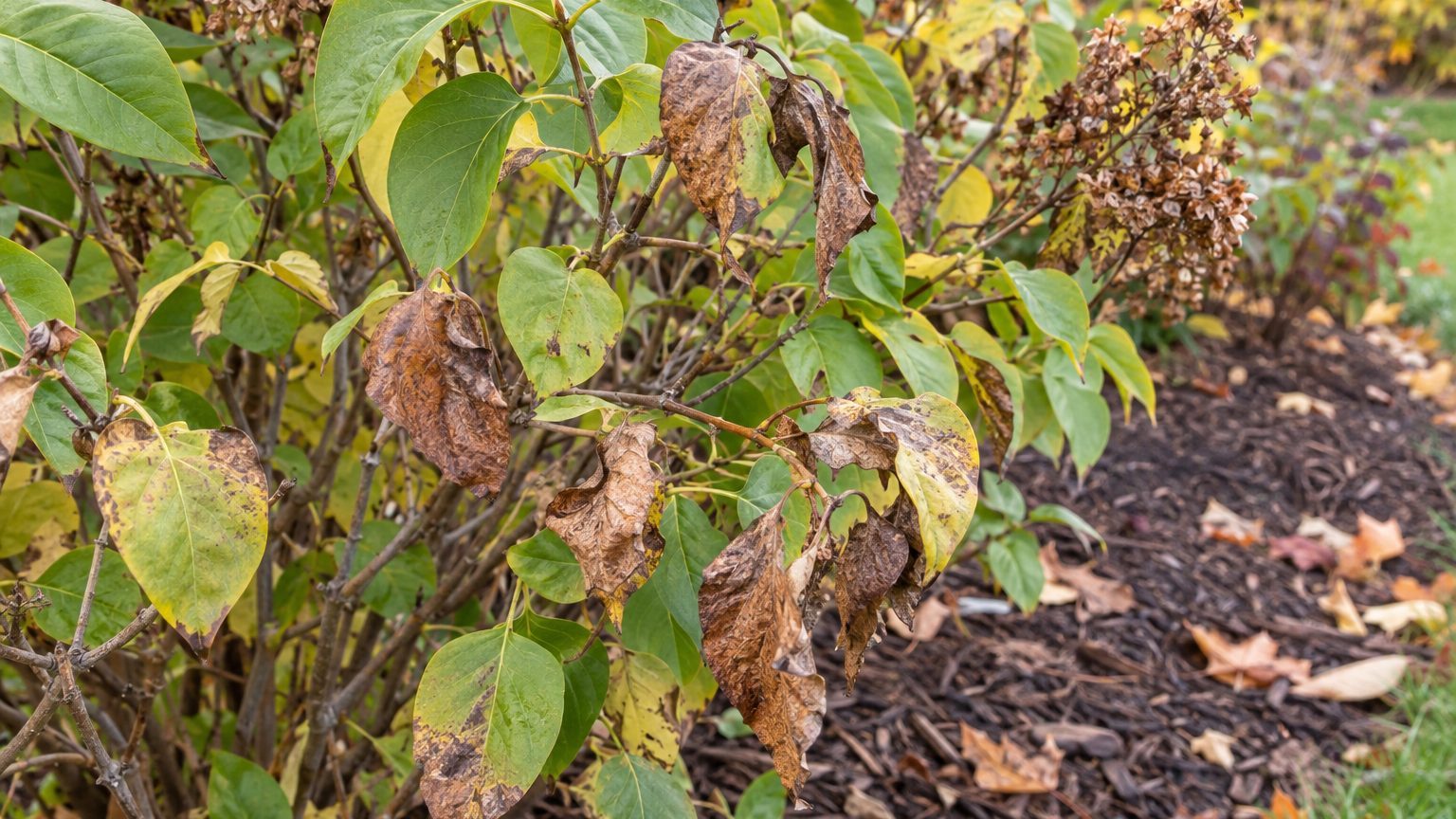
Brown spots can creep inward from the edges of lilac leaves and spread as an infection progresses. A fungal leaf disease is a likely cause, while powdery mildew, a leaf-mining insect and heat stress can produce overlapping symptoms.
Lilac Leaves Turning Brown: What You See

Brown spotting that starts at the leaf edge is a useful sign, so look there first.
- Brown spots begin along the leaf edges and move inward, sometimes looking splotchy rather than neat.
- As the infection advances, neighboring spots grow together and the leaves curl.
- Leaves that curl eventually drop, and the shrub can look thin and bedraggled by late summer.
- Some spots are irregular and dark, occasionally ringed by a yellow halo.
- Damage often begins in summer and intensifies into September, as seen in Iowa.
Lower and inner leaves may show it early because they tend to stay damp.
From the almanac
Lilacs in your state
The dates on this page depend on where you live. Your state's page carries its frost dates, its USDA zones and the year laid out month by month.
Northeast
Southeast
- Alabama
- Arkansas
- Delaware
- Florida
- Georgia
- Kentucky
- Louisiana
- Maryland
- Mississippi
- North Carolina
- South Carolina
- Tennessee
- Virginia
- West Virginia
Midwest
Southwest
West
Pacific Northwest
Canada
Lilac Leaves Turning Brown or Something Else?
Several other lilac problems can look similar from a distance, but each leaves a different mark up close. Check the leaf surface and the underside before deciding anything.
A quick look at what coats the leaf, or what is tunneled inside it, helps separate these problems.
| Looks like | How to tell them apart |
|---|---|
| Powdery mildew | A white powdery film on the leaf surface that often washes away once rains become regular, and it appears in dry spells with several days of high humidity, as in Illinois. |
| Leaf miner damage | A thin linear mine visible from the underside of the leaf that becomes a larger blotch as the larvae feed inside. |
| Heat stress | Shriveled leaves and early leaf drop after excessive summer heat, with no spots creeping in from the edges, as described in Maryland. |
Powdery mildew is expected on most older lilacs in summer in Illinois, and it often rides along with leaf spot rather than replacing it.
What Causes Lilac Leaves Turning Brown, and Where It Is Worst
The usual cause is a fungus called Pseudocercospora, which produces leaf spot and leaf blight. It overwinters on fallen leaves and infects the new leaves in spring during wet weather, as seen in Vermont. As wet weather continues, more leaves become infected.
High local humidity and continued wet weather favor the problem, and many lilacs in Iowa are affected alongside other common diseases. Septoria leaf spot and powdery mildew have also contributed to blight and heavy leaf drop.
Growing conditions make it worse, and these are worth checking in your own yard:
- Inconsistent soil moisture
- Saturated soil after excessive rain, which can suffocate and kill parts of the root system
- Shady spots with poor airflow
- Lack of proper pruning
Stressed plants are also more open to insects and infection, so a weak shrub tends to decline faster.
How to Treat Lilac Leaves Turning Brown
Treatment is mostly about sanitation and conditions, done in this order.
- Confirm the cause by checking the spot pattern and the leaf underside, so that you do not treat a leaf miner problem as a fungus.
- Rake up fallen leaves and throw them away rather than composting them, because the fungus overwinters on them and reinfects new growth in spring.
- Remove and destroy leaves with mines throughout the season, since that kills the larvae feeding inside, as advised in Vermont.
- Thin crowded stems so air moves through the shrub and the leaves dry faster after rain.
- Water at the base on a steady schedule, so the soil neither dries out nor stays saturated.
- Ask your state extension office whether any fungicide is registered in your state and when to apply it, since only they know what is approved locally.
Leaf loss in late summer does not by itself show whether the shrub will recover. Focus on cleanup and good care, and let the plant rebuild.
How to Prevent Lilac Leaves Turning Brown Coming Back
Prevention follows the season, starting before the first leaves open.
- In early spring, clear every fallen leaf from beneath the shrub before new growth emerges, because spores wait there for wet weather.
- Thin crowded or inward-growing stems so air can move through the canopy.
- During wet spring spells, watch the lower leaves for the first brown edge spots and pick off affected foliage early.
- Through summer, water deeply at the base when rain is short and hold back when the soil is already soaked, to avoid swings in moisture.
- In fall, rake and discard dropped leaves again so the fungus has nowhere to overwinter.
If the site stays shady and damp, consider moving a struggling shrub to a sunnier spot.
Where This Comes From
This guidance draws on university extension and government plant health information from Illinois, Iowa, Maryland and Vermont, among other places. Local timing and approved treatments differ, so check with your state’s extension service before acting.
Common Questions
Will a Lilac Recover After Losing Its Leaves Early?
A lilac may recover, but its condition and growing conditions matter. Steady watering and cleaning up fallen leaves help the shrub rebuild, though repeated stress leaves it more open to infection.
Can You Stop Lilac Leaf Spot by Spraying Alone?
Spraying does not replace cleanup and airflow. Leaf removal, pruning and even moisture address the conditions that let the fungus spread, and your extension office can say what is approved locally.
Why Do Old Lilacs Look Worse After a Hot Summer?
Lilacs can become bare at the bottom and leggy with age, and they often look bedraggled after a hot summer with leaf infections, as noted in Maryland. Thinning old stems gives the shrub fresh, better-aired growth.