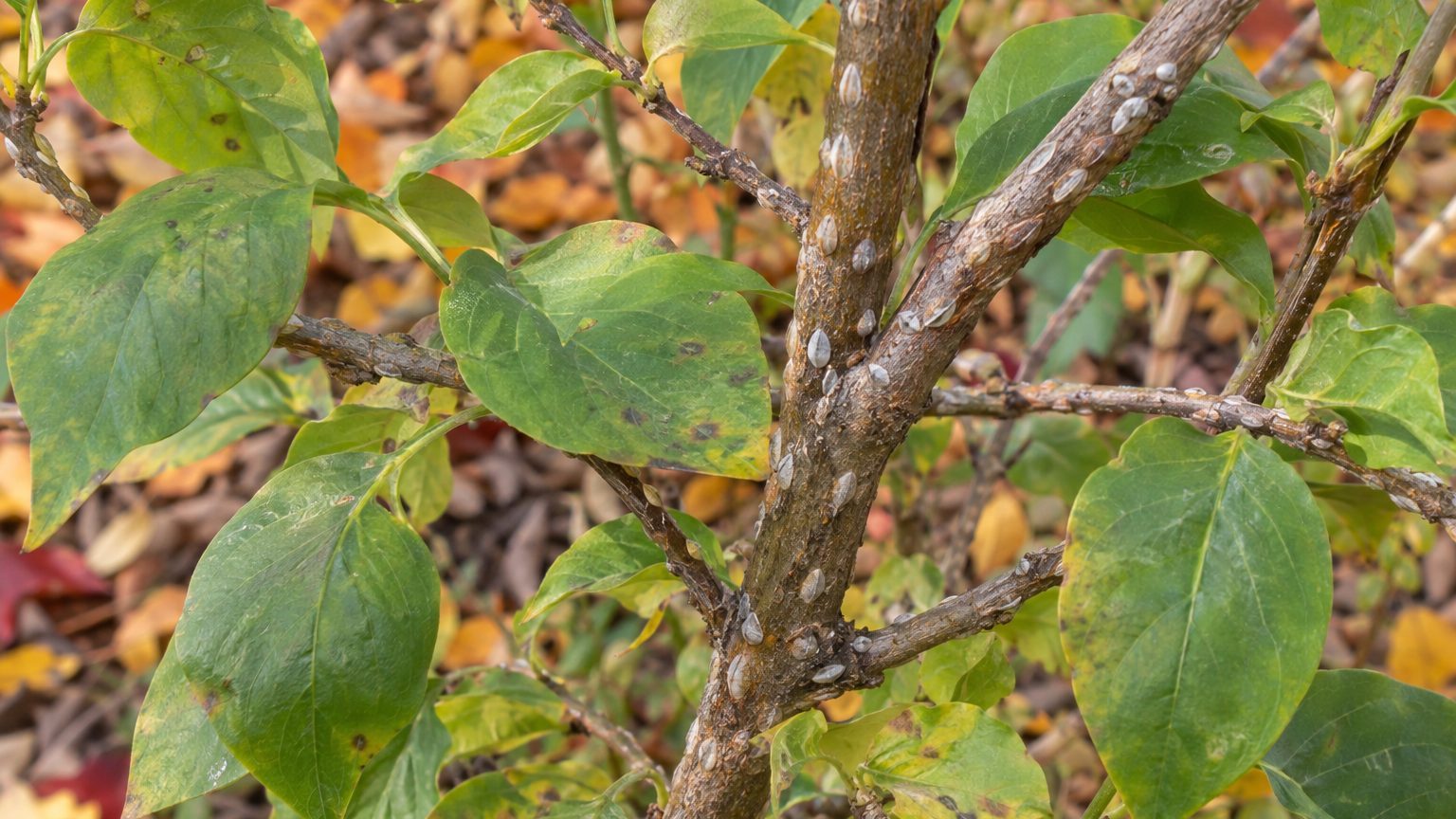
Look along the bark of a lilac and you may spot rows of tiny gray-brown bumps, each shaped like a miniature mussel shell. They are oystershell scale, a sap-sucking insect that can quietly weaken a lilac. Knowing what the crust looks like, when the young hatch, and what to do about them keeps the shrub healthy.
Oystershell Scale: What You See

Start with the bark, because that is where this pest lives, and look closely at the older stems and trunk.
- Small, hard, convex covers sit pressed against the bark, shaped like tiny oyster shells and grayish brown, and each mature one is about 1/8-inch long.
- The crust can be found throughout the plant, on branches and on the trunk, often packed so closely that the bark looks roughened.
- In Arizona, lift a cover in winter and you may find tiny white eggs beneath the female’s waxy shield.
- Leaves turn yellow and stay smaller than they should, because the insects are draining the plant underneath.
- Twigs and whole branches may die back.
In Colorado, late May or early June brings the mobile young, so that is a good time to check a suspect shrub.
From the almanac
Lilacs in your state
The dates on this page depend on where you live. Your state's page carries its frost dates, its USDA zones and the year laid out month by month.
Northeast
Southeast
- Alabama
- Arkansas
- Delaware
- Florida
- Georgia
- Kentucky
- Louisiana
- Maryland
- Mississippi
- North Carolina
- South Carolina
- Tennessee
- Virginia
- West Virginia
Midwest
Southwest
West
Pacific Northwest
Canada
Oystershell Scale or Something Else?
Lilacs get plenty of problems that leave yellow leaves and dead twigs, so the shell-like crust on the bark is what settles the matter. Pair the symptom with a look at the bark itself before you decide on anything.
A fingernail helps. A scale cover lifts off as a separate shield, while bark features stay part of the stem.
| Looks like | How to tell them apart |
|---|---|
| Rough, cracked bark with yellowing leaves | Bark cracks can come with scale, but scale leaves a raised, shell-shaped cover you can flick off; plain cracking has nothing on the surface. |
| Twig dieback with small leaves | Scale dieback comes with gray-brown covers on the dead and nearby living wood; dieback with clean, bare bark points elsewhere. |
| Gray flecks or crust on old stems | Scale covers are convex and oyster-shaped, about 1/8-inch long, and hide white eggs beneath; flat or powdery patches without eggs are something different. |
If a lifted cover is empty, inspect other covers and nearby bark before ruling out oystershell scale.
What Causes Oystershell Scale, and Where It Is Worst
The Insect
The cause is a small armored insect that feeds on the plant it lives on. Developing scales suck the fluids from the cells under the bark, often killing the cells at the feeding site. Lilac, with its thin bark, offers a good feeding site, and the pest has been reported on more than 130 host plants.
Oystershell scale can produce one generation per year in some regions. In Arizona, the insects spend the winter as eggs under the scale of the female. In Colorado, the pearly white eggs hatch on warm, calm days in late May or early June, and most hatch over a fairly brief period of 2-3 weeks.
The young crawl over the bark looking for a feeding site, and they remain mobile for only a few days after hatching. Those that find a spot settle and build their covers. In Colorado, females lay eggs in late summer and early fall and die at the end of the season.
Where It Turns Up
Scale turns up on lilacs in Colorado, Utah, Arizona and Kentucky, so it is not tied to one region. A stressed shrub suffers more, while vigorous growth from proper siting and care appears to help reduce infestations.
How to Treat Oystershell Scale
Confirm the pest first, then match your action to the insect’s stage.
- Confirm the pest by lifting a cover and looking for white eggs beneath, so that you do not treat a problem you do not have.
- Watch for the crawlers in late May or early June in Colorado, so that you act while the young are mobile and unprotected by a cover.
- Ask your state extension office which products are approved where you live and when to apply them, so that the treatment is legal and aimed at the right stage.
- Check the bark again later in the season, so that survivors are caught before the next generation.
Catching scale early means less damage and an easier recovery. Without effective management, severe infestations can kill a shrub, so a lilac with heavy crust deserves attention soon.
How to Prevent Oystershell Scale Coming Back
Prevention comes down to a healthy shrub and regular looks at the bark through the year.
- In Arizona, inspect the bark in winter for eggs beneath the covers.
- Give the shrub proper siting and care, because vigorous growth appears to help reduce infestations.
- In late May or early June, look for crawlers on the bark, because that is when the young hatch and move about in Colorado.
- Water during dry spells as part of normal lilac care, but use the bark signs, not yellowing alone, to judge whether scale is present.
- In late summer and early fall, check stems again, since females lay eggs then, in Colorado, before dying at the end of the season.
Make the bark check a habit, because consistent observation is what keeps a small patch from becoming a dying branch.
Where This Comes From
The details here come from university extension and government plant health pages written for Colorado, Arizona, Utah and Kentucky. Timing differs by place, so check with your own state’s extension service before you act.
Common Questions
Can a Lilac Recover from Oystershell Scale?
Often it can when the problem is caught early, since earlier action means less damage and easier recovery. Left untreated, heavy infestations can kill the plant.
Which Other Plants Get Oystershell Scale?
Ash, dogwood, maple, poplar, willow, aspen and cotoneaster are common hosts. If one of them is nearby and crusted, check your lilac too.
Why Are My Lilac Leaves Small and Yellow?
Small, yellowing leaves can come from scale feeding, but check the bark for shell-shaped covers on the stems before blaming it. If you find none, ask your state extension office to look at a sample.